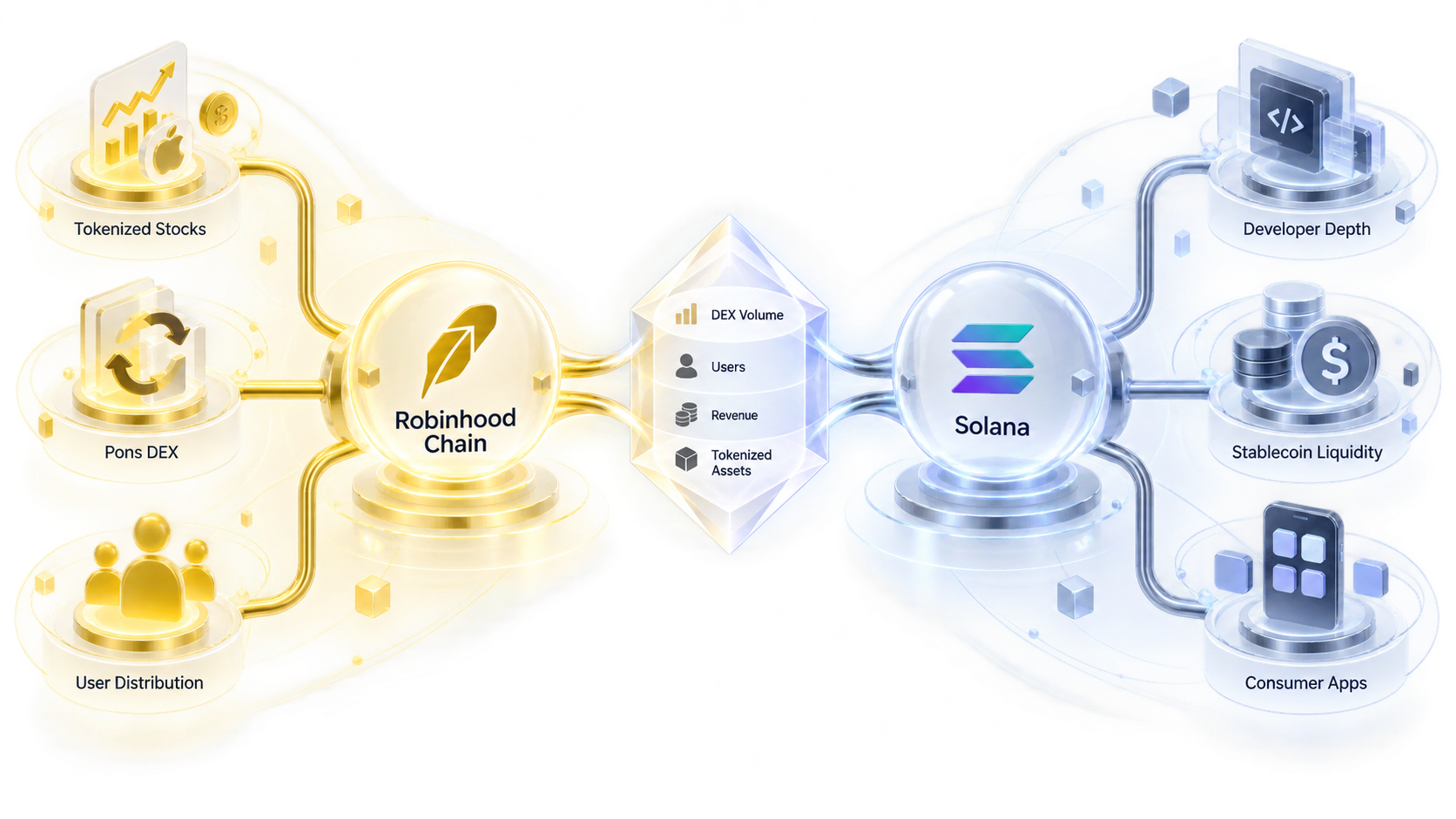
Robinhood Chain and Solana can both support fast on-chain trading, but they are not the same type of network. Solana is an independent Layer 1 blockchain with its own validator set and SOL token. Robinhood Chain is a Layer 2 network built with Arbitrum technology and designed to settle back to Ethereum security.
The comparison became popular after Robinhood Chain recorded a rapid increase in decentralized exchange activity. That growth is notable, but the source of the volume matters. A large share has come from Pons Launchpad and the speculative tokens created through it. Solana’s activity is spread across a much larger ecosystem.
Robinhood Chain vs Solana at a glance
| Area | Robinhood Chain | Solana |
|---|---|---|
| Network type | Ethereum Layer 2 | Independent Layer 1 |
| Main positioning | Tokenized finance and real-world assets | General-purpose high-speed apps |
| Security model | Uses Ethereum settlement through an L2 design | Secured by Solana validators |
| Current growth engine | Pons launches, DEX trading, tokenized assets | DEXs, payments, DeFi, memecoins, consumer apps |
| Maturity | New network with concentrated activity | Established network with a broad ecosystem |
Why did Robinhood Chain DEX volume rise so quickly?
Pons Launchpad makes it simple to create and trade fixed-supply tokens on Robinhood Chain. New tokens begin on a bonding curve. When a launch reaches its required threshold, liquidity moves to Uniswap v4. This process can generate many rapid trades as users enter and exit new markets.
Crypto.news reported that Robinhood Chain reached about $47 billion in cumulative DEX volume in its first two months, with Pons producing a large share of daily activity. These figures show strong early usage, but they should be read as a snapshot of a new, incentive-driven market—not as proof that Robinhood Chain has already matched Solana’s full economy.
Tapbit Learn has a separate breakdown of the Robinhood Chain DEX volume record.
Where does Solana remain stronger?
Solana has years of operating history and a wide range of applications. Its liquidity is distributed across major DEXs, lending markets, liquid staking, payments, NFT platforms and consumer apps. Developers can also draw on mature wallets, data tools and infrastructure providers.
This breadth makes Solana’s activity more resilient. If one launchpad cools down, other parts of the network can still generate transactions. Robinhood Chain’s early activity is more concentrated, so its next test is whether users stay for tokenized stocks, payments and other financial applications.
For background on that larger network, see Solana ecosystem growth.
Where could Robinhood Chain have an advantage?
Robinhood Chain’s strongest advantage is distribution. Robinhood already serves a large group of investors who trade stocks, options and crypto. If the company connects those users to on-chain assets in a simple way, the network may acquire customers who would not normally use DeFi.
Its focus on tokenized real-world assets also gives the chain a clear identity. Instead of competing only for memecoin volume, Robinhood Chain can connect securities, stablecoins and other financial products. The official project describes the network as a permissionless, finance-focused Layer 2 with approximately 100-millisecond blocks.
To understand the design before comparing activity, read What Is Robinhood Chain?
What metrics give the fairest comparison?
- Volume quality: Is trading spread across many assets and apps, or concentrated in short-lived launches?
- Active users: Are wallets returning after their first transaction?
- Stablecoin liquidity: Deep stablecoin markets make trading and settlement easier.
- Developer activity: New applications create reasons for users to remain on a chain.
- Fees and reliability: A network must stay fast and affordable during demand spikes.
- Tokenized-asset adoption: Robinhood Chain needs real usage beyond experimental listings.
Bottom line
Robinhood Chain has produced an unusually fast start, led by Pons and DEX trading. Solana remains the more mature and diversified network. The contest will not be decided by one month of volume. It will be decided by whether Robinhood Chain converts its financial distribution into lasting users and whether Solana continues expanding beyond its strongest existing categories.
Track related markets on Tapbit
Create a Tapbit account. You can then check the HOOD-USDT futures market, the SOL-USDT futures market, or trade PONS-USDT spot.