

Robinhood Chain trading is gaining attention because the network puts two very different markets in the same onchain environment: tokenized stocks built for real-world asset access and meme coins driven mainly by speculation. The combination can generate transactions quickly, but it also makes activity figures harder to interpret. A burst of swaps does not automatically prove that tokenized finance has achieved durable adoption.
Robinhood describes its chain as a permissionless, Ethereum-compatible Layer 2 designed for financial services and real-world assets. The mainnet went live in July 2026 using Arbitrum technology, and the network uses ETH for transaction fees. Traders who want broader access to established crypto markets can also create a Tapbit account, while remembering that activity on Tapbit is separate from activity on Robinhood Chain.
Why Is Robinhood Chain Activity Rising?
The first driver is product expansion. Robinhood initially introduced stock tokens for eligible European customers on Arbitrum One, then moved toward a dedicated chain with more control over performance and market design. The official Robinhood Chain overview positions the network as infrastructure for tokenized stocks, ETFs, lending, swaps and other onchain financial products.
Robinhood Wallet and standard EVM wallets can connect to chain ID 4663. Speculation is another driver: meme coins can create many small swaps and transfers quickly. Cash Cat is one example, but Robinhood says it did not issue the token and that it has no intrinsic utility.
Are Tokenized Stocks or Meme Coins Driving the Growth?
Both can increase activity, but they create different types of demand. Tokenized stocks may attract users seeking extended trading access or onchain composability. Meme coins tend to attract faster, sentiment-led turnover. Transaction counts alone cannot show which segment is economically more important because one high-value stock-token transfer and dozens of tiny meme-coin swaps are counted differently but may appear together in a headline activity number.
| Activity source | Typical reason to transact | Main risk |
|---|---|---|
| Tokenized stocks | Market exposure, transfer or collateral use | Issuer, regulatory and tracking risk |
| Meme coins | Short-term speculation and community trading | Volatility, weak liquidity and manipulation |
| Stable assets | Settlement, bridging and liquidity provision | Depeg and counterparty risk |
What Token Is Used for Robinhood Chain Gas?
ETH is the native gas token. Robinhood’s network documentation confirms that the chain is built on Ethereum, uses Ethereum blobs for data availability and lists ETH as the currency symbol. ARB is not required to pay Robinhood Chain transaction fees.
Users therefore need ETH on Robinhood Chain before they can send tokens, approve a contract, trade on a decentralized exchange or bridge assets out. Holding ETH on Ethereum mainnet or another Layer 2 is not enough by itself; the wallet must have ETH on the correct network. A bridge or supported transfer route is normally required.
How Much Do Robinhood Chain Transactions Cost?
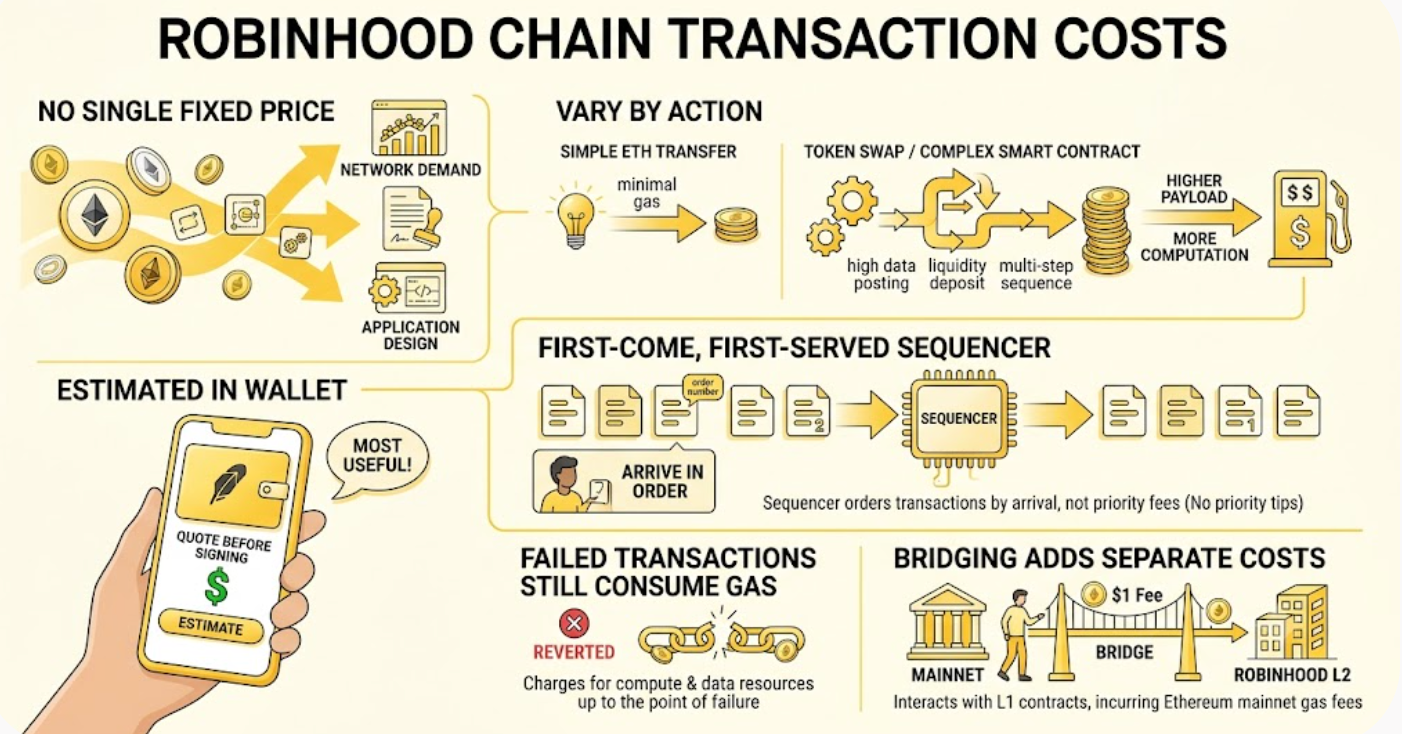
There is no single fixed transaction price. A simple ETH transfer normally consumes less gas than a token swap, liquidity deposit or multi-step smart-contract transaction. Costs also depend on network demand, data posting expenses and the application’s design. The wallet quote shown immediately before signing is the most useful estimate.
Its first-come, first-served sequencer orders transactions by arrival rather than priority fees. Failed transactions can still consume gas, and bridging adds separate costs.
Gas Fees vs Trading Fees: What Is the Difference?
Gas pays for blockchain execution. A trading fee is charged by the exchange, DEX or liquidity protocol facilitating the trade. Slippage is neither of those: it is the difference between the expected price and the actual execution price, usually caused by liquidity depth and order size. A user may therefore pay several costs in one action.
| Cost | What it covers | When it appears |
|---|---|---|
| Network gas | Onchain execution and settlement | Transfers, approvals and contract calls |
| Trading fee | Application or liquidity-provider service | Swaps or marketplace trades |
| Slippage | Price movement and liquidity impact | Especially in thin markets |
| Bridge fee | Moving assets between networks | Deposits to or withdrawals from the chain |
Why Users Need ETH Before Trading
A common mistake is bridging a tradable token without bringing any ETH. The asset may arrive, yet the user cannot approve or sell it because every subsequent action needs gas. Keeping a small ETH buffer helps prevent this situation. Users should also verify the destination network, token contract and bridge address before signing; EVM addresses look similar across chains, and sending through an unsupported route can lead to loss.
Does Higher Activity Benefit ETH or ARB?
The direct connection is stronger for ETH because ETH pays gas and Robinhood Chain settles through Ethereum-oriented infrastructure. More genuine use can raise marginal demand for gas and increase data posted to Ethereum. The effect on ETH price, however, may be small compared with broader market demand.
ARB has an important technological connection because Robinhood Chain uses the Arbitrum platform. Yet ARB is a governance token for the Arbitrum ecosystem, not Robinhood Chain’s gas asset. Higher Robinhood Chain volume does not automatically create proportional ARB demand or distribute network revenue to ARB holders. Any investment thesis must separate software adoption from token value capture.
Can Robinhood Chain Remain Cheap as Volume Grows?
Layer-2 architecture and fast block production give the network more capacity than Ethereum mainnet for routine transactions. Costs may remain low if capacity expands alongside demand and applications use efficient contracts. Still, popular launches can concentrate activity, and complex transactions consume more resources than simple transfers.
Liquidity may be the larger constraint: a cheap swap can still suffer severe slippage. Tokenized stocks may also carry issuer, trading-hour or jurisdictional restrictions unrelated to network speed.
Network Congestion and Sequencer Risks
Robinhood operates the main sequencer that receives and orders transactions. Its terms state that continuous availability is not guaranteed, so downtime or latency could delay trading even if assets remain recorded onchain. This is a familiar trade-off for many rollups: centralized sequencing can provide fast confirmation, but it introduces an operational dependency.
Other risks include smart-contract bugs, malicious tokens, bridge exploits, oracle failures and fragmented liquidity. Meme-coin contracts may also include unusual permissions, transfer restrictions or concentrated ownership. Users should confirm contracts through official project channels and the Robinhood Chain block explorer rather than relying on a ticker or social-media link.
Conclusion
Robinhood Chain trading is heating up because real-world asset infrastructure and speculative crypto activity are arriving at the same time. Tokenized stocks could support longer-term use, while meme coins can boost near-term volume and user acquisition. ETH is required for gas, ARB is not, and the real cost of trading includes application fees, bridge charges and slippage as well as network gas. The network’s next test is whether liquidity and recurring use remain after the initial excitement cools.
FAQ
Does Robinhood Chain use ETH or ARB for gas?
It uses ETH. Users need ETH on Robinhood Chain to pay for transfers, approvals, swaps and other contract interactions.
Are Robinhood Chain meme coins official Robinhood tokens?
Not necessarily. A permissionless network allows third parties to deploy tokens. Verify the contract and issuer instead of assuming affiliation from the chain name.
Are Robinhood stock tokens the same as owning U.S. shares?
No. Tokenized exposure can involve an issuer and specific contractual terms, eligibility rules and restrictions. Users should read the product documentation rather than assuming conventional shareholder rights.
Why can a cheap transaction still produce an expensive trade?
Network gas may be low while slippage, bridge costs or a DEX trading fee remains high. Thin meme-coin liquidity can make price impact much larger than the gas charge.
Does Robinhood Chain activity automatically increase the ARB price?
No. Arbitrum technology supports the chain, but ARB is not its gas token and activity does not guarantee direct value accrual to ARB holders.


