

The Solana ecosystem in 2026 is getting more interesting for a reason that has little to do with another “fastest blockchain” argument. More real assets, payment systems and institutional products are moving onto the network.
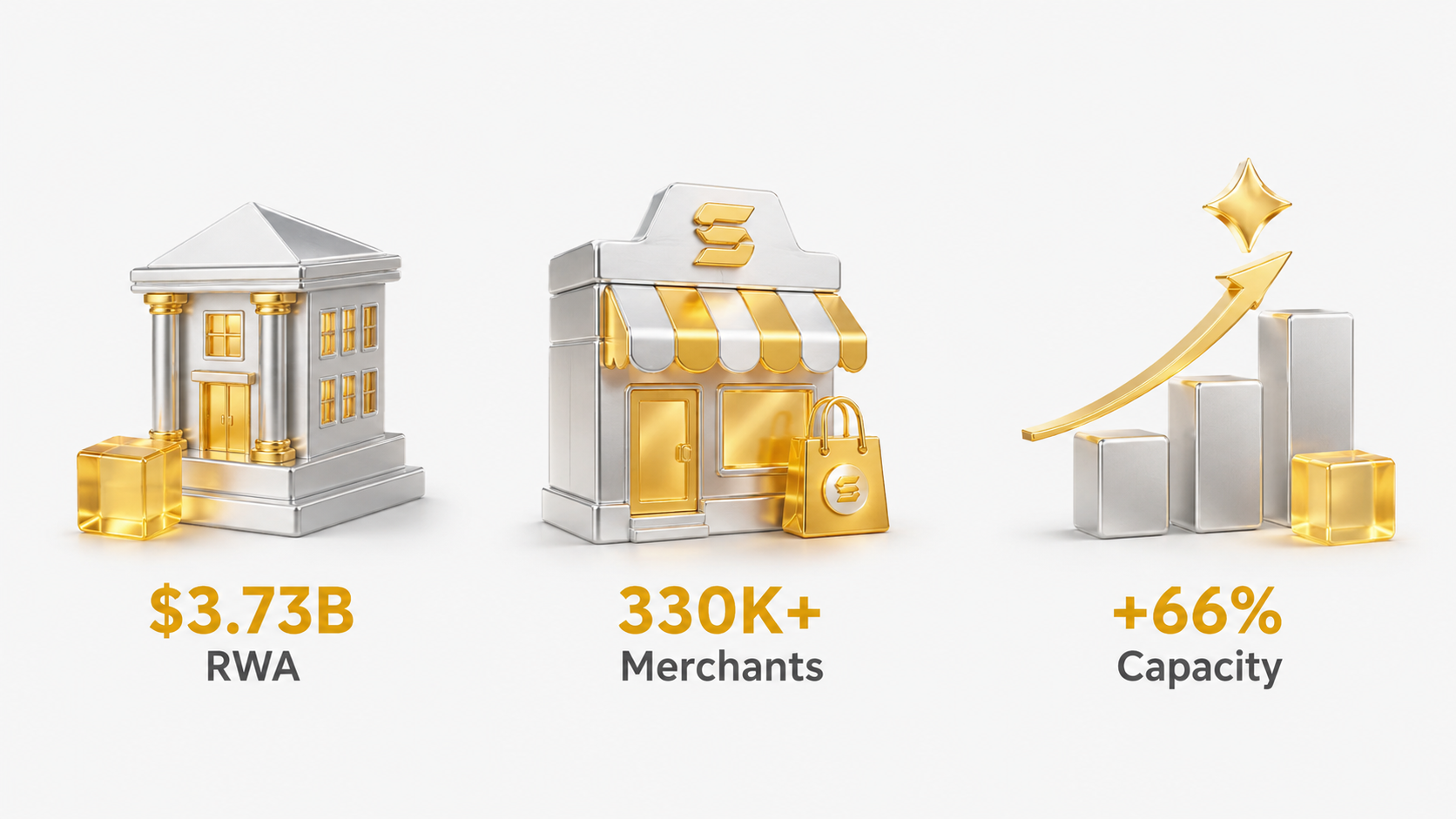
Solana's July ecosystem update reported $3.73 billion in real-world asset value, more than 313,000 RWA holders, payment expansion toward 330,000+ merchants and a 66% increase in maximum block capacity. Those numbers do not guarantee a higher SOL price, but they give investors something better than hype to measure: actual usage.
How Big Is the Solana Ecosystem in 2026?
Solana has grown beyond DeFi trading and memecoins. Its current ecosystem includes stablecoin payments, tokenized funds, public-equity products, consumer apps, institutional funds and high-throughput trading venues.
The network's official July update highlighted $3.73 billion of RWA value by month-end. That is important because RWA value represents assets with links to traditional finance rather than purely crypto-native tokens.
The same update counted more than 313,000 unique addresses holding tokenized real-world assets. A single large issuer can make AUM look impressive; a growing holder base shows that ownership is spreading too.
Solana Payments Are Moving Into the Real World
Payments become more interesting when you can use them somewhere other than a crypto conference.
Solana's July update highlighted a path to more than 330,000 merchants through payment integrations in South Korea. Earlier ecosystem work also included Korean payment processors exploring stablecoin and Solana Pay infrastructure.
For users, the appeal is simple: fast settlement, low transaction costs and stablecoins that behave more like digital cash than a volatile token.
For SOL investors, payment growth matters because it creates network activity that is not tied only to speculation.
Tokenized Stocks Are Becoming Part of Solana's Growth Story
Tokenized equities expanded during 2026, giving investors blockchain-based access to products linked to public companies. Solana's July update highlighted multiple equity-tokenization providers and the arrival of new U.S.-listed and tokenized products.
This connects the Solana ecosystem with one of the biggest themes in digital finance: bringing traditional securities onto programmable rails. Tapbit Learn has previously explained how tokenized stocks work, including the important difference between price exposure and direct share ownership.
For Solana, the opportunity is not simply “stocks trade 24/7.” It is becoming infrastructure where stablecoins, securities and settlement can interact in the same environment.
Solana RWA Value Reached About $3.73 Billion
RWA is a broad label. It can include tokenized Treasury products, funds, credit, commodities and securities. The $3.73 billion figure therefore represents a basket of different assets rather than one product.
Why does the number matter? Because issuers usually care about custody, settlement, compliance and liquidity. If regulated or institutional assets keep choosing Solana, it suggests the network is competing on more than raw transaction speed.
Still, $3.73 billion of RWA value does not mean $3.73 billion of demand for SOL. The two numbers are economically related only through network usage, fees, liquidity and investor expectations.
Solana Increased Block Capacity by 66%
In July, maximum block capacity increased from 60 million to 100 million compute units per block. That is a 66% increase.
You do not need to memorize “compute units.” Think of them as space in a delivery truck. A bigger truck can carry more activity before it gets crowded.
Higher capacity can help the network handle periods of heavy demand, especially as trading, payments and tokenized assets grow. It does not solve every performance problem, but it gives developers more room to build without immediately fighting for block space.
Why Are Institutions Looking at Solana?
Institutions care about a different checklist than crypto traders. They want predictable settlement, deep liquidity, reliable custody, compliance support and enough throughput to handle real business volume.
Solana is increasingly showing up in tokenized funds, equity products, payment pilots and U.S.-listed investment vehicles. The July update reported about $1.12 billion in cumulative net flows into U.S.-listed Solana funds by July 31, including seed assets and prior-product conversions.
That does not mean institutions have “chosen one chain.” It means Solana is now competing seriously for financial-market use cases that used to belong almost entirely to Ethereum.
Does Ecosystem Growth Automatically Push SOL Higher?
No. This is the most important distinction in the article.
Network usage can support SOL through transaction fees, staking economics, liquidity demand and stronger investor expectations. But a network can grow while its token underperforms if valuation is already high or if much of the activity uses stablecoins rather than SOL itself.
Price also depends on the broader crypto cycle, token supply, staking behavior and investor risk appetite.
Usage is evidence. Price is an auction. They talk to each other, but they are not married.
What Could Slow the Solana Ecosystem Down?
Competition is the obvious risk. Ethereum and other high-throughput chains are also fighting for stablecoins, tokenized assets and institutional users.
Reliability matters too. Solana has improved its infrastructure, but institutional users expect stable performance during periods of extreme demand.
Another risk is low-quality activity. A network can post huge transaction numbers if much of the traffic is bots or short-lived speculation. That is why payments, RWA value, app revenue and institutional issuance are better long-term signals than transaction count alone.
What Metrics Should SOL Investors Watch Next?
- RWA value: Are more real financial assets moving onto Solana?
- Stablecoin supply and settlement: Is payment usage growing?
- Merchant adoption: Are real businesses accepting Solana-based payments?
- App revenue: Are applications creating sustainable economic activity?
- Institutional issuers: Are recognized financial firms launching products?
- Network reliability: Can capacity growth keep up with demand?
How to Trade SOL on Tapbit
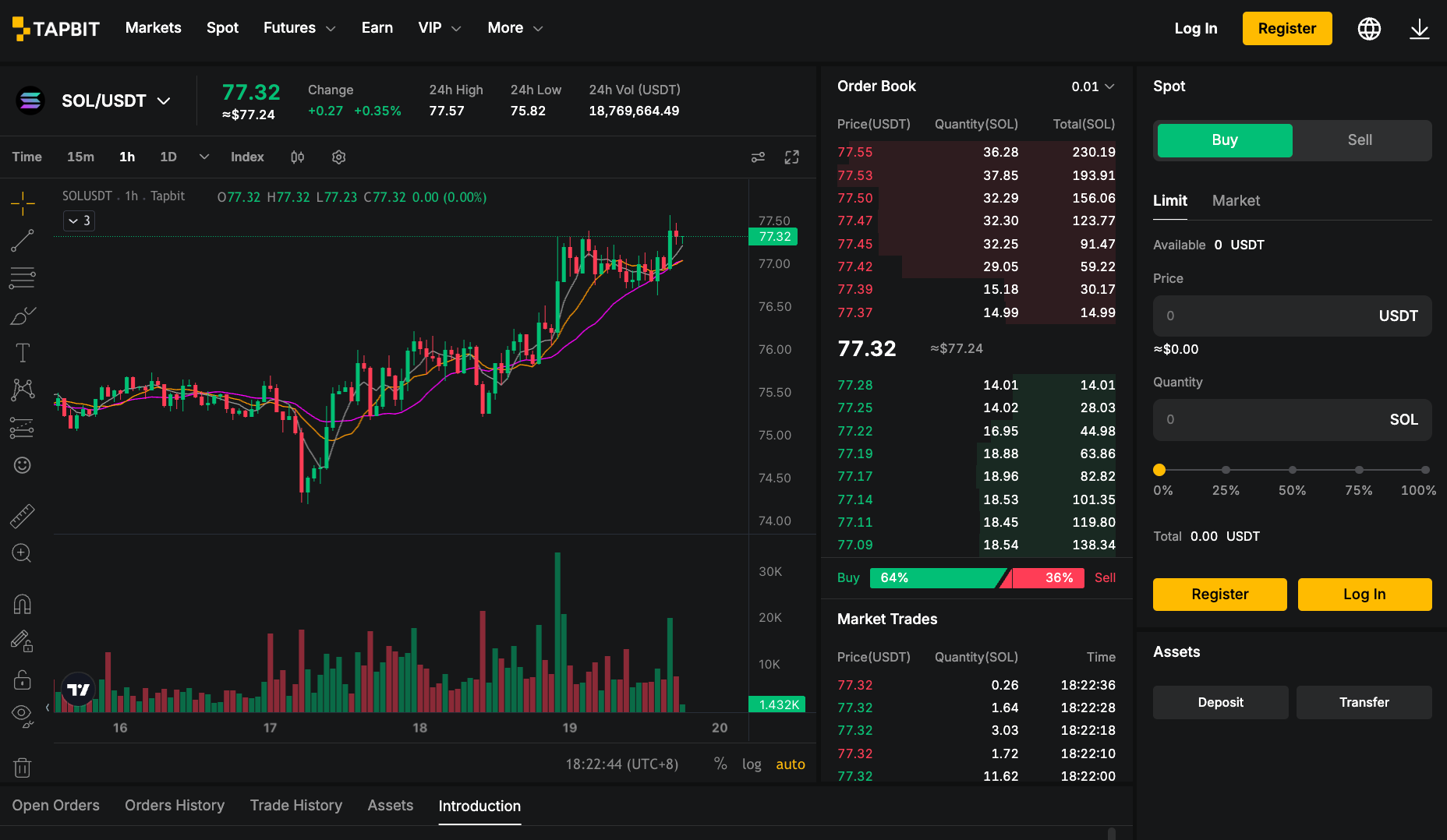
Tapbit supports SOL-USDT spot trading for direct SOL exposure and SOL-USDT perpetual futures for leveraged long or short positions.
-
Create an account or log in.
-
Choose SOL-USDT spot, or open SOL-USDT perpetual futures and check mark price, index price and funding.
-
For futures, choose order type, quantity, leverage and margin mode before opening long or short.
-
Add TP/SL and monitor margin and liquidation risk.
Bottom Line
The Solana ecosystem in 2026 has a stronger fundamental story than “fast chain, cheap fees.” RWA value reached $3.73 billion, payment integrations are reaching hundreds of thousands of merchants, tokenized equities are expanding and block capacity is higher. The next test is whether those numbers keep growing after the headlines fade. If Solana can turn payments, RWAs and institutions into durable activity, SOL has a stronger economic foundation. If the growth is temporary, the market will notice that too.
FAQ
How big is the Solana ecosystem in 2026?
Solana's official July update reported $3.73 billion in RWA value, more than 313,000 RWA holders and expanding payment and institutional activity.
Are tokenized stocks available on Solana?
Yes. Multiple providers have launched tokenized-equity products on Solana, although the legal rights and redemption structures differ by issuer.
Does Solana ecosystem growth increase SOL price?
It can support demand and investor confidence, but there is no automatic one-to-one relationship between network usage and token price.
Can I trade SOL on Tapbit?
Yes. Tapbit supports SOL-USDT spot and SOL-USDT perpetual futures.


