
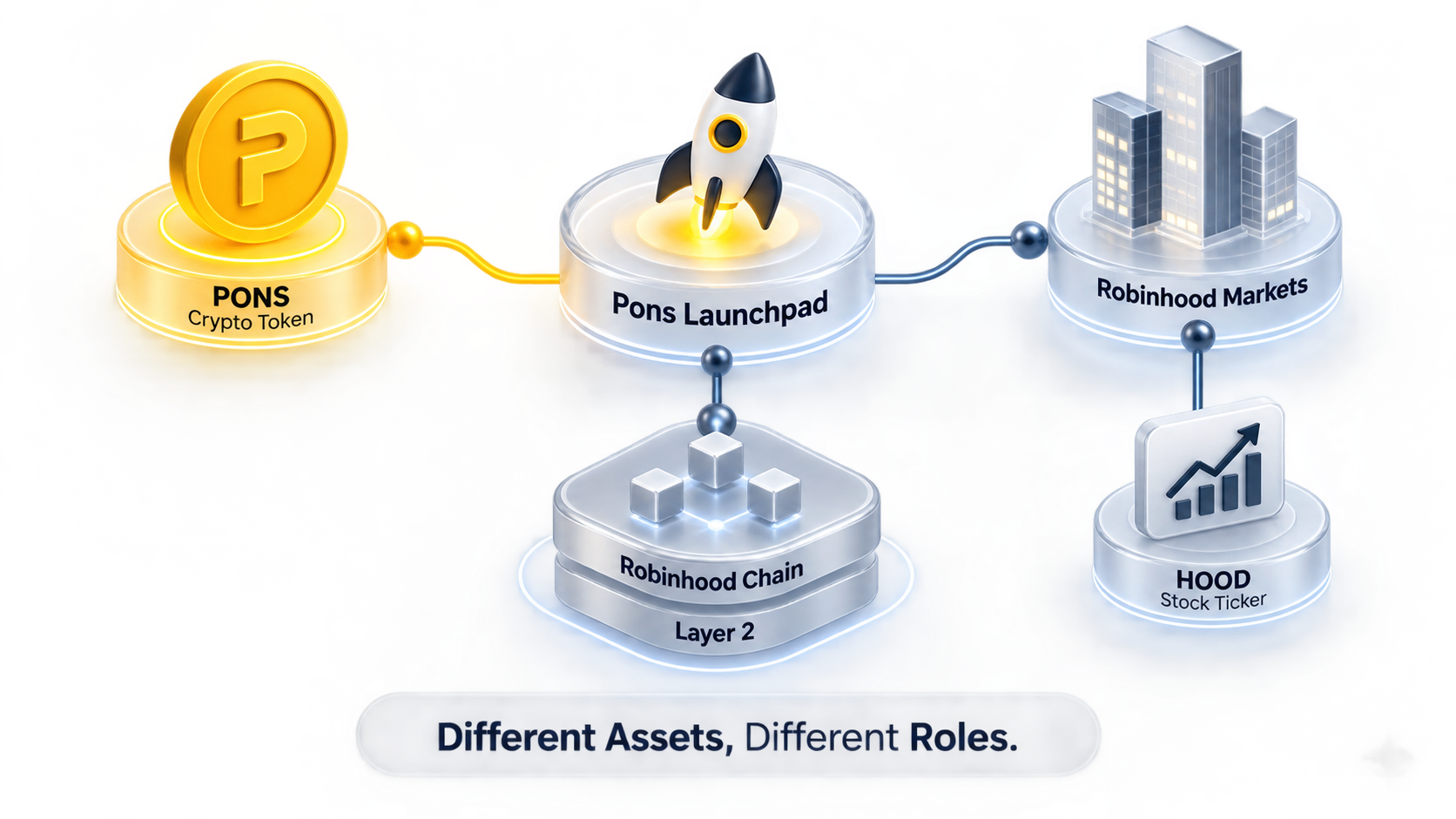
PONS is an asset; Pons Launchpad is a product. A user can buy or sell the PONS token. A creator or trader uses Pons Launchpad to interact with token-launch smart contracts.
The shared name makes the relationship look more complicated than it is. The easiest way to understand it is to separate four different things: a token, an application, a blockchain and a listed company.
PONS token vs Pons Launchpad
| Name | What it is | Main action |
|---|---|---|
| PONS | A tradable crypto token | Hold, transfer or trade the asset |
| Pons Launchpad | A decentralized launch application | Create and trade newly launched tokens |
| Robinhood Chain | An Ethereum Layer 2 blockchain | Records transactions and runs smart contracts |
| HOOD | Robinhood Markets’ Nasdaq stock ticker | Represents publicly traded company shares |
What is the PONS token?
PONS is the ticker used for a crypto asset associated with the Pons ecosystem. Like other transferable tokens, it has a market price determined by buyers and sellers. It can move between compatible wallets and trade on supported venues.
The token’s price can react to activity on Pons Launchpad because users often connect the PONS name with the platform’s growth. Still, platform activity and token value are two different measurements. High launch volume can attract attention to PONS, but the market decides how that attention affects price.
Before using any PONS market, match the contract and network details with official project information. A ticker alone is not a unique identifier because unrelated tokens can use similar names.
What is Pons Launchpad?
Pons Launchpad is a non-custodial decentralized application. It provides smart contracts that create fixed-supply tokens, open an initial bonding-curve market and graduate qualifying launches to Uniswap v4.
A bonding curve is an automated price formula. Users trade with the contract during the first stage. When the launch reaches its threshold, liquidity is placed in a DEX pool and the position is locked under the Pons mechanism.
The launchpad can be used without owning a stock in Robinhood Markets. It runs on Robinhood Chain, but it is built by a third party. That distinction is important whenever a protocol uses a well-known network name.
What role does Robinhood Chain play?
Robinhood Chain is the infrastructure layer. It processes wallet transactions, runs Pons smart contracts and stores the resulting on-chain record. It is built as an Ethereum Layer 2 using Arbitrum technology and is positioned around financial applications and tokenized assets.
Pons uses this network in the same way that a website uses cloud infrastructure: the application creates the user experience, while the underlying system supplies execution and data settlement.
For the network background, see What Is Robinhood Chain?
Is PONS the gas token of Robinhood Chain?
No official source used for this article identifies PONS as Robinhood Chain’s native gas token. Treat PONS as an ecosystem asset, not as ownership of the chain or an automatic claim on all network fees. Gas rules should be checked in Robinhood’s current network documentation because they can change as the chain develops.
Is PONS the same as HOOD stock?
No. HOOD is the Nasdaq ticker for Robinhood Markets, Inc. A share represents equity in the public company. PONS is a crypto token. The two instruments have different issuers, markets, price drivers and rights.
The connection is thematic: Pons is built on Robinhood Chain, and Robinhood Markets is developing that chain. This connection does not turn PONS into tokenized HOOD equity.
Why does the distinction matter?
Clear identity prevents three common mistakes. First, users may assume buying PONS gives them ownership in Pons Launchpad. Second, they may read rising launchpad volume as guaranteed demand for PONS. Third, they may mistake a third-party app for an official Robinhood product.
A better research sequence is:
- Identify whether the page describes the token, the launchpad or the blockchain.
- Confirm the contract address and network.
- Check the token’s actual market liquidity.
- Read the application’s smart-contract rules.
- Separate platform usage metrics from token price metrics.
Tapbit Learn compares the launch mechanism in Pons vs Pump.fun. The PONS price overview covers recent market attention, while the Robinhood Chain explainer covers the network itself.
Trade PONS on Tapbit
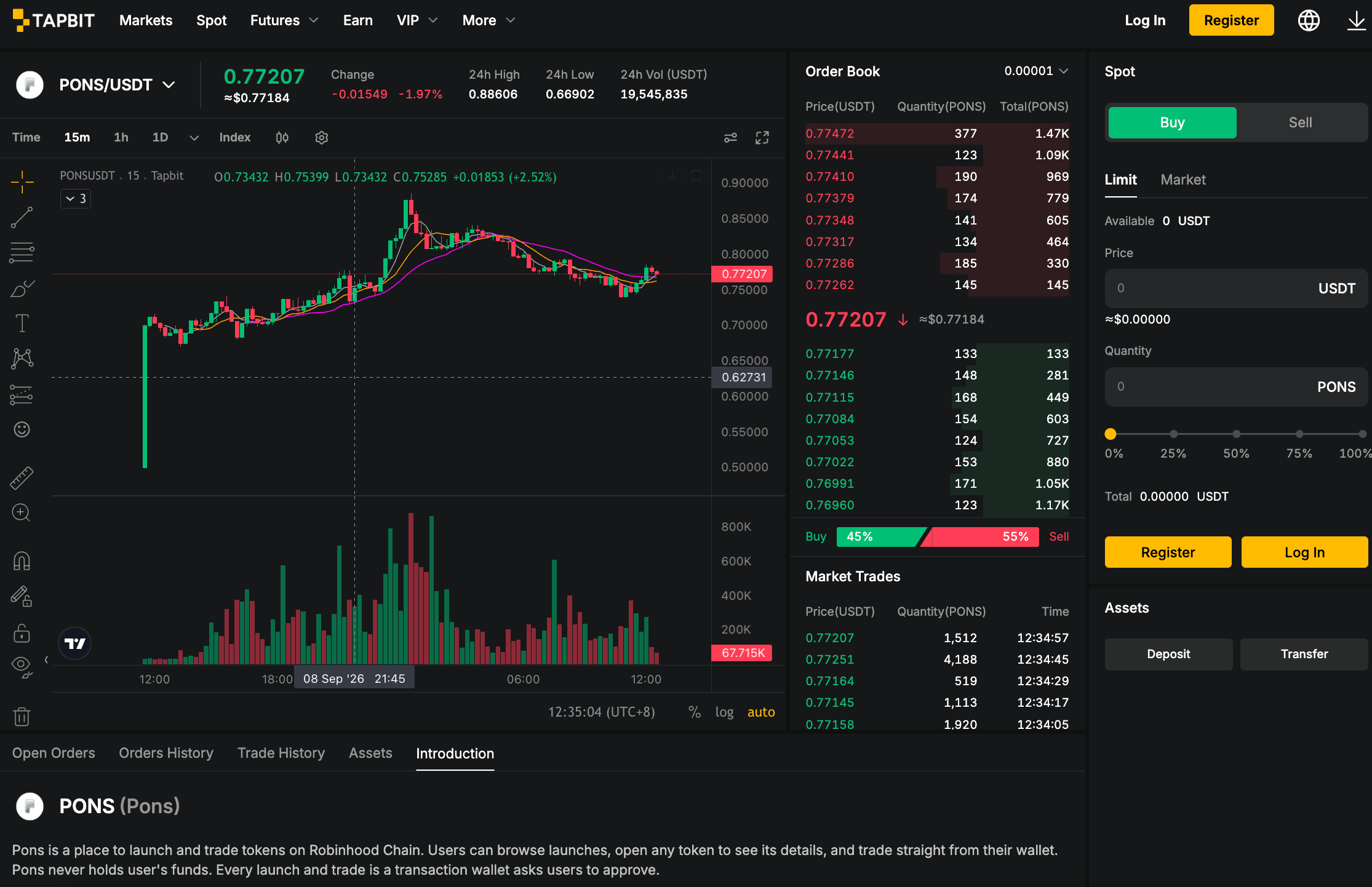
Create a Tapbit account, then visit the PONS-USDT spot market to view live price, depth and recent trades.
Bottom line
PONS is the tradable token. Pons Launchpad is the application. Robinhood Chain is the network under the application, and HOOD is Robinhood Markets stock. Keeping those four identities separate makes every Pons headline easier to understand.


