
What Is Robinhood Chain?
Robinhood Chain is a blockchain network designed to support onchain financial applications. Robinhood’s support material describes it as a permissionless, Ethereum-compatible Layer 2, bringing traditional-market and crypto use cases into a shared network. Its July 1, 2026 announcement describes the mainnet and expanded stock-token applications. Robinhood Chain support · Robinhood mainnet announcement
In plain English, the network supplies transaction infrastructure. Applications use that infrastructure to let people interact with digital assets. The network is not itself a share in Robinhood, and using it does not automatically make someone a shareholder in any company represented by an application.
The Four Parts Beginners Should Separate
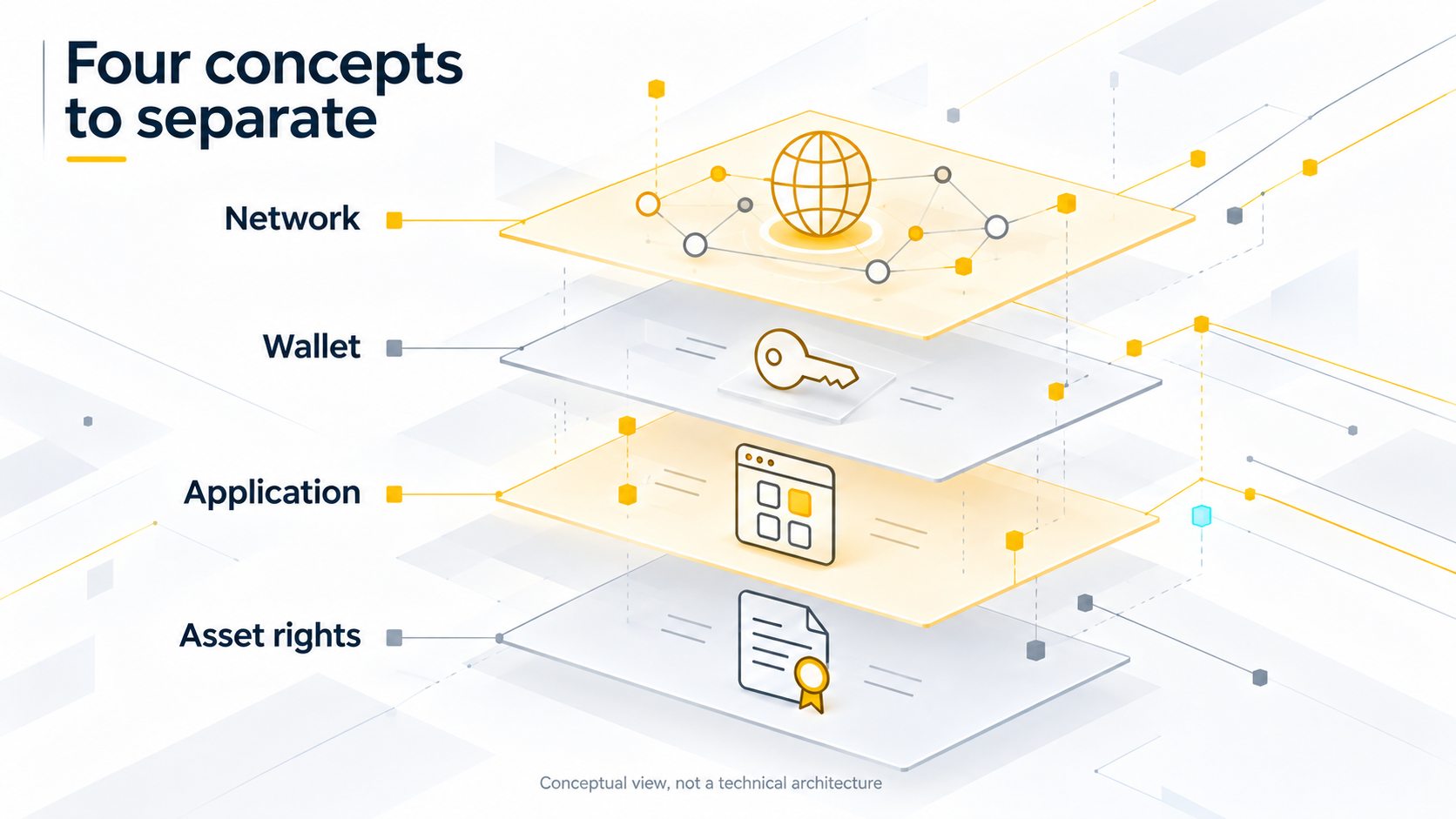
Think of four layers. The network records transactions. A wallet provides the means to authorize interactions. An application defines an activity, such as swapping assets. The asset itself carries whatever rights its issuer or code actually provides.
A useful analogy is a road, a key, a shop and a product. Sharing the same road does not make every shop equally safe. Possessing a key does not tell you what the product is worth. Similarly, a reputable network name is not a guarantee about every application or token using it.
This distinction helps prevent a common mistake: assuming that a token mentioned alongside a well-known brokerage is issued, backed or guaranteed by that brokerage. Each relationship must be checked independently.
What Does Layer 2 Mean?
A Layer 2 handles transaction activity in a system connected to an underlying blockchain rather than being an entirely unrelated ledger. The exact arrangement depends on the network’s design, data availability and verification mechanisms.
Ethereum compatibility concerns the ability to use familiar account, contract and developer conventions. It does not mean all balances, applications or permissions are automatically identical to Ethereum mainnet. An asset held on one network does not simply appear on another because the networks use compatible technology.
Arbitrum Orbit is associated with customizable chain infrastructure. Before making precise claims about settlement, withdrawal periods, proof mechanisms or administrative control, consult the network’s current technical documentation. The general phrase Layer 2 does not resolve those details by itself. This glossary deliberately avoids asserting that every security property is identical to Ethereum’s.
How Wallets and Network Transfers Fit In
A wallet helps a user sign transactions. Some services manage keys on the customer’s behalf, while self-custodial wallets place more responsibility on the user. The interface should make that distinction clear. Losing access or signing a malicious authorization can have serious consequences.
Moving value between networks may involve a bridge or another transfer service. That introduces additional questions: which asset arrives, who operates the mechanism, what fees apply and whether withdrawal or redemption can be delayed. Check the receiving network rather than relying only on an asset’s ticker.
For an unfamiliar transfer, use official documentation and test a small amount where appropriate. Never enter a recovery phrase into a promotional page, support message or supposed verification tool. No article can make an unverified bridge safe.
What Are Stock Tokens on a Blockchain?
A stock token is a digital asset associated with an equity-related economic claim or exposure. Its actual rights depend on the issuer, legal terms and product structure. The label does not universally guarantee voting rights, dividends, redemption or direct ownership of the underlying share.
Robinhood’s mainnet announcement discusses stock-token applications and jurisdiction-dependent availability. That does not authorize every reader to use every product. A permissionless base network can host applications that apply identity checks and geographic restrictions.
A perpetual contract is different again: it is a derivative governed by exchange rules. Its funding, reference price and liquidation process are not the same thing as a token’s issuance or redemption mechanism. Investors should identify the product before comparing prices or rights.
How Is the Network Different From Robinhood Stock?
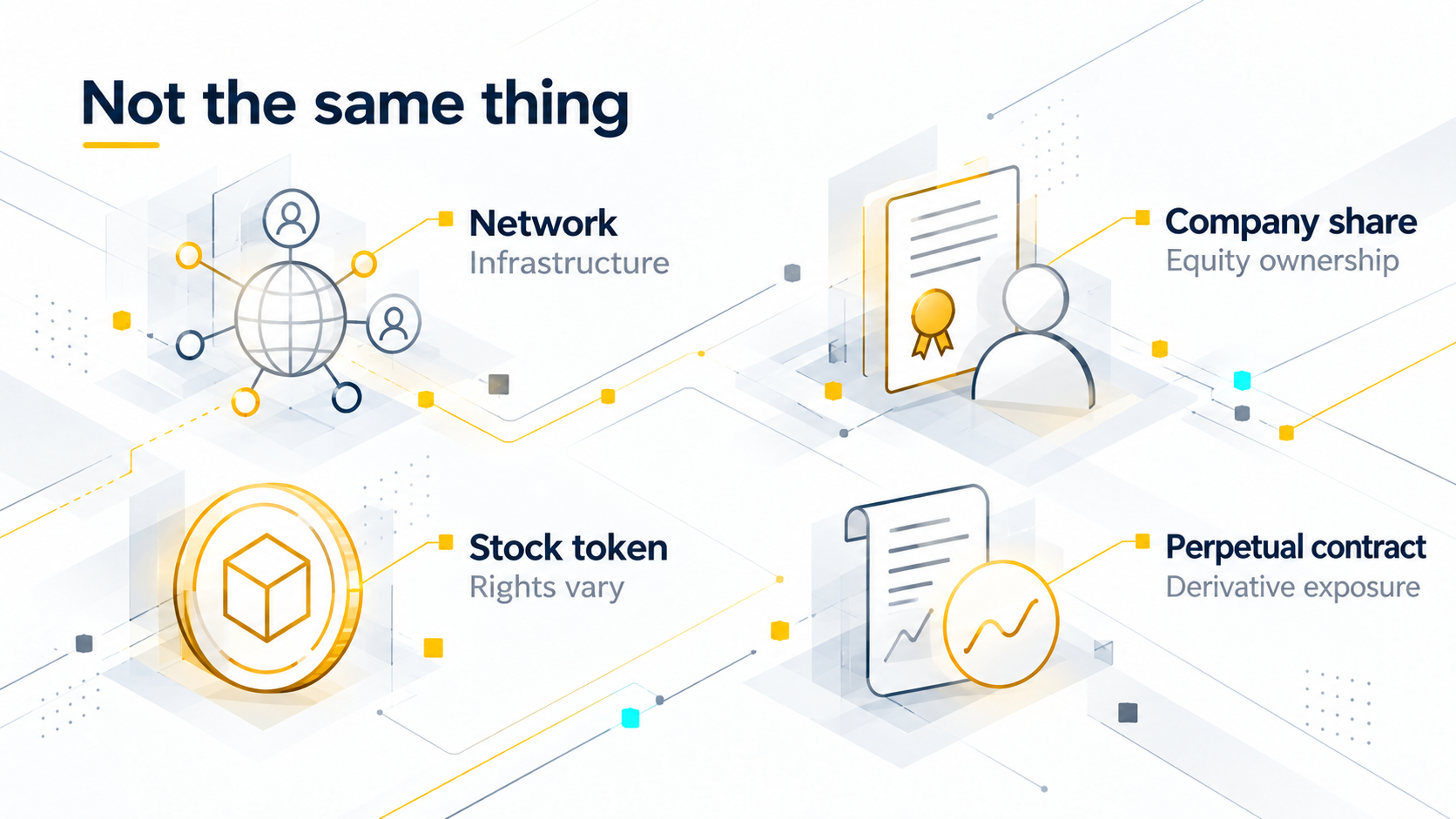
Robinhood stock relates to a company. Robinhood Chain relates to network infrastructure. Growth in a chain’s activity is not automatically equivalent to growth in the company’s profit, and neither guarantees the performance of a stock-linked contract.
To connect network adoption to a business thesis, a reader would need evidence of who earns fees, what costs are incurred and how the activity appears in company disclosures. Transaction counts are operational indicators, not a substitute for a financial statement.
This glossary does not track today’s PONS price, rank chains by daily revenue or predict HOOD’s share price. Those questions require distinct data and belong in separate articles.
A Related Tapbit Product, With Different Rights
The related company contract is HOOD-USDT on Tapbit. It does not provide ownership of Robinhood Chain or automatic access to its applications.
Before using the route:
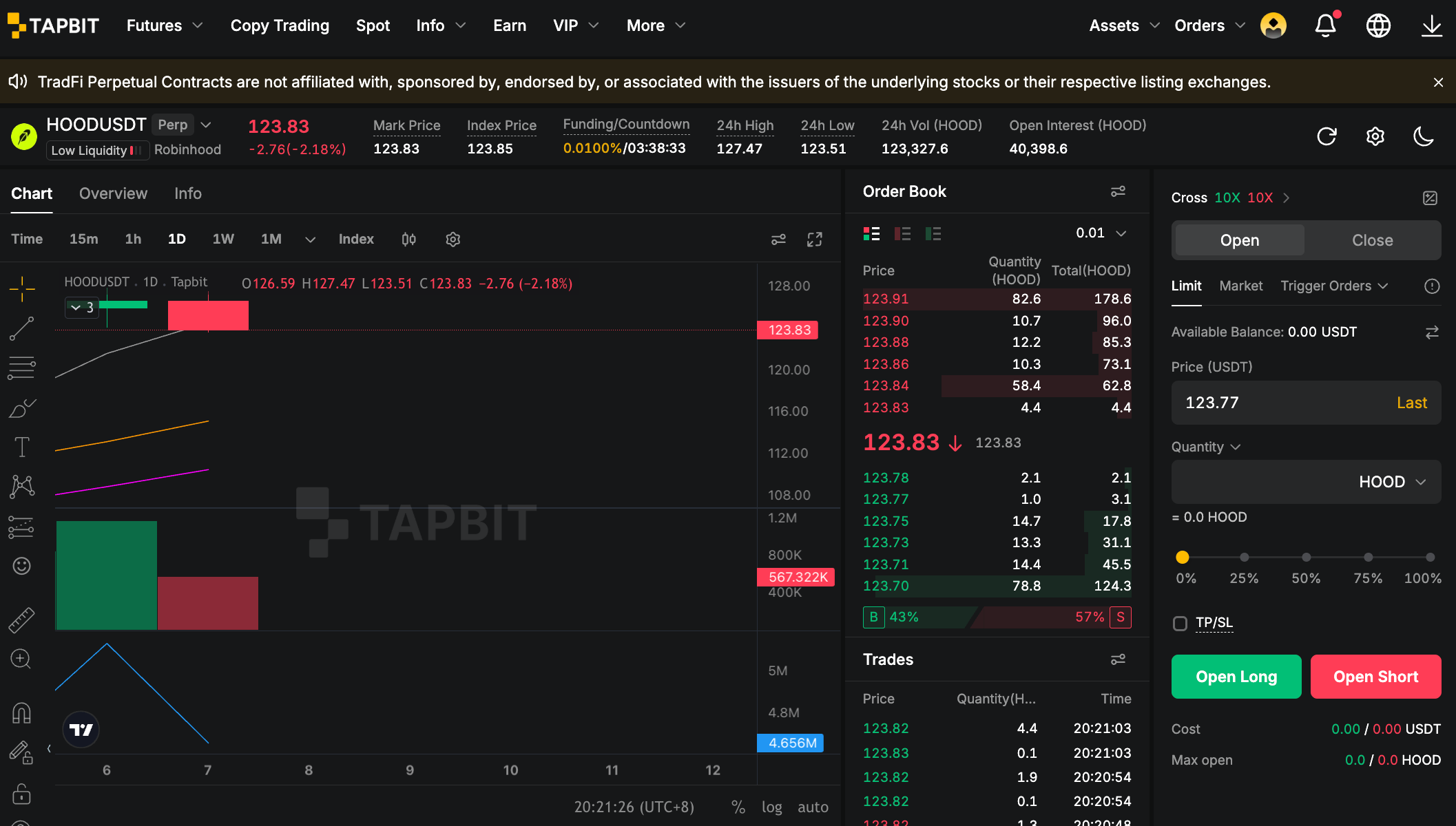
- Log in and confirm eligibility.
- Inspect the exact contract and mark/index references.
- Review order size, direction, costs and margin.
- Set risk controls and monitor liquidation exposure. Contract details must be checked in the live interface.
The core lesson is simple: ask what you are holding, what rights it provides and which system enforces those rights. Familiar branding does not answer those questions.
FAQ
Is Robinhood Chain a stock? No. It is network infrastructure.
Does a stock token always provide shareholder rights? No. Read the issuer’s terms; different structures provide different rights.
Can every user access every app? No. Network openness and financial-product eligibility are separate questions.
Does a low transaction fee eliminate risk? No. Asset volatility, contract exploits, transfer mistakes and product restrictions can remain.
Educational content only; not individualized investment advice. Derivatives involve substantial loss and liquidation risk.


