

Start with the purpose of liquidity
A decentralized exchange needs two assets in a pool so traders can swap between them. For example, a PONS-related token market might pair a new token with the network’s quote asset. The assets inside that pool are called liquidity.
If a pool has more liquidity, a normal-sized trade usually changes the price less. If it has very little liquidity, one trade can move the price sharply. This is why the source and control of liquidity matter when a new token launches.
Step 1: The token begins on a bonding curve
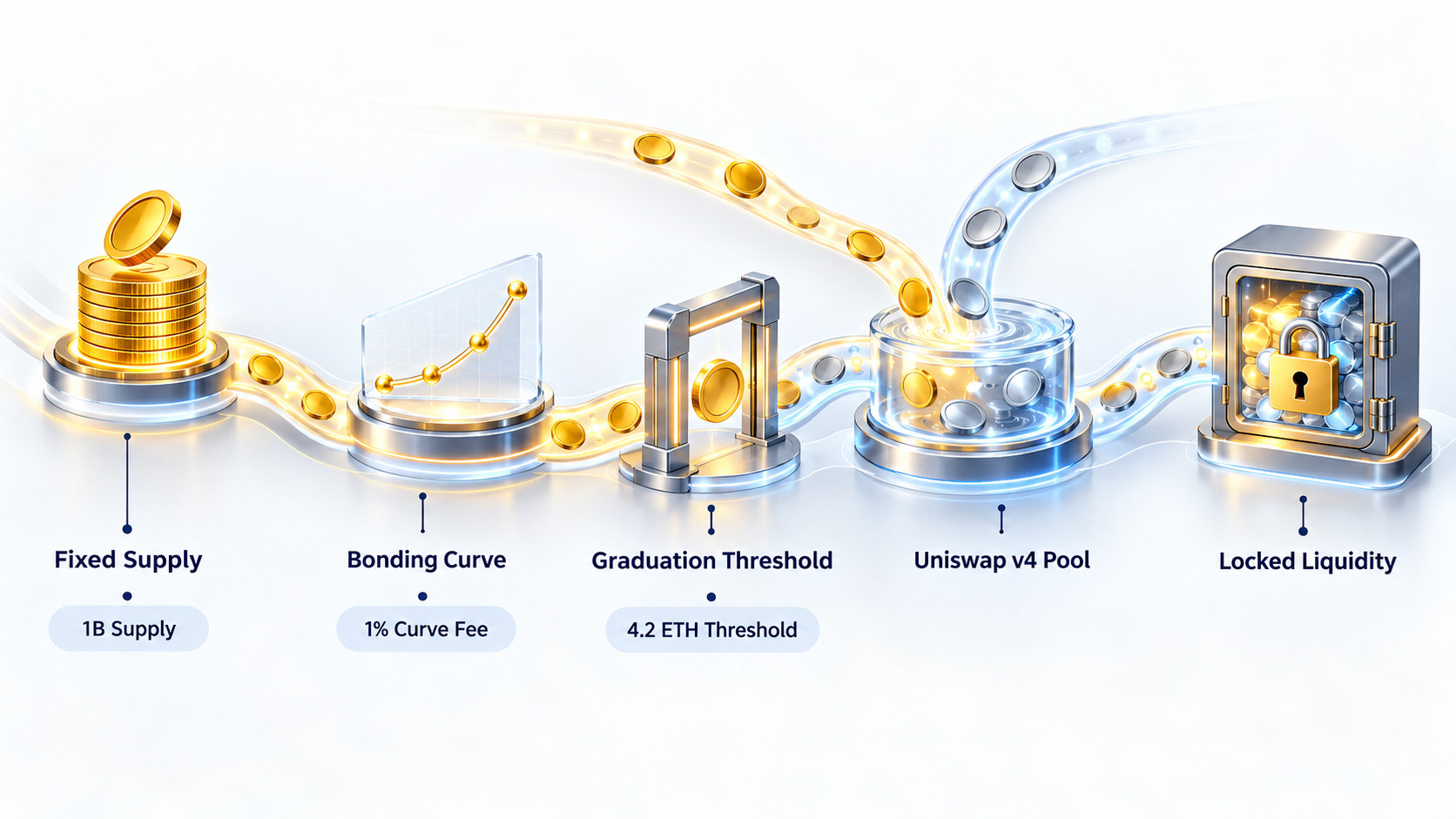
Pons V2 creates a fixed-supply ERC-20 token and places its early market inside a bonding-curve contract. A bonding curve automatically quotes a price from a formula. Users buy from and sell back to the curve.
The curve gives a new token an immediate market without asking the creator to arrange a conventional exchange listing. As users buy, the contract accumulates value and moves toward a defined graduation threshold.
Step 2: The launch reaches graduation
Graduation is the point at which the token leaves its initial curve-only stage. According to Pons V2 documentation, the process creates a Uniswap v4 market after the required threshold is reached.
This change matters because the token is no longer trading only against the launch contract’s formula. It now has a public liquidity position on a decentralized exchange. Buyers and sellers interact with the pool, and the pool price responds to the balance of the two assets.
Step 3: Liquidity moves to Uniswap v4
The graduation transaction supplies token inventory and quote assets to the new pool. Together, those assets allow swaps to continue. The position representing control of that liquidity is then locked under the launch mechanism.
Think of the position as a key to the pool’s deposited assets. If the creator kept that key without restrictions, the creator could remove the assets and leave traders with a thin or unusable market. Locking the position removes that simple withdrawal route.
What does “permanently locked” mean?
In this context, permanently locked means the liquidity position is placed under rules that prevent it from being withdrawn in the normal way. The pool can continue supporting swaps even though the original creator cannot reclaim the deposited liquidity.
The lock applies to the liquidity position, not to every token held by every trader. Users can still buy and sell. It also does not freeze the market price. Price continues changing with demand, supply and available pool depth.
What a liquidity lock changes—and what it does not
- It improves continuity: the initial pool is less likely to disappear because one person removes its core liquidity.
- It makes the launch rules visible: users can inspect the relevant contracts and graduation transaction.
- It does not guarantee deep liquidity: a locked pool can still be small.
- It does not control price: a token can rise or fall sharply after graduation.
- It does not assess the token idea: locking liquidity says nothing about a project’s usefulness or community.
The practical lesson is straightforward: a lock answers “can the initial liquidity be removed?” It does not answer “will people continue trading this token?”
Where do trading fees go?
Swaps on a bonding curve or DEX can charge fees. Pons documentation describes fees during the curve stage and a post-graduation structure that can direct value toward the launch ecosystem, including optional buyback behavior. Exact fee paths depend on the deployed contracts and launch settings, so the transaction and contract view are the best places to verify a specific market.
How can a user verify graduation?
- Confirm the token contract address from the project’s official launch page.
- Open the contract on a Robinhood Chain block explorer.
- Find the graduation transaction and the Uniswap v4 pool address.
- Check the pool’s two assets and current liquidity.
- Review whether trading is concentrated in a small number of wallets.
This process connects the launchpad interface to the actual on-chain record. It also prevents confusion between tokens with similar names.
How this connects to Robinhood Chain
Robinhood Chain processes the smart-contract transactions, while Pons supplies the launch and graduation logic. Pons is an independent application, not a Robinhood-owned launch product. The chain is the infrastructure; the launchpad is the tool built on it.
For the broader relationship, read What Is Robinhood Chain? and the comparison of Pons vs Pump.fun. Tapbit Learn also tracks the separate PONS price story.
Check PONS on Tapbit
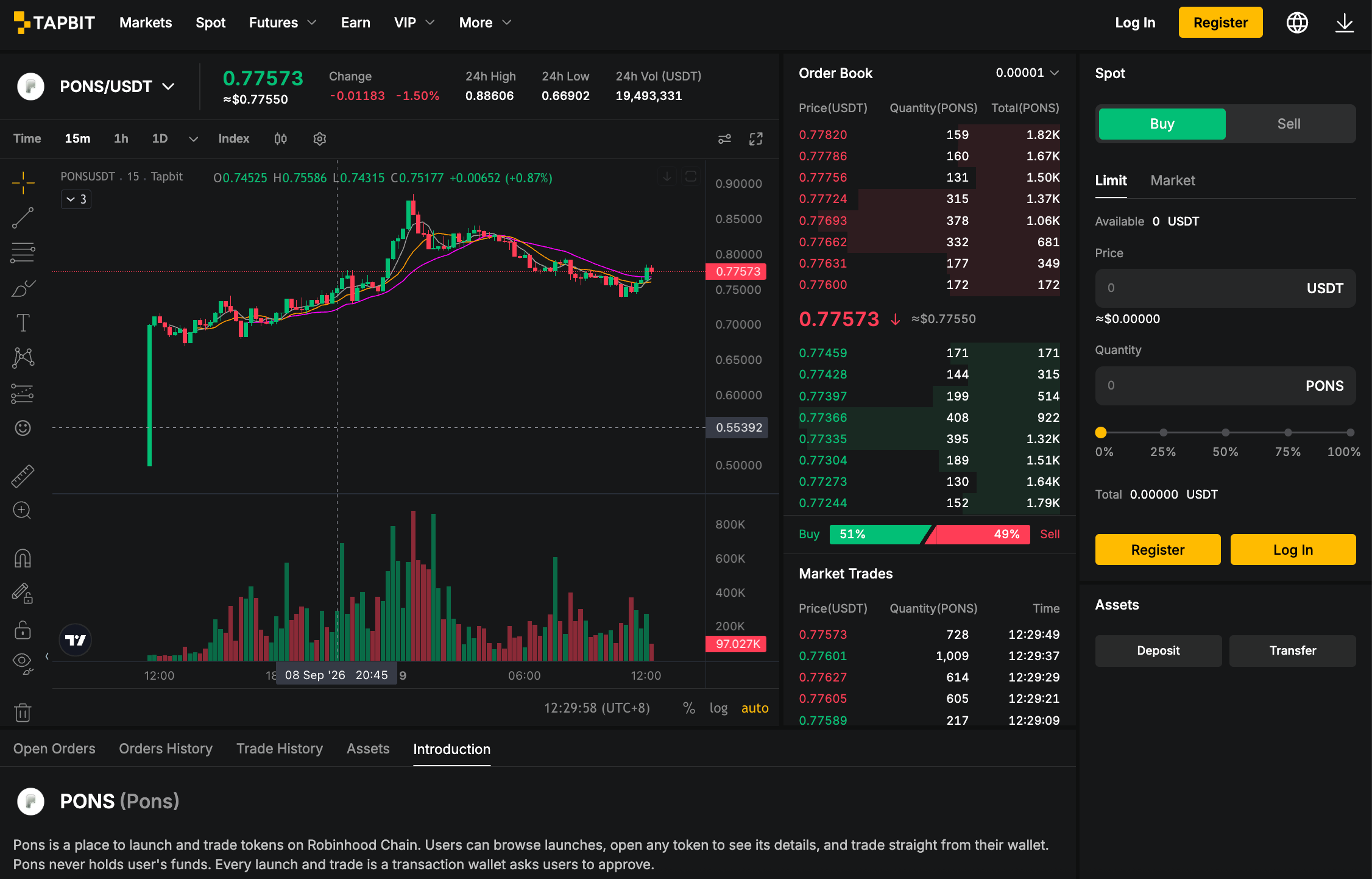
Create a Tapbit account, then open the PONS-USDT spot market to view its live order book and recent trades.
Bottom line
Pons liquidity locking is the final part of a three-stage process: bonding-curve trading, graduation and a locked Uniswap v4 position. The lock keeps the initial pool in place. Market depth and token demand still decide how useful and active that pool becomes.


