

OTC Token is the Solana-based coin used by OTC Desks, a protocol that turns an NFT into what the project calls a tokenized stock desk. Users burn OTC to mint a desk NFT, activate token accounts attached to its vault, and receive a share of assets purchased by the protocol’s fee pot. Despite the name, this is not a conventional over-the-counter brokerage desk.
The official OTC Desks website presents the mechanism as an onchain experiment combining token burns, NFT ownership, and tokenized-equity distributions. Readers interested in broader crypto access can also create a Tapbit account to explore supported markets, without assuming that OTC itself is listed on Tapbit.
What Is OTC Token Used For?
OTC has a specific role inside the protocol: it is the deposit asset burned when a user creates a desk. Burning removes those tokens from circulation rather than sending them to a treasury. The mint transaction then issues a Metaplex Core NFT and derives a vault address for that NFT.
Project documentation says the current desk deposit is 100,000 OTC. The first 96 desks reportedly burned 1 million OTC each, after which the cost was reduced and early-minter refunds were handled separately. These parameters can change, so users should read the live mint page before signing a transaction.
How an OTC Desk Works on Solana
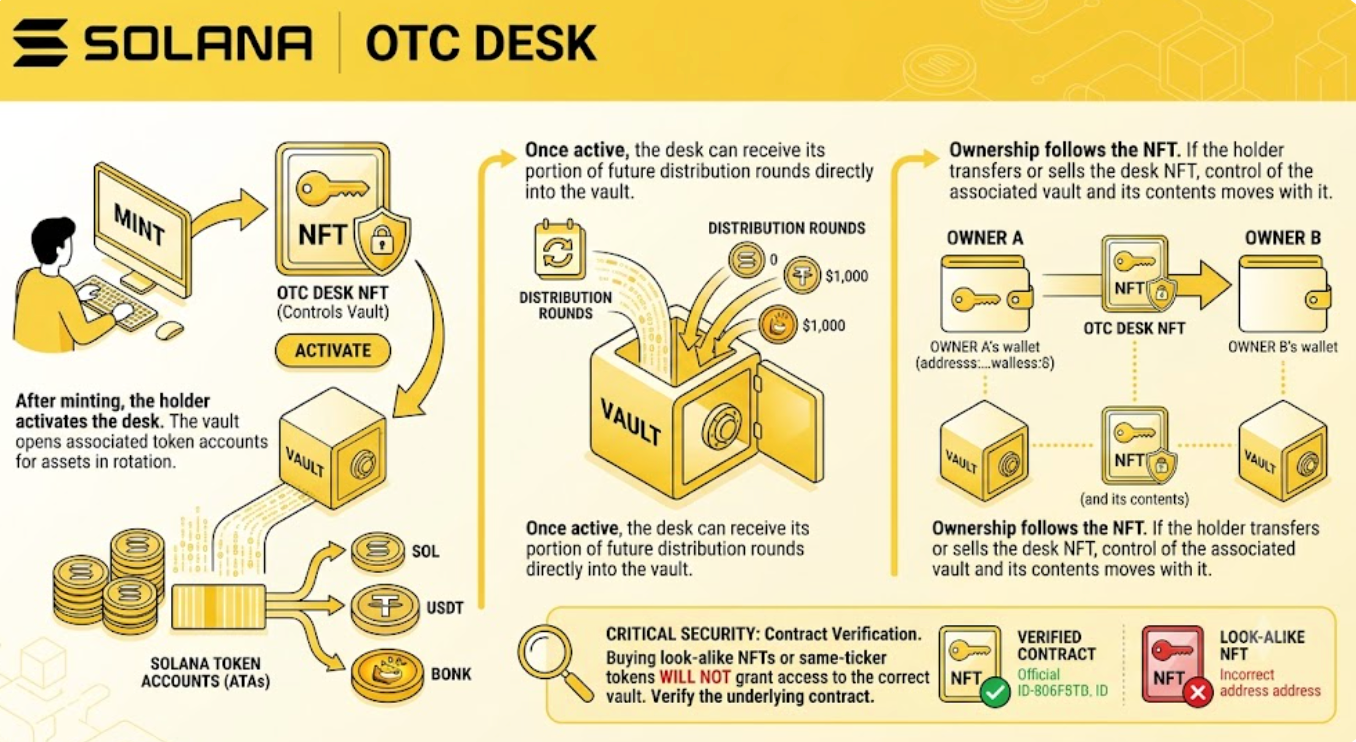
A desk is an NFT that controls a vault rather than a static profile image. After minting, the holder activates it so the vault can open one Solana token account for each asset in the protocol’s rotation. Once active, the desk can receive its portion of future distribution rounds.
Ownership follows the NFT. If the holder transfers or sells the desk NFT, control of the associated vault and its contents moves with it. That design makes contract verification especially important: buying a look-alike NFT or a token with the same ticker would not provide access to the intended vault.
Where the Tokenized Assets Come From
OTC Desks collects several revenue streams into a pot. Its documentation describes a 0.5 SOL surcharge on each mint, with 0.45 SOL going to the pot and 0.05 SOL to the protocol. A 5% royalty on desk transfers is also directed to the pot, while the OTC token’s creator fees are swept into the system.
When the pot reaches its stated threshold, it buys the next asset in a rotating lineup. The documentation currently describes 11 assets: 10 tokenized equities plus OTC itself. Each active desk receives an equal share of a round, rather than a share weighted by desk age or the amount of OTC previously burned.
Does OTC Represent a Stock?
No. OTC is the protocol token, not a share of a listed company and not a tokenized version of one stock. The desk NFT is designed to hold separate tokenized assets acquired by the protocol. That distinction matters because the rights attached to a tokenized equity depend on its issuer, custodian, jurisdiction, and redemption terms.
The project’s use of the phrase “real tokenised stock” should not be treated as proof that every holder has the same voting, dividend, redemption, or legal ownership rights as a brokerage shareholder. Users should inspect the issuer and mint address of every vault asset, then confirm what claim—if any—the token grants on the underlying security.
OTC Token, Desk NFT, and Vault Compared
| Component | Role | Main Risk |
|---|---|---|
| OTC token | Burned to mint a desk; also appears in the asset rotation | Price volatility and thin liquidity |
| Desk NFT | Represents control of a derived vault | Wrong collection or lost wallet |
| Vault | Holds distributed assets | Smart-contract, issuer, and custody assumptions |
| Tokenized equities | Assets purchased during rotation rounds | Restrictions, tracking, liquidity, and legal-rights risk |
What Makes the Model Interesting?
The system links demand for new desks to a declining OTC supply because minting burns tokens. It also makes each NFT economically different over time: an older desk may already hold assets from earlier rounds, while a newly minted desk starts with future accruals and any amounts recorded after its creation.
The equal-distribution structure is easy to understand, but it creates dilution at the desk level. When more desks become active, each one receives a smaller fraction of later rounds. A rising OTC price can also make minting expensive even when the number of tokens required stays unchanged.
Key Risks Before Buying OTC
OTC is a small, narrative-driven Solana asset. Its market price may react more to attention and liquidity than to the value held across desk vaults. Slippage can be significant, and a wallet may be unable to exit near the displayed price during a sharp sell-off.
Contract and ticker confusion are equally important. “OTC” is a common finance abbreviation, so unrelated tokens can use the same symbol. Buyers should navigate from the project’s official domain, compare the Solana mint address across multiple trusted explorers, review holder concentration, and make a small test transaction before committing more funds.
Smart-contract bugs, compromised project keys, malicious interfaces, tokenized-asset restrictions, and unclear legal claims could affect either the OTC token or the assets held by a desk. The model should therefore be evaluated as an experimental onchain protocol, not as a guaranteed stock-income product.
Conclusion
OTC Token powers a distinctive Solana mechanism: burn the coin to mint an NFT desk, activate its vault, and participate in equal distributions funded by protocol activity. The design gives OTC more utility than a ticker alone, but it does not remove the risks of a small token, a changing smart-contract system, and tokenized assets whose shareholder rights may differ from ordinary stocks. Verify the official contracts and understand the vault before buying OTC or a desk NFT.
FAQ
Is OTC Token the same as traditional OTC trading?
No. Traditional OTC trading involves privately negotiated transactions. OTC Token is a Solana crypto asset used within the OTC Desks protocol.
What happens to OTC when a desk is minted?
The protocol says the required OTC deposit is burned during the same Solana transaction that creates the desk NFT.
Do OTC desk holders own real company shares?
The vault holds tokenized assets, but the legal and economic rights depend on each asset’s issuer and terms. A tokenized equity may not provide the same rights as a brokerage-held share.
Can an OTC desk be sold?
The NFT can be transferred, and the project says its vault and accumulated assets move with it. Buyers must verify the correct collection and inspect the vault contents before purchase.
Is OTC Token listed on Tapbit?
This article does not confirm a Tapbit OTC listing. Always check Tapbit’s current market list directly before attempting to trade any asset.


