

WHUF may appeal to investors looking for an early-stage bet on crypto reputation, but it is not a low-risk investment. The token is designed to power Ethos, a protocol that records reviews, vouches and other credibility signals for crypto users and projects. Its investment case depends on whether those tools attract durable usage and whether WHUF becomes necessary inside that network rather than merely a speculative asset after launch.
While evaluating early-stage tokens such as WHUF, readers can create a Tapbit account to explore supported crypto markets and trading tools. This link does not imply that WHUF is listed or available for trading on Tapbit.
The official WHUF sale page describes a fixed supply, an English-auction launch and a conditional price-protection mechanism. Those features are unusual, but none guarantees demand, liquidity or a positive return. Anyone considering the auction should evaluate the clearing valuation, allocation schedule and token utility together.
WHUF Investment Snapshot
| Question | Current Information |
|---|---|
| Project | Ethos onchain reputation and credibility protocol |
| Token name | Whuffie (WHUF) |
| Total supply | 10,000,000 WHUF |
| Future emissions | None stated; fixed supply |
| Public sale allocation | 2,000,000 WHUF, equal to 20% of supply |
| Auction bid range | $0.10 to $9.90 per WHUF |
| Implied FDV range | $1 million to $99 million |
| Largest allocation | Team, 28.9% |
| Main risks | Valuation, adoption, unlocks, liquidity, contract execution and conditional protection |
What Is Ethos and What Does WHUF Do?
Ethos is building a public credibility layer for crypto. Users can create profiles, review other participants and vouch for accounts they consider trustworthy. The aim is to make reputation harder to manufacture because some credibility actions require economic commitment rather than a simple social-media endorsement.
WHUF is intended to replace ETH as the protocol's native economic asset. Ethos says users will be able to stake or vouch WHUF, earn it through contributions and use it within reputation markets. Protocol activity can also create token burns. In theory, this forms a loop in which more useful reputation data produces more demand for the token and makes dishonest signaling more expensive.
The weak point is that intended utility is not the same as proven demand. Ethos has operated before WHUF, so investors should watch whether users actually prefer the new token and whether integrations generate recurring activity after initial incentives fade.
How the WHUF Auction Price Is Set
The public sale uses a uniform-price English auction powered by Sonar. Participants commit USDC and state the highest price they are willing to pay. After bidding closes, the auction identifies a clearing price. Successful bidders pay that same final price even if their maximum bid was higher.
Bids are allowed between $0.10 and $9.90 per WHUF. With a 10 million fixed supply, those prices imply valuations from $1 million to $99 million. A bidder's maximum is therefore not merely a way to secure an allocation; it is a valuation decision.
| WHUF Price | Implied Fully Diluted Valuation |
|---|---|
| $0.10 | $1 million |
| $0.50 | $5 million |
| $1.00 | $10 million |
| $5.00 | $50 million |
| $7.50 | $75 million |
| $9.90 | $99 million |
There is no single confirmed WHUF auction price until the sale clears. Third-party pages that display a fixed presale price may be showing the starting bid, an estimate or an unrelated token. The official auction interface and final settlement are the relevant references.
WHUF Tokenomics: Where the Supply Goes
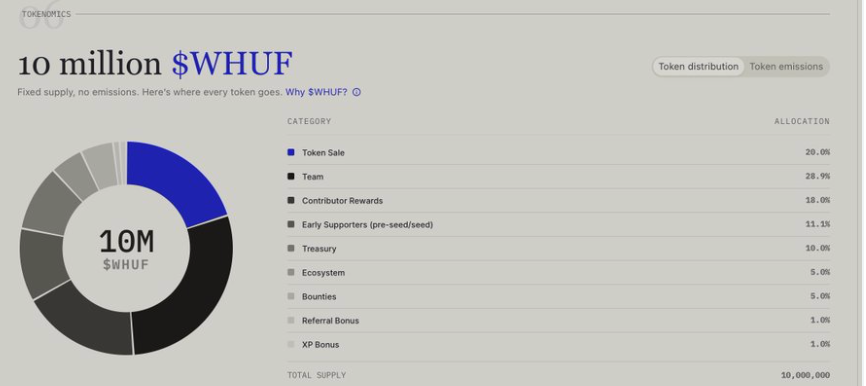
WHUF has a stated fixed supply of 10 million tokens with no emissions. The sale receives 20%, while the team receives 28.9%, the largest single allocation. Contributor rewards account for 18%, early supporters 11.1%, the treasury 10%, the ecosystem 5% and bounties 5%. Referral and XP bonus pools receive 1% each.
| Allocation | Share | Tokens |
|---|---|---|
| Team | 28.9% | 2,890,000 |
| Public token sale | 20.0% | 2,000,000 |
| Contributor rewards | 18.0% | 1,800,000 |
| Early supporters | 11.1% | 1,110,000 |
| Treasury | 10.0% | 1,000,000 |
| Ecosystem | 5.0% | 500,000 |
| Bounties | 5.0% | 500,000 |
| Referral bonus | 1.0% | 100,000 |
| XP bonus | 1.0% | 100,000 |
A fixed supply can limit dilution from newly created tokens, but it does not prevent selling by existing holders. The team and early-supporter allocations together exceed the public sale, so vesting, cliffs and unlock dates matter. Investors should verify the final vesting contracts and monitor circulating supply instead of relying only on the maximum supply figure.
Does the WHUF Price Guarantee Remove Downside Risk?
No. Ethos advertises protection covering 85% of the purchase price for qualifying auction buyers, potentially increasing to 90% if the clearing price reaches at least $7.50. The protection is conditional rather than an automatic market-price floor.
According to the sale terms, a buyer must vouch the purchased WHUF within the specified 30-day period and keep it continuously vouched. Unvouching permanently forfeits the protection. Redemption is through the Ethos Foundation, requires KYC and AML checks, and applies for a limited period. Counterparty, eligibility, operational and enforcement risks remain.
The mechanism may reduce some loss for participants who satisfy every condition, but it should not be treated like deposit insurance, a guaranteed refund or permission to bid at any valuation.
The Bull Case for WHUF
The strongest case is that crypto lacks a portable reputation system. Wallet history reveals transactions but often fails to show whether a founder, trader or promoter has behaved responsibly. If Ethos credibility scores become widely used by token launches, lenders, communities and consumer applications, WHUF could gain utility as the asset securing those judgments.
Its fixed supply and burn design could strengthen that case if network usage grows faster than tokens return to circulation. A broad contributor allocation may also reward people who create useful reputation data rather than concentrating every token with investors.
Why WHUF Could Underperform
Reputation systems face a difficult adoption problem: scores become useful only when many people contribute accurate information, but users may not participate until the scores are already useful. Incentives can attract activity without guaranteeing quality. Coordinated groups may also attempt to manipulate reviews, vouches or reputation markets.
Valuation is equally important. A $1 million FDV leaves much more room for adoption uncertainty than a $99 million FDV. If aggressive bidding pushes the clearing price toward the cap, buyers are paying in advance for significant execution. Post-launch liquidity may be shallow, and bonus recipients or unlocked holders could add selling pressure.
Contract vulnerabilities, governance disputes, changing regulations and confusion with older projects named Ethos create additional risk. Investors should verify the official contract after deployment and avoid buying a token merely because it uses the WHUF ticker.
Is WHUF Token a Good Investment?
WHUF is better viewed as a high-risk venture-style token than a conservative crypto holding. A lower auction valuation, transparent vesting, verified contracts, growing protocol usage and durable demand for vouching would improve the risk-reward profile. A high clearing valuation, unclear circulating supply or weak activity after incentives would make the case less attractive.
Before participating, compare the clearing FDV with actual users, integrations and fee activity. Read the final sale and guarantee terms, check regional eligibility and decide how much liquidity you can afford to lock in a speculative position.
Conclusion
WHUF gives Ethos a native asset for staking credibility and coordinating its reputation economy. The 10 million fixed supply, uniform-price auction and conditional protection may attract attention, but the investment outcome will depend on the auction valuation and real protocol adoption.
The token could perform well if Ethos becomes a widely used reputation layer and WHUF captures that usage. It could also fall sharply if the market overprices the launch, unlocks create pressure or the credibility model fails to retain users. For most buyers, WHUF should remain a small, speculative position rather than a core holding.
FAQ
What is WHUF?
WHUF, short for Whuffie, is the planned native token of Ethos, an onchain reputation protocol that uses reviews, vouches and credibility markets.
What is the WHUF auction price?
Bidders can set maximum prices from $0.10 to $9.90, but all successful participants pay the final uniform clearing price. That price is not known before the auction closes.
What is the total WHUF supply?
The stated fixed supply is 10 million WHUF with no future emissions. The public auction offers 2 million tokens, or 20% of supply.
Is the WHUF 85% price guarantee automatic?
No. Buyers must meet vouching, holding, timing, KYC and AML requirements. Unvouching can permanently remove eligibility, and the mechanism still carries counterparty and operational risk.
What should investors monitor after launch?
Important signals include the clearing valuation, circulating supply, vesting and unlocks, liquidity, holder concentration, protocol activity, fee burns and verified contract information.


