
USDG, short for Global Dollar, is a U.S. dollar-pegged stablecoin managed by Paxos entities. It is designed to be redeemable at a one-to-one rate for U.S. dollars through eligible Paxos channels, while moving on public blockchains like other crypto assets. On Robinhood Chain, USDG provides a dollar-denominated asset for trading, transfers and onchain financial applications.
That simple description needs an important qualification. A $1 target does not mean that USDG is a bank deposit, government-insured cash or a guaranteed investment. Its market price can move away from the peg, and holders still face issuer, reserve, liquidity, smart-contract and network risks.
USDG at a Glance
| Full name | Global Dollar |
| Ticker | USDG |
| Asset type | U.S. dollar-denominated stablecoin |
| Manager | Paxos Digital Singapore and Paxos Issuance Europe, according to Paxos terms |
| Robinhood Chain role | Stablecoin infrastructure for transfers, trading and settlement |
| Robinhood Chain contract | 0x5fc5360D0400a0Fd4f2af552ADD042D716F1d168 |
| Tapbit market | USDG/USDT |
How USDG Is Designed to Hold $1
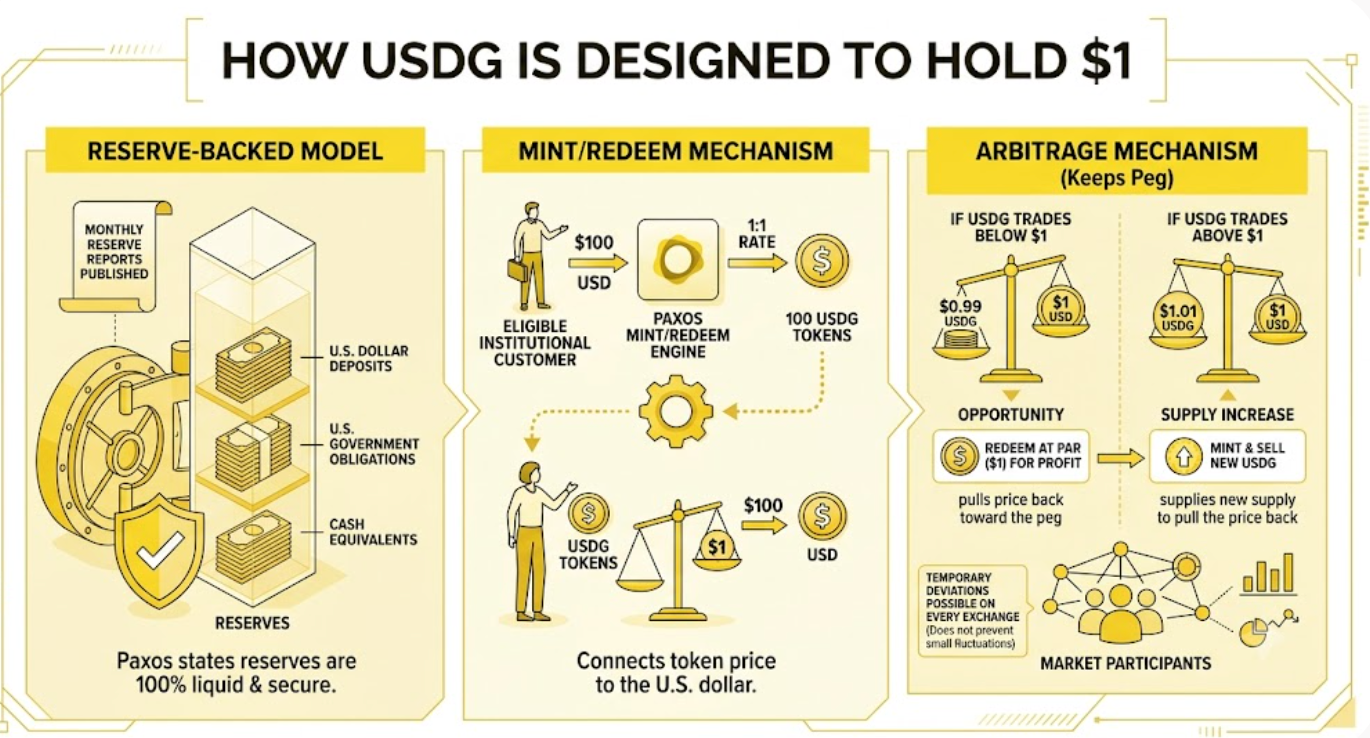
USDG uses a reserve-backed model. Paxos states that reserves for its dollar stablecoins are held in U.S. dollar deposits, U.S. government obligations and cash equivalents, and that reserve reports are published monthly. Eligible institutional customers can mint or redeem USDG with Paxos at a 1:1 rate.
This redemption mechanism helps connect the token price to one U.S. dollar. If USDG trades below $1 and market participants can redeem it at par, the discount may create an arbitrage opportunity. If it trades above $1, new supply or selling can help pull the price back toward the peg. The mechanism is influential, but it does not prevent temporary deviations on every exchange.
Why USDG Is on Robinhood Chain
Robinhood Chain is an Ethereum-compatible Layer 2 built for onchain financial infrastructure. Its documentation identifies Paxos USDG as a stablecoin infrastructure provider, making USDG a practical quote and settlement asset for applications operating on the network.
A stable unit of account can make trading and payments easier than using an asset whose dollar value changes sharply. USDG may also be used in supported lending or liquidity applications, although those activities introduce separate protocol and counterparty risks. Robinhood itself does not issue USDG or manage its reserves.
The canonical USDG contract published by Robinhood Chain is 0x5fc5360D0400a0Fd4f2af552ADD042D716F1d168. Users should compare the complete address—not only the ticker—before sending funds or interacting with a decentralized application. Anyone can create a token with a familiar name.
USDG Price and Liquidity on Tapbit
The supplied Tapbit market snapshot showed USDG/USDT at approximately $0.9999, with a displayed 24-hour range of $0.9999 to $1.0000 and about 14,047 USDT in volume. These figures describe one point in time and can change quickly as orders enter or leave the market.
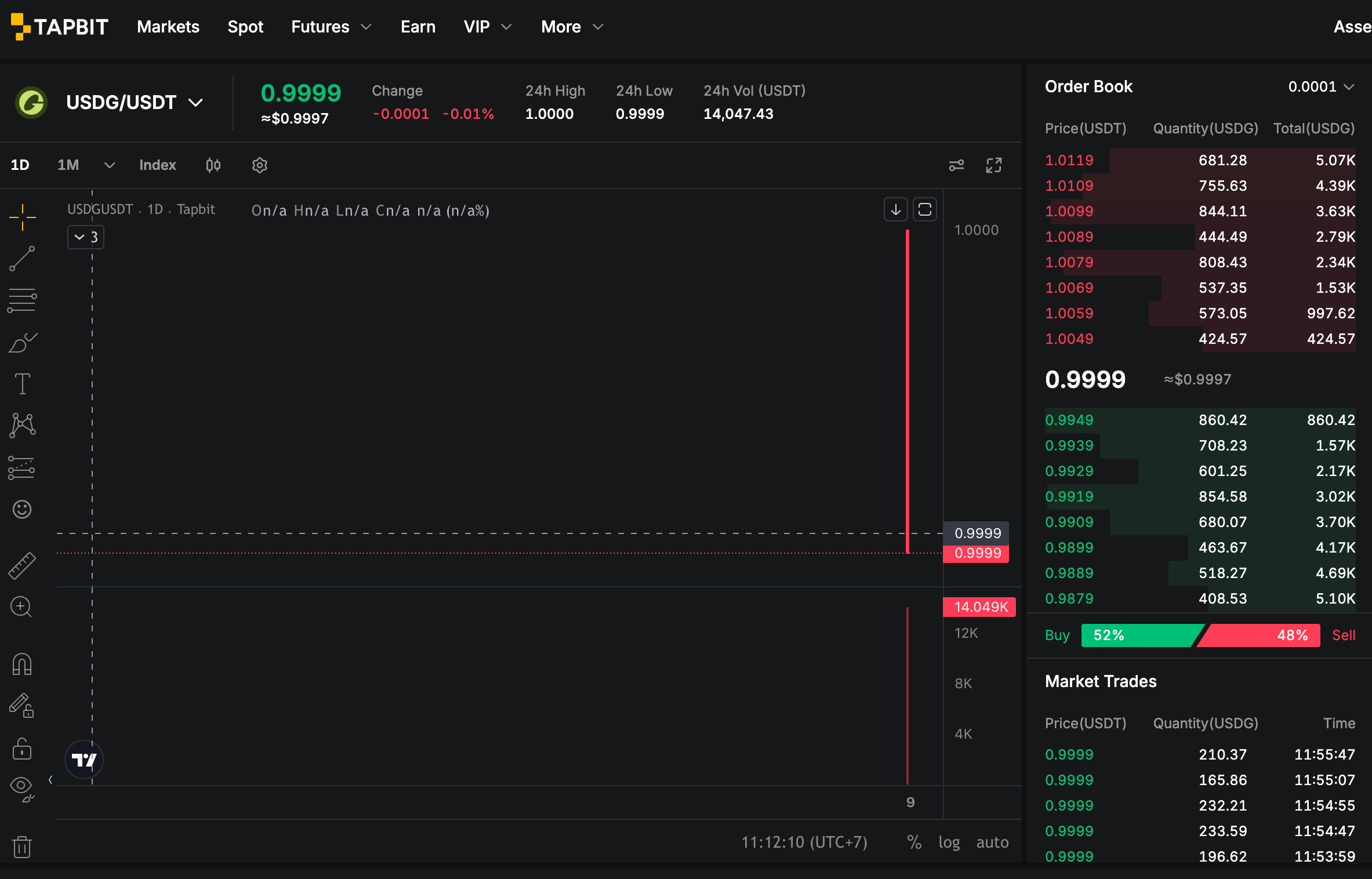
For a stablecoin pair, the headline price tells only part of the story. Traders should also inspect the spread between the best bid and ask, the amount of liquidity near $1 and the likely slippage for their order size. A thin order book can produce an unfavorable execution even when the last traded price appears close to the peg.
How to Trade USDG/USDT on Tapbit
Users can open the USDG/USDT spot market on Tapbit, review the live order book and choose between a market order and a limit order. A limit order provides more control over the execution price, while a market order prioritizes speed and may incur slippage.
Before depositing USDG, confirm that Tapbit supports the same network used by the sending wallet. The ticker alone is not enough. Check the deposit page, the full address and any required confirmation details before moving funds. Blockchain transfers sent through an unsupported network may be difficult or impossible to recover.
USDG Compared With USDT and USDC
USDG, USDT and USDC all aim to track the U.S. dollar, but they differ in issuer, reserve structure, distribution network, supported chains and market depth. USDT and USDC generally have broader exchange and DeFi liquidity. USDG's distinguishing feature is its Paxos-managed structure and its role within the Global Dollar Network and Robinhood Chain ecosystem.
Those differences matter in practice. A trader may prefer the deepest order book, while an application may prioritize a particular chain or issuer. No stablecoin should be evaluated on its ticker or target price alone.
Key Risks of Holding or Trading USDG
Depeg risk: USDG can trade below or above $1, especially during market stress or when local liquidity is limited. Issuer and reserve risk: the token depends on Paxos entities, banking partners, custodians and the assets supporting redemption. Access risk: direct redemption may depend on eligibility, jurisdiction and account requirements.
Smart-contract and network risk: bugs, outages, bridge problems or operational failures may delay or impair transfers. Liquidity risk: a quoted price does not guarantee that a large order can execute near that level. Wrong-token risk: fake tokens and unsupported-network deposits can lead to permanent loss.
Conclusion
USDG is a Paxos-managed dollar stablecoin that gives Robinhood Chain users a dollar-denominated asset for trading and settlement. Its reserve-backed design and 1:1 redemption framework are intended to support the peg, while its official Robinhood Chain contract helps users identify the correct token.
Still, the correct way to assess USDG is not to ask whether one token is always worth exactly $1. Review the issuer's latest reserve disclosures, redemption conditions, market depth and network details before trading or transferring it.
FAQ
What does USDG stand for?
USDG stands for Global Dollar, a U.S. dollar-denominated stablecoin managed by Paxos entities.
Is USDG issued by Robinhood?
No. Robinhood Chain supports USDG, but Robinhood does not issue the token or manage its reserves. Paxos entities manage USDG.
Is one USDG always worth one dollar?
USDG is designed for a $1 value and 1:1 redemption through eligible Paxos channels, but its exchange price can temporarily move above or below the peg.
What is the USDG contract on Robinhood Chain?
Robinhood Chain documentation lists 0x5fc5360D0400a0Fd4f2af552ADD042D716F1d168. Always verify the full address against current official documentation before transferring funds.
Can I trade USDG on Tapbit?
Yes. Tapbit provides a USDG/USDT spot market. Availability and deposit networks can vary by region and over time, so check the live market and deposit page before trading.


