

The gold price today is drawing attention because XAU is trading close to a major round-number zone. Live market references on June 26, 2026 showed spot gold around $4,011.50 per ounce, after a visible daily decline of about $92.92 or 2.22%. That places gold near the lower end of recent momentum, even though the longer-term gold narrative remains supported by inflation hedging, reserve diversification, and demand for hard assets.
For traders, the question is not only “what is the gold price today?” It is also whether the decline is a normal correction, a deeper reversal, or a reset before another attempt higher. The answer depends on how gold behaves around $4,000, how the U.S. dollar moves, and whether risk sentiment improves or weakens.
Gold Price Today: Current Levels and Market Snapshot
Gold is trading around the $4,000-$4,020 area in the latest visible market snapshot. A Kitco result showed gold near $4,011.50, while another live gold-price result highlighted a daily decline of $92.92, equal to about -2.22%. The same data showed gold down roughly $317.55 over 30 days, or about -7.05%.
That combination is important. Gold is still historically elevated, but short-term momentum has cooled. A market can be in a long-term uptrend and still suffer sharp pullbacks when positioning gets crowded, the U.S. dollar rebounds, or traders reduce exposure before major macro events.
| Level | Approx. Value | Signal |
|---|---|---|
| Current price | $4,011.50 | Above $4,000 |
| Daily move | -$92.92 / -2.22% | Selling pressure |
| 30-day move | -$317.55 / -7.05% | Bigger correction |
| Support | $3,950-$4,000 | Must hold |
Why Gold Is Moving Today
The gold price today is being shaped by both macro forces and market positioning. Gold often rises when traders want protection from inflation, currency weakness, financial stress, or geopolitical uncertainty. It can fall when real yields rise, the U.S. dollar strengthens, or investors rotate back into risk assets.
The current move appears to reflect several overlapping pressures:
- Dollar strength: a stronger dollar can make gold more expensive for non-U.S. buyers.
- Rate expectations: if traders expect higher real yields, non-yielding gold can face pressure.
- Profit-taking: after a strong multi-month gold cycle, investors may lock in gains near big round numbers.
- Risk rotation: if equities or crypto rebound, some capital may leave defensive assets.
- Technical selling: a break below recent support can trigger systematic and short-term selling.
This is also why gold matters to crypto traders. Gold, Bitcoin, and commodity-linked products can all react to liquidity, inflation expectations, and risk appetite, though they do not always move together. Tapbit Learn's why is crypto up today guide explains how macro catalysts can influence digital-asset sentiment.
Gold Price Today vs Crypto and Commodity Narratives
Gold is not a crypto asset, but it increasingly appears in the same conversation as Bitcoin, stablecoins, tokenized commodities, and real-world asset narratives. Traders compare gold with Bitcoin as a store-of-value trade, with oil as a commodity-market signal, and with U.S. equities as a risk-sentiment indicator.
In crypto, gold-related interest usually appears in three ways:
- GOLD-USDT futures: a derivative way to trade gold-linked price movement using USDT.
- Tokenized gold products: blockchain representations of gold exposure, usually dependent on issuer custody and redemption rules.
- Macro comparison: gold as a defensive benchmark against Bitcoin, equities, and fiat currencies.
This is similar to how energy themes appear in crypto markets. For commodity context, Tapbit Learn's what is OIL(WTI) coin and oil coin guide explain how oil-linked narratives can differ from actual commodity futures.
Gold Price Outlook: Bullish, Base and Bearish Scenarios
For the next few sessions, the gold price today setup depends on whether XAU holds $4,000 or slips into a deeper correction.
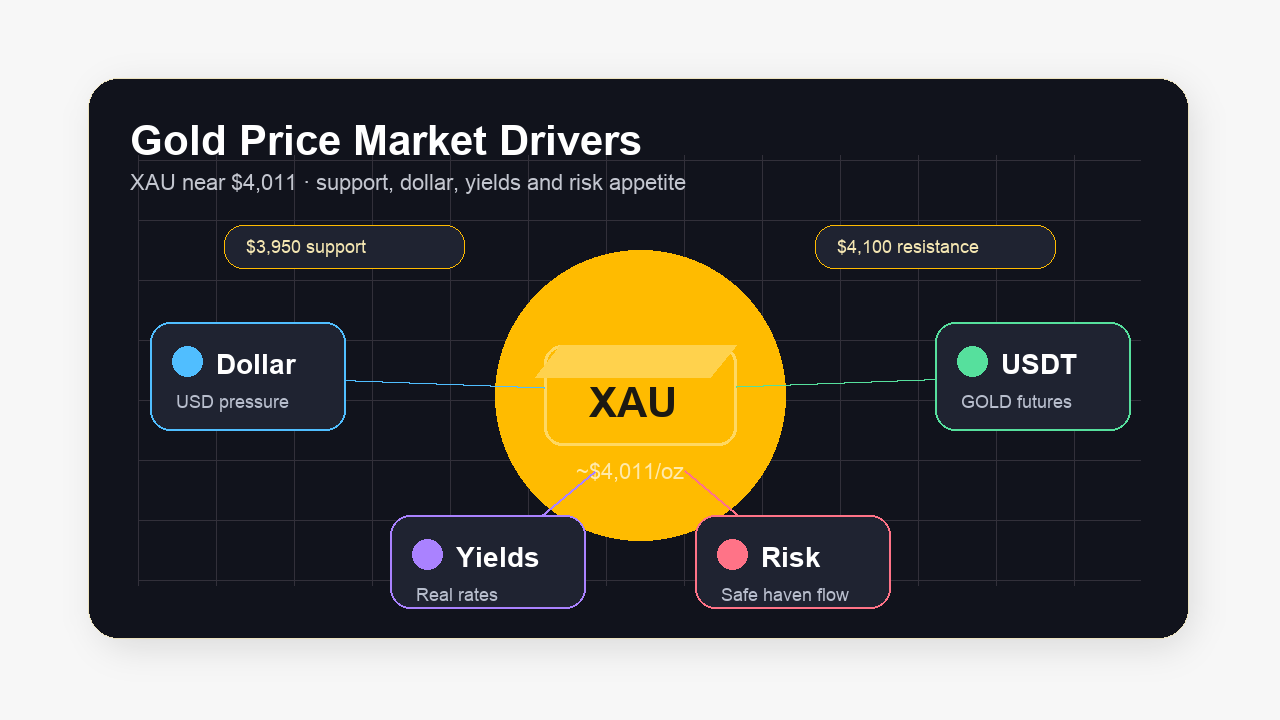
Bullish scenario: Gold holds the $3,950-$4,000 support area and quickly reclaims $4,050-$4,100. This would suggest that the latest pullback was mostly profit-taking. A close above $4,100 could invite momentum traders back into the market.
Base scenario: Gold trades sideways between $3,950 and $4,100 while traders wait for macro confirmation. This would fit a market digesting a strong rally after a sharp 30-day pullback. In this case, short-term traders may focus on range behavior rather than chasing breakouts.
Bearish scenario: Gold loses $3,950 with rising volume and a stronger dollar. That would weaken the structure and could expose the $3,850-$3,900 region. The deeper the fall below $4,000, the more likely traders are to treat the level as resistance on rebounds.
The key is confirmation. A single bounce above $4,000 does not automatically mean the correction is over. Likewise, a one-day drop does not erase the broader hard-asset narrative.
How to Trade GOLD-USDT Futures on Tapbit
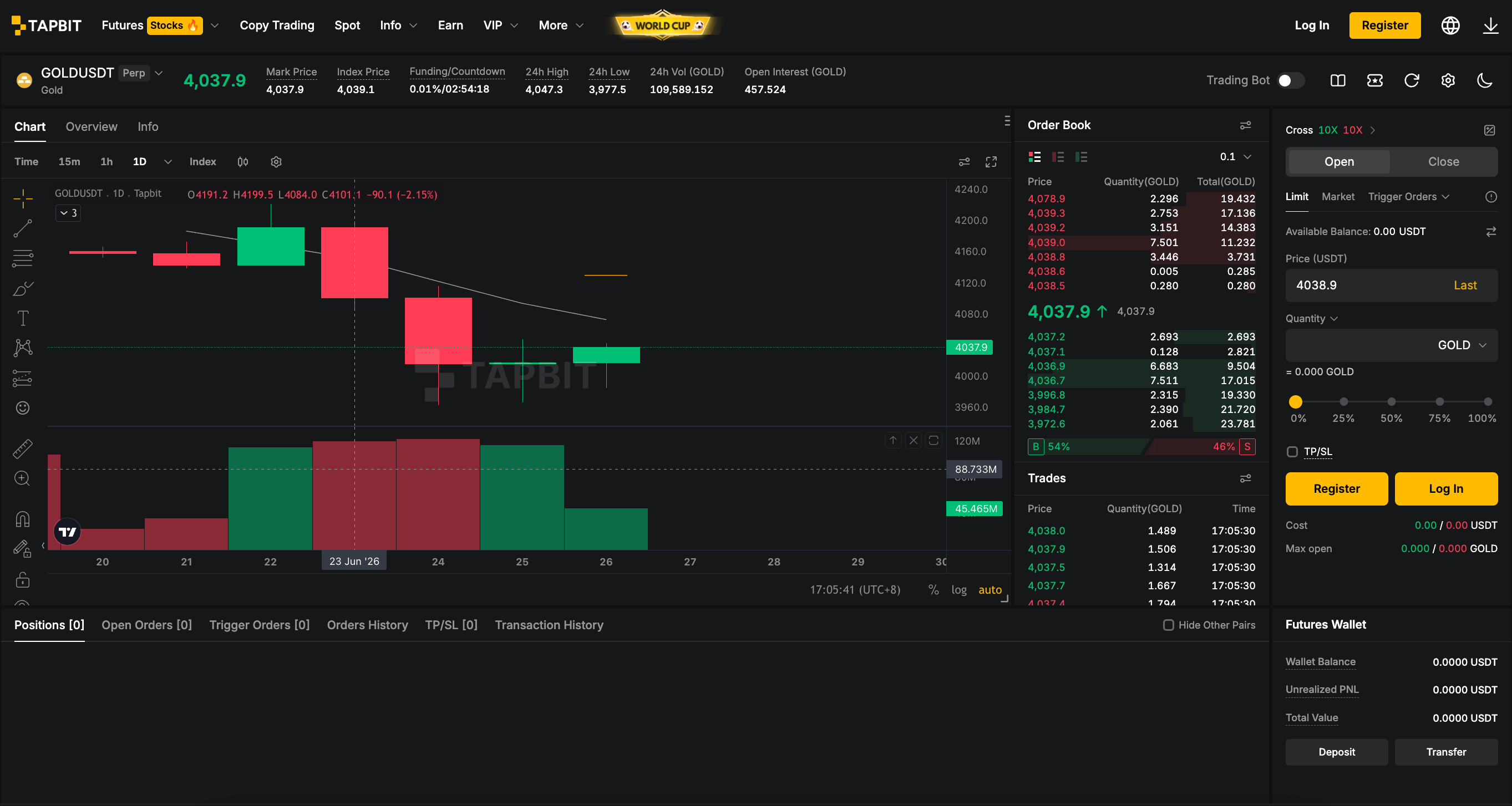
Tapbit's GOLD-USDT futures page gives users access to a gold-linked derivatives market quoted in USDT. This is not physical gold ownership and it is not a spot gold purchase. It is a futures-style product designed for traders who want to express a view on gold price movement.
GOLD-USDT Futures Steps
- Open the GOLD-USDT futures page on Tapbit.
- Check the latest price, 24H change, 24H volume, order book, and market depth.
- Choose margin mode, leverage, order type, and position direction based on your trading plan.
- Set TP/SL before opening a long or short position, and review Tapbit's fee structure.
If you are new to Tapbit, you can create an account first and explore the product interface. You can also view crypto prices to compare gold-linked movement with broader crypto conditions.
What Traders Should Watch Next
Gold traders should focus on four signals: the $4,000 zone, the U.S. dollar, bond yields, and risk appetite. If gold stabilizes while the dollar weakens, the bullish case improves. If the dollar strengthens and real yields rise, gold may struggle to regain momentum.
Crypto traders should also watch whether gold strength coincides with Bitcoin strength or Bitcoin weakness. When both gold and Bitcoin rise, markets may be pricing currency debasement or liquidity expansion. When gold rises while crypto falls, the move may be more defensive.
For RWA and commodity narratives, it is useful to separate actual futures markets from themed tokens. Tapbit Learn's what is USOR coin guide shows why commodity-themed crypto assets should not be confused with verified commodity ownership.
FAQ
What is the price of gold today?
The latest visible market snapshot showed gold near $4,011.50 per ounce, close to the important $4,000 psychological level. Prices move constantly, so traders should check live quotes before making decisions.
Why is gold down today?
Gold appears to be under pressure from profit-taking, dollar strength, rate expectations, and technical selling after a strong prior cycle. A daily move near -2.22% suggests the pullback is meaningful, not just minor noise.
Is GOLD-USDT the same as physical gold?
No. GOLD-USDT futures are derivative products linked to gold price movement and quoted in USDT. They do not represent physical gold bars, coins, or direct ownership of metal.
What level matters most for gold right now?
The most important near-term level is $4,000. Holding above it keeps the market constructive. A sustained break below $3,950 would make the short-term structure weaker.
Can gold and Bitcoin rise together?
Yes, but not always. Gold and Bitcoin can both benefit from liquidity, currency-debasement fears, or inflation hedging. However, gold often behaves more defensively, while Bitcoin tends to be more volatile and risk-sensitive.


