
What Is OIL (WTI) Coin?
OIL (WTI) coin is a blockchain-based crypto asset designed to provide exposure to West Texas Intermediate crude oil prices — the primary U.S. crude oil benchmark used in global energy markets.
Unlike most crypto assets, which derive value from network activity or protocol utility, oil-linked tokens tie their price thesis directly to a physical commodity that moves on geopolitical events, OPEC+ policy decisions, and macroeconomic supply-demand dynamics.
WTI — West Texas Intermediate — is one of two dominant global crude oil pricing benchmarks alongside Brent crude. It is lighter and lower in sulfur content than many other crude grades, making it cheaper to refine into gasoline and diesel. WTI futures are traded on the CME (Chicago Mercantile Exchange), and the benchmark's delivery point is the Cushing storage hub in Oklahoma. When financial media says "oil is trading at X dollars," they are almost always referring to the front-month WTI contract.
The "OIL (WTI)" ticker is not standardized. Different projects use similar names to signal exposure to the WTI benchmark — some legitimately, some as pure narrative branding with no actual commodity backing. That ambiguity makes it essential to understand what you are actually buying before you trade.
Why Is Oil Getting So Much Crypto Attention Right Now?
The timing of the 2026 tokenized oil surge is not accidental.
WTI crude oil has climbed above $100 per barrel in May 2026, driven by the de facto closure of the Strait of Hormuz — a waterway through which roughly 20% of the world's petroleum liquids normally pass. With the U.S.-Iran conflict keeping traditional commodity markets in a state of elevated volatility, energy prices have become one of the central macro stories of the year.
This has created a straightforward problem: traditional oil futures markets close. When WTI spiked past $115 on a weekend earlier this year, the CME was not open. Crypto-native oil markets, which trade around the clock, kept running. That real-world demonstration of 24/7 availability accelerated institutional and retail interest in blockchain-based oil exposure simultaneously.
The broader context is the RWA (real-world asset) sector, which has grown to over $25 billion in on-chain value as of 2026. Commodity tokenization — oil, gold, energy credits — is now seen as one of the most credible use cases for blockchain infrastructure, not a speculative narrative. When legacy players like Wintermute launch WTI CFD products and oil market veterans begin building tokenized crude projects on Arbitrum, it signals that the trend has moved beyond retail hype.
How Does Tokenized Oil Actually Work?
Tokenized oil projects use blockchain infrastructure to represent oil-related value as a tradable digital asset. The mechanics vary significantly depending on the project structure — and those structural differences determine how closely the token actually tracks real oil prices.
Model 1: Real Asset-Backed Oil Tokens
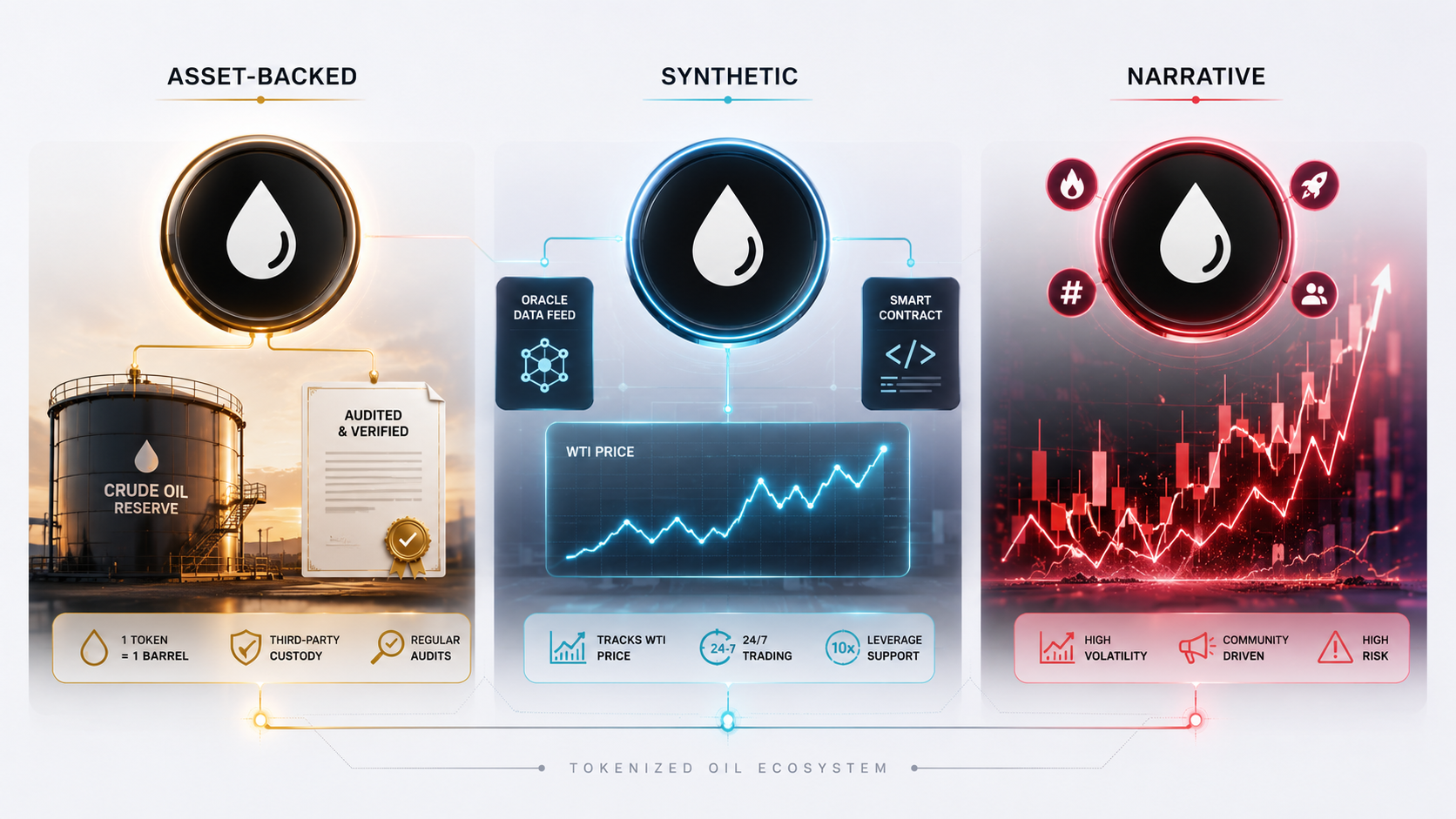
The most credible segment of the tokenized oil market involves tokens backed 1:1 by physical crude oil or verified commodity contracts.
The process typically works as follows: an energy supplier or commodity custodian confirms the existence and quality of a physical oil reserve through independent audits. Smart contracts then mint tokens against those verified reserves — one token representing one barrel or a defined energy unit of crude oil. The physical oil remains in custody while the token circulates freely on-chain.
Projects like WTIC (West Texas Intermediate Coin) operate in this category. Each token represents one barrel of WTI crude, backed by Volumetric Energy Receipts held by an independent custodian and audited monthly. Tokens are issued and redeemed at the WTI daily settled benchmark price, with no rollover risk and no management fee while held. The LITRO project, building on Arbitrum with a planned early 2027 launch, takes a similar approach — minting tokens strictly on a 1:1 basis with audited, verified physical reserves.
This model directly addresses the "paper oil" problem in traditional futures markets, where the volume of contracts traded routinely exceeds actual physical supply.
Model 2: Synthetic Oil Trackers
Synthetic oil tokens use oracle data feeds and smart contracts to track WTI or Brent price movements without any physical oil backing. The price exposure is real; the commodity ownership is not.
Some projects in this category function as oil-pegged stablecoins — indexed to WTI price instead of the U.S. dollar — giving traders a way to hold oil-denominated value within the crypto ecosystem without needing a commodity brokerage account.
Crypto exchanges including Hyperliquid have expanded this approach into perpetual futures: 24/7 WTI and Brent perpetual contracts settled in USDC, tradeable with leverage, with no expiration date or rollover requirement. Wintermute Asia also entered this space in March 2026 with OTC WTI CFDs, allowing institutional-grade execution via chat, API, or electronic platform using crypto or fiat as margin.
Model 3: Oil-Themed Narrative Tokens
The third category is the most important one to understand — and the most frequently misrepresented.
Oil-themed narrative tokens carry names and branding that reference crude oil but have no verified connection to physical commodity markets. Projects like USOR (U.S. Oil Reserve) on Solana attracted attention in early 2026, gaining nearly 200% in a single week driven by community hype. The token is Solana-native, its value derives from narrative momentum rather than reserve backing, and it operates as a high-volatility speculative asset — not a commodity instrument.
These tokens are not inherently fraudulent, but conflating them with asset-backed oil tokens is a significant analytical error. The risk profiles are entirely different.
What Is WTI Oil Used For?
Understanding the underlying commodity helps clarify why oil-linked tokens have genuine macro significance.
WTI crude oil is one of the most economically critical commodities in the world. Its primary uses include gasoline production, diesel and jet fuel, petrochemicals, plastics manufacturing, and industrial lubricants. Because so much economic activity depends on energy costs, WTI price movements ripple through inflation, transportation costs, manufacturing margins, and consumer spending globally.
WTI is the benchmark most closely tied to U.S. energy markets and CME futures trading. Brent crude is the other dominant global benchmark, primarily tracking North Sea production and influencing pricing in Europe, Africa, and the Middle East. The two benchmarks trade at a spread that reflects geopolitical conditions, supply routes, and regional supply-demand balances.
When tokenized oil projects reference "WTI," they are specifically targeting this U.S. benchmark — the world's most actively traded crude oil futures contract by volume.
What Is the Difference Between Oil and WTI Oil?
This is one of the most frequently asked questions around oil-linked crypto, and it matters for evaluating any tokenized oil project.
"Oil" is a broad term that encompasses many different crude grades produced worldwide, each varying in density, sulfur content, and refining requirements. Grades range from ultra-light condensates to heavy, high-sulfur varieties that require significantly more processing before becoming usable products.
WTI is a specific grade: light (low density), sweet (low sulfur, around 0.24%), and sourced primarily from the Permian Basin and other U.S. shale regions. These characteristics make it easier and cheaper to refine into high-value products like gasoline, which is why it commands a premium over heavier grades.
Brent crude, the other major benchmark, is also light and sweet but sourced from North Sea fields. The WTI-Brent spread typically reflects the difference in U.S. versus global supply conditions. In 2026, with the Strait of Hormuz disruptions affecting global supply more directly than U.S. domestic production, Brent has at times traded at a significant premium to WTI.
Tokenized oil projects that reference WTI specifically are targeting the U.S. energy market benchmark — a meaningful distinction from broader "oil exposure" claims.
Not Every Oil Coin Is Backed by Real Oil
This is the most important sentence in this entire article.
The oil-themed crypto space in 2026 is genuinely heterogeneous. At one end, you have projects with audited reserves, independent custodians, and transparent redemption mechanisms. At the other end, you have speculative meme tokens wearing oil branding to attract energy-narrative traders with no commodity backing whatsoever.
The difference is not always obvious from the name or the ticker. Before engaging with any OIL (WTI) token, the key due diligence questions are:
Reserve verification: Is there an independent auditor confirming physical oil backing? Monthly audits? Published proof?
Custody structure: Who holds the physical commodity? Is it a regulated custodian? Can you verify the custody arrangement?
Redemption mechanism: Can tokens actually be redeemed for oil or for cash at the benchmark price? On what timeline, and through what process?
Smart contract security: Has the contract been audited? Is it upgradeable, which creates governance risk?
Projects that cannot clearly answer these questions with verifiable documentation should be treated as speculative narrative tokens rather than commodity instruments — regardless of what their marketing materials claim.
OIL (WTI) Coin vs Oil ETFs vs Oil Futures
Tokenized oil is often compared to two existing retail products for oil exposure: oil ETFs and oil futures contracts. The comparison is useful for understanding both the advantages and the structural limitations of each approach.
Oil ETFs — like the widely traded USO — provide equity-market-hours exposure to WTI through a basket of futures contracts. The main structural problem is rollover cost: as each monthly futures contract approaches expiration, the ETF must sell the expiring contract and buy the next month's contract. When oil markets are in contango (future prices higher than spot), this creates a persistent drag that causes the ETF to underperform the spot price over time. Oil ETFs also only trade during market hours.
Oil futures contracts offer the most direct commodity price exposure, with physical delivery available at contract expiration. But they require a commodity brokerage account, carry margin requirements, have defined expiration dates, and demand active position management from experienced traders. Rollover must be managed manually or through a broker.
Tokenized oil sits between these two options in terms of complexity, with several structural differences worth understanding:
|
Feature |
OIL (WTI) Token |
Oil ETF |
Oil Futures |
|
Trading hours |
24/7 |
Market hours only |
Market hours only |
|
Rollover cost |
None (if asset-backed) |
Yes — persistent drag |
Yes — manual management |
|
Commodity backing |
Varies by project |
Indirect via futures |
Direct at expiration |
|
Settlement |
Blockchain / USDC |
Brokerage account |
CME / physical delivery |
|
Entry barrier |
Low |
Medium |
Higher |
|
Regulatory clarity |
Developing |
Established |
Established |
The 24/7 availability advantage is not theoretical. When oil markets moved sharply during the March 2026 Iran conflict escalation over a weekend, traders with exposure through crypto-native instruments could react immediately. Those holding oil ETFs had to wait for market open.
Why Tokenized Oil Is Becoming a Major RWA Trend
The tokenized oil narrative in 2026 is part of a much larger structural shift in how traditional assets are brought on-chain.
The real-world asset (RWA) sector now encompasses government bonds, real estate, carbon credits, gold, private credit, and increasingly, energy commodities. The core thesis is consistent across asset types: blockchain infrastructure can make traditionally illiquid, operationally complex assets more accessible, more transparent, and more efficiently tradable.
For oil specifically, the case is compelling. The global crude oil market is valued at approximately $6 trillion. It is dominated by large institutional players, settlement is slow (T+2 or T+3 in most cases), and retail access requires brokerage infrastructure that most global investors do not have. Tokenization addresses all three friction points: it enables fractional ownership, settles on-chain in near-real-time, and is accessible to anyone with a crypto wallet.
The institutional validation is building. Wintermute entered the space with OTC WTI CFDs in March 2026. The LITRO project has secured energy industry veterans to build a 1:1 physically-backed crude token on Arbitrum. The OIL1 stablecoin launched at Davos as a settlement instrument for the $2.4 trillion global oil market. These are not retail meme coin projects — they reflect serious infrastructure development in the energy-blockchain intersection.
Analysts at Deloitte project that tokenized commodities could represent 10% of global trade value by 2030. Whether that projection is accurate or optimistic, the direction of travel is clear. Energy commodities are moving on-chain, and the infrastructure is developing faster than most traditional finance participants anticipated.
How to Trade Oil Markets and Monitor Commodity Narratives on Tapbit
As macro-driven commodity trading becomes increasingly relevant in crypto, oil-linked assets and energy narratives are attracting a growing segment of traders who want 24/7 access to price movements that traditional markets cannot provide.
For traders watching the oil narrative, understanding where prices are moving in real time is the starting point. You can check crypto prices and track market data across commodity-linked assets and macro-sensitive tokens on Tapbit before forming a view.
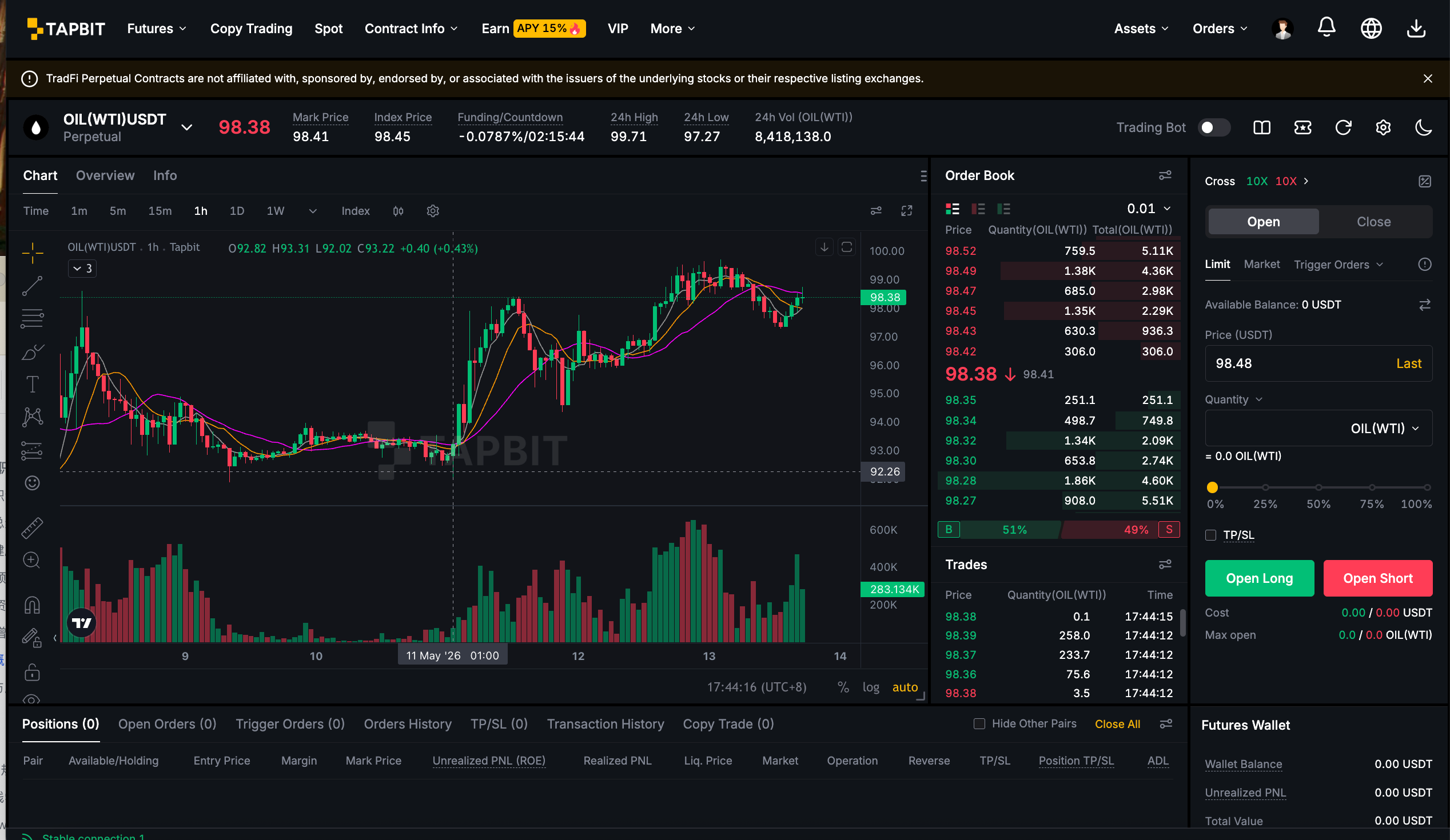
Tapbit offers OIL(WTI) perpetual futures trading directly — giving traders 24/7 exposure to WTI crude oil price movements without a commodity brokerage account, rollover complexity, or contract expiration to manage. Here is how to get started:
Step 1 — Create and fund your account Create a Tapbit account and deposit USDT into your futures wallet. Review the trading fee structure before your first trade so you understand the cost of each position.
Step 2 — Open the OIL(WTI)-USDT perpetual contract Navigate to the Futures section and select the OIL(WTI)-USDT perpetual pair. The interface displays the mark price, index price, funding rate, and 24-hour volume in real time.
Step 3 — Set your leverage Tapbit's OIL(WTI) perpetual supports up to 10X leverage. For traders new to commodity futures, starting at 1X–3X gives meaningful oil price exposure while limiting liquidation risk during sharp geopolitical-driven moves. Oil is one of the most volatile macro assets of 2026 — leverage amplifies both gains and losses quickly.
Step 4 — Choose your direction and order type Select Buy/Long if you expect WTI to rise, or Sell/Short if you expect a pullback. Use a Limit order to control your entry price, or a Market order for immediate execution. Enter your position size in OIL(WTI) units.
Step 5 — Set Stop Loss and Take Profit Always configure a Stop Loss before confirming your order. Oil markets in 2026 are subject to sudden geopolitical gaps — WTI moved more than $15 in a single weekend session earlier this year. A pre-set Stop Loss prevents a single event from liquidating your position without warning.
Step 6 — Monitor and manage Track your open position, unrealized PnL, and funding rate in the Positions panel at the bottom of the trading interface. Close your position manually using the Flatten button, or let your Take Profit trigger automatically.
For more experienced traders who want broader commodity and macro exposure, USDT futures trading on Tapbit provides access across multiple asset classes beyond oil.
One practical note: macro-driven commodity trades carry significant gap risk during geopolitical events. Position sizing and stop-loss discipline matter more in oil-adjacent markets than in most other crypto categories.
Final Thoughts
The OIL (WTI) coin narrative in 2026 is real, and the underlying macro driver — a volatile WTI price above $100 per barrel, 24/7 demand for commodity exposure, and growing institutional interest in tokenized RWAs — provides genuine fundamental context for the trend.
But the most important thing any trader or investor can do before touching an oil-linked crypto asset is figure out exactly what kind of product they are looking at.
Is it a 1:1 physically-backed token with audited reserves and a transparent custodian? A synthetic perpetual contract tracking WTI prices? A narrative-driven community token with oil branding and no commodity backing?
These are not minor distinctions. They represent entirely different risk profiles, entirely different return drivers, and entirely different questions to ask before entering a position.
The tokenized oil space is maturing fast. Projects with genuine commodity infrastructure, transparent reserve verification, and real settlement mechanisms are beginning to separate themselves from the noise. As the RWA sector continues to expand, the clearest opportunity lies in understanding which oil tokens represent real commodity access — and which ones simply borrowed the narrative.
That distinction is more valuable than any price target.
FAQ
What is OIL (WTI) coin?
OIL (WTI) coin refers to crypto assets designed to track or represent exposure to West Texas Intermediate crude oil markets. The category includes physically-backed tokens, synthetic price trackers, and oil-themed narrative tokens — each with different structures, risk profiles, and relationships to actual commodity prices.
What is WTI oil used for?
WTI crude oil is used primarily for gasoline, diesel, jet fuel, and petrochemicals. It is also one of the world's two main crude oil pricing benchmarks — the other being Brent — and is the reference price for CME crude oil futures contracts.
What crypto coin is backed by oil?
Several projects claim oil backing, but not all are equal. Projects like WTIC use independent custodians and monthly audits to back tokens 1:1 with physical WTI crude. Others, including many oil-themed tokens on Solana, are narrative-driven assets with no verified commodity backing. Due diligence on reserve transparency and custody structure is essential.
What is the difference between oil and WTI oil?
"Oil" broadly describes crude petroleum across all grades and regions. WTI specifically refers to West Texas Intermediate — a light, sweet (low-sulfur) crude grade sourced primarily from U.S. shale regions and used as the primary North American pricing benchmark. Most tokenized oil projects that reference WTI are tracking this specific grade and its CME futures price.
Can normal people buy oil futures?
Yes, but it requires a commodity brokerage account and comes with complexity around margin requirements, contract expiration dates, and rollover management. Tokenized oil and crypto-native oil perpetuals offer lower barriers to entry, fractional position sizing, and 24/7 market access — at the cost of less regulatory clarity and, in some cases, no actual commodity backing.
Why are tokenized oil markets becoming popular?
Three factors are converging in 2026: WTI oil prices above $100 driven by Middle East supply disruptions, growing institutional interest in real-world asset tokenization, and demonstrated demand for 24/7 commodity trading that traditional futures exchanges cannot provide. The ability to trade oil exposure through a crypto wallet while CME is closed has moved from a theoretical benefit to a demonstrated one.


