
What Is Oil Coin? The Short Answer Is: It Depends
What is oil coin? The first answer is that oil coin is not one single crypto asset. It is an umbrella search term for many oil-related tokens and tokenization ideas.
Depending on the context, oil coin may mean:
- A project named OilCoin or OILCOIN
- A token using the ticker OIL
- USOR or another oil-reserve narrative token
- A tokenized oil RWA project
- An oil-themed meme token
- A broader commodity crypto concept
This makes the keyword tricky. Two unrelated tokens can use similar names. One token might be purely narrative-driven. Another might claim RWA backing. A third might be an older project with unclear current activity.
Before you research further, identify four things: exact name, ticker, blockchain, and contract address.
The Main Types of Oil Crypto Tokens
Oil-related crypto tokens usually fall into a few broad categories.
| Type | What It Claims | What to Verify |
|---|---|---|
| Oil-themed meme token | Uses oil branding or energy jokes | Community, liquidity, contract address |
| Oil-reserve narrative token | Claims oil reserve exposure or story | Whether backing is independently verified |
| OilCoin-style concept token | Links blockchain to oil value | Project status, legal structure, audits |
| Tokenized oil RWA | Represents a real oil-linked asset | Custody, legal claim, audits, compliance |
The name alone does not tell you which category a token belongs to. This is why "oil coin" research must start with disambiguation.
What Is OilCoin (OILCOIN)?
OilCoin, often written as OILCOIN, is an earlier project that proposed connecting digital tokens with the economic value of physical oil reserves. It is part of the broader history of real-world asset tokenization in the energy sector.
That does not mean every token called OIL, OilCoin, or oil coin is the same project.
OilCoin should not be confused with USOR, OLIO, OIL tokens on different chains, or newer oil-reserve narrative tokens. These may have different teams, contracts, blockchains, and levels of verification.
Because project activity can change, readers should verify OilCoin's current status before making any assumptions. This article treats OilCoin as a historical and conceptual example, not as a recommendation.
OIL Tokens, USOR, and Oil-Themed Narrative Coins
The ticker OIL has been used by multiple unrelated crypto projects. That means seeing "OIL" on a price tracker does not automatically tell you what the token is.
USOR is one example of an oil-reserve narrative token. It became visible in early 2026 by using a U.S. oil reserve theme. Public information does not independently verify U.S. government backing or physical oil reserve collateral behind USOR.
Other oil-themed tokens may follow similar patterns:
- Strong energy or oil branding
- Fast social media attention
- Solana or other low-cost chain deployment
- Limited verified asset backing
- High volatility
These tokens can still trade actively. But active trading does not equal real oil backing.
What Would a Real Oil-Backed Token Look Like?
A real oil-backed token would need more than an oil-themed name.
It would normally require:
① Physical Custody
A verified custodian would need to hold the physical oil or oil-linked asset.
② Legal Claim
Token holders would need a documented legal right, redemption rule, or financial claim linked to the asset.
③ Independent Audit
A third party would need to confirm that the reserves exist and match the token supply.
④ Pricing Oracle
The token would need a transparent pricing mechanism tied to recognized benchmarks such as WTI or Brent crude.
⑤ Regulatory Compliance
Commodity-linked tokens may require licensing, disclosure, or jurisdiction-specific compliance.
Without these pieces, a token may be oil-themed, but it should not be treated as verified tokenized oil.
Why Do So Many Oil Coins Use Similar Names?
Crypto markets often copy successful narratives. When one oil-themed token gains attention, similar names can appear quickly.
This can confuse users because small differences matter:
| Similar Detail | Why It Matters |
|---|---|
| Ticker | OIL, OILCOIN, USOR may be unrelated |
| Chain | A token on Solana is not the same as one on Ethereum |
| Contract | Same name can have different contracts |
| Backing claim | Marketing language may not be proof |
| Liquidity | Some tokens trade actively; others may be thin |
Always verify the exact contract address. Never rely on a token name alone.
How to Research Any Oil Coin Before Interacting With It
Use this checklist before engaging with any oil-related crypto token.
Step 1: Identify the Asset
Find the exact name, ticker, chain, and contract address from a primary source.
Step 2: Verify the Contract
Use the correct blockchain explorer. For Solana tokens, use a Solana explorer. For Ethereum tokens, use an Ethereum explorer.
Step 3: Check Backing Claims
Look for audits, legal disclosures, proof of reserves, custody agreements, or redemption terms.
Step 4: Review On-Chain Data
Check holder concentration, liquidity, trading volume, and contract activity.
Step 5: Compare Neutral Sources
Do not rely only on project marketing or social media posts.
For general crypto context, you can
view market data on Tapbit. If you are new to crypto tools, you can create an account, review trading fees, or contact 24/7 support.
This does not mean any specific oil coin is available on Tapbit. Always confirm asset availability directly on the relevant platform.
How to Track WTI Oil Futures on Tapbit
Some readers searching for oil coin may actually want oil-market exposure rather than an oil-themed crypto token. Tapbit's OIL(WTI)USDT product is a TradFi oil market-linked futures product, not OilCoin, USOR, an OIL token, or a tokenized oil RWA.
Here is a 4-step workflow:
- Open Tapbit Futures and select TradFi
- Choose
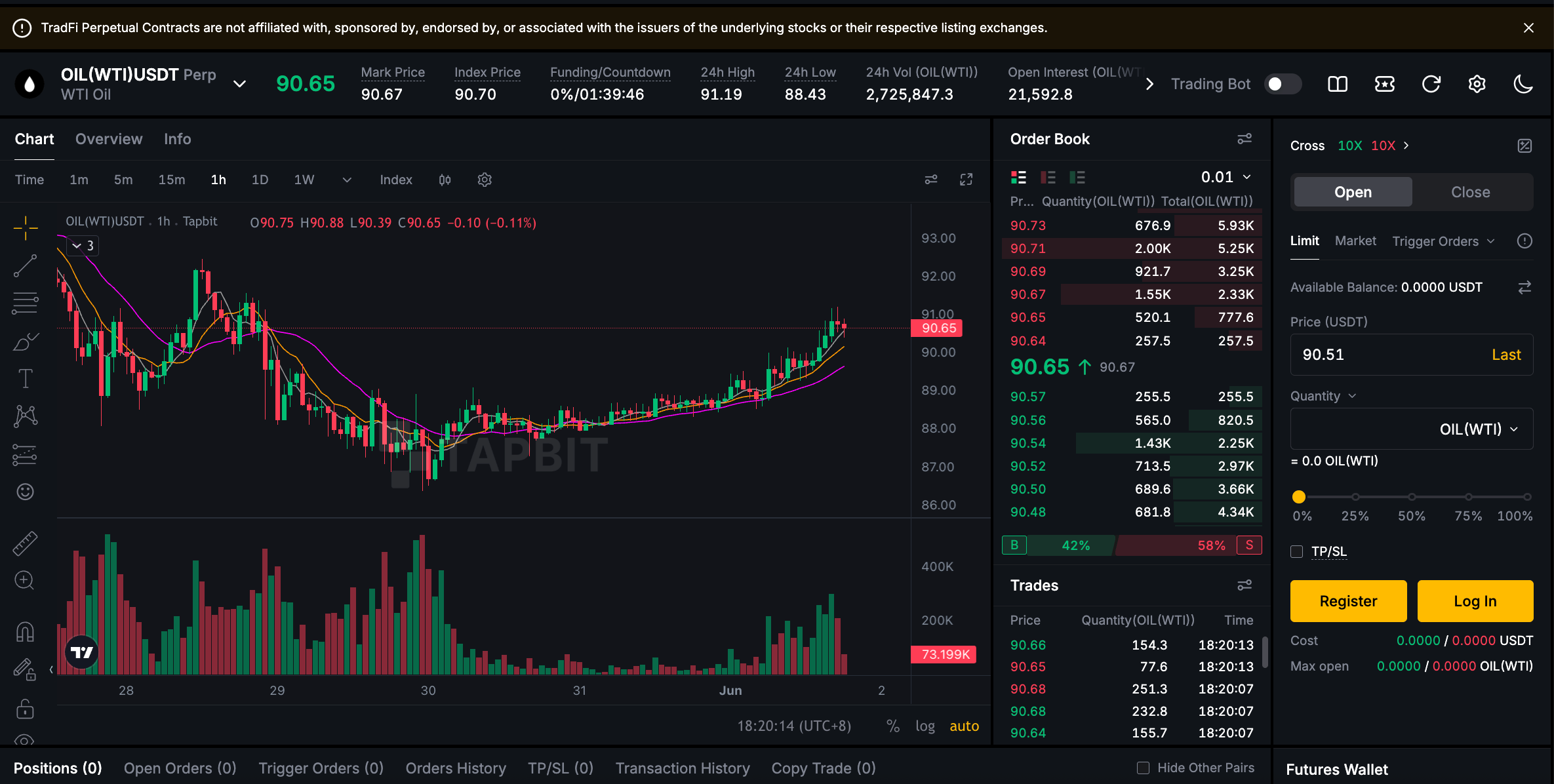
- trade WTI Oil futures through OIL(WTI)USDT.
- Check last price, 24H change, 24H volume, and the order book.
- Set margin, leverage, order type, and TP/SL before opening a position.
⚠️ WTI Oil futures are derivatives linked to oil-market price action. They are not proof that any oil coin is backed by physical oil.
Closing
What is oil coin in simple terms? It is a broad phrase, not one guaranteed asset. Oil coin can refer to OilCoin, OIL tokens, USOR-style oil narratives, tokenized oil RWAs, or oil-themed meme tokens. The gap between "uses the word oil" and "is backed by oil" is large. Define the token first. Verify the contract. Check the backing. Then decide what you are actually looking at.
FAQ
Is there a crypto coin actually backed by crude oil?
Tokenized oil is a real RWA concept, but verified oil-backed crypto tokens require custody, legal claims, independent audits, and compliance. Many oil-themed tokens do not meet that standard.
Is OilCoin the same as USOR?
No. OilCoin and USOR are separate concepts or projects. Always verify the exact token name, ticker, chain, and contract address.
Can an oil coin track crude oil prices like WTI or Brent?
Only if it has a verified pricing mechanism and legal structure tied to oil benchmarks. Most oil-themed tokens do not reliably track crude oil prices.
Why are there so many coins with oil in the name?
Oil is a powerful narrative tied to energy, geopolitics, and RWA tokenization. Similar names can attract attention, but they also create confusion.
What is the difference between oil coin and tokenized oil?
Oil coin is a broad phrase. Tokenized oil, in the proper RWA sense, should represent a verified legal claim to oil or oil-linked assets.
What should I check before buying any oil-themed crypto token?
Check the contract address, blockchain, liquidity, holder distribution, audits, legal disclosures, and whether any oil-backing claim is independently verified.


