
A few months ago, the QCOM debate was easier. Qualcomm was still mostly judged like a handset chip stock. Investors watched Android demand, Apple modem headlines, China smartphone trends, and margins. If those looked good, the stock had support. If they looked weak, QCOM struggled.
That old story has not disappeared. But it is no longer the whole story.
Qualcomm is now trying to convince Wall Street that it should not be valued only as a smartphone supplier. The company wants investors to see a wider platform: AI inference, data center CPUs, automotive chips, IoT, edge computing, and software.
That changes the July question. It is no longer simply, “QCOM has rallied, should I sell?” A better question is: Has Qualcomm done enough to earn a new valuation, or is the market getting ahead of the numbers? That is where the trade gets interesting.
QCOM Is Not Cheap, But It Is No Longer Just a Handset Bet
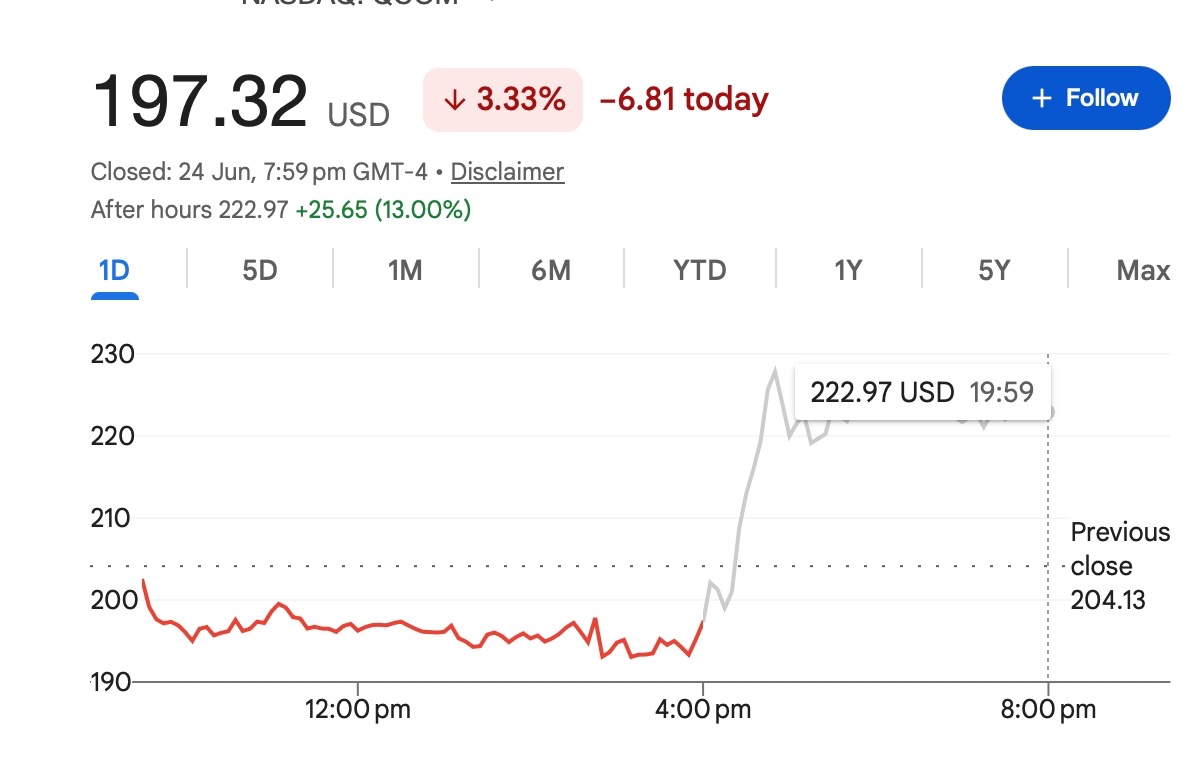
QCOM recently traded around $197, below the earlier June level near $220. That pullback matters. It takes some heat out of the stock, but it does not make the risk disappear.
At roughly 21 times earnings, Qualcomm is not priced like a broken cyclical stock. Investors are already giving it some credit for AI, automotive, and non-handset growth.
The question is whether it deserves more.
That depends on whether Qualcomm can actually shift the business mix over the next few years. If smartphones remain the main driver and Apple modem risk keeps hanging over the stock, the multiple probably stays capped. If data center, automotive, IoT, and AI inference start becoming real revenue engines, QCOM could look very different.
That is why July is not a clean sell signal. It is more like a checkpoint.
The Investor Day Changed the Conversation
Qualcomm’s latest Investor Day gave bulls something new to work with. The company raised its FY2029 non-handset revenue target to $40 billion. That includes more than $15 billion from data center, $10 billion from automotive, and more than $14 billion from IoT.
Those are big numbers. They also tell you what Qualcomm is trying to do. Management wants the market to stop treating QCOM as a company trapped inside the smartphone cycle.
That is a meaningful shift. The old concern was that Qualcomm would lose some Apple modem revenue and struggle to replace it. The new argument is that non-handset businesses can eventually become large enough to change the whole earnings profile.
That is the bull case. But it is still a future case. The market can get excited about 2029 targets in July. It will still want proof in earnings, orders, margins, and customer adoption.
Meta Gives the Data Center Story More Credibility

One reason investors are taking Qualcomm’s AI push more seriously is Meta. Qualcomm announced a multi-generation data center CPU agreement with Meta, built around its Dragonfly C1000 CPU. Production is expected in the second half of 2028.
That is not near-term revenue. But it is not a small headline either. Meta is not a random customer. A hyperscaler relationship gives Qualcomm’s data center ambitions more credibility. It makes the story harder to dismiss as just another chip company chasing AI buzzwords.
Still, traders should keep the timing in mind. A 2028 production window does not fix 2026 earnings. It does not remove handset risk next quarter. It does not guarantee that Qualcomm will win large data center share.
It does show that the door is open. Now Qualcomm has to walk through it.
The Modular Deal Matters Because AI Is Not Only Hardware
Qualcomm also agreed to buy Modular, an AI software company. That may sound less exciting than a big chip deal, but it matters.
AI hardware is not enough on its own. Developers need software, tools, frameworks, and a reason to build on the platform. Nvidia’s advantage has never been only its chips. Its software ecosystem is a huge part of the moat.
Qualcomm appears to understand that. If the company wants to compete in AI inference from devices to data centers, it needs more than efficient silicon. It needs a software layer that makes developers and customers comfortable using its hardware.
Modular helps fill that gap. Again, this is not an overnight fix. But it makes the AI platform story more complete.
The Apple Risk Is Still There
The bullish headlines are real. So is the biggest overhang.
Apple still wants more control over its modem roadmap. If Apple reduces its reliance on Qualcomm over time, investors will keep asking how much revenue is at risk and how quickly Qualcomm can replace it.
That is why QCOM cannot be valued only on AI optimism.
The market has to balance two things at once. On one side, Qualcomm is building new growth stories in AI, automotive, IoT, and data center. On the other side, one of its most important historical customers is working to bring more modem technology in-house.
That tension is not going away in July.
It may become less important if Qualcomm’s non-handset businesses keep scaling. But until the numbers prove it, Apple risk will remain part of the stock.
So, Should You Sell in July?
The honest answer is: it depends on why you own QCOM.
If you bought much lower and QCOM has become too large in your portfolio, trimming makes sense. Taking some profit after a strong move is not the same as turning bearish. It is just risk management.
If you own QCOM because of handset recovery, July is a good time to be more cautious. That story is not dead, but it is not the most exciting part of Qualcomm anymore.
If you own QCOM because you believe in the AI and automotive transition, selling everything now may be too early. The company has finally put a larger non-handset story in front of investors, and the market may need time to reprice it.
That is why a partial approach fits better than an all-or-nothing decision.
QCOM feels more like a hold or trim than a straight sell.
What Tapbit Users Should Keep in Mind
For Tapbit users, QCOM is interesting because it sits between several major themes: AI chips, edge computing, data centers, smartphones, automotive semiconductors, and stock-linked trading products.
But any QCOM-linked product needs to be understood clearly. A perpetual contract, CFD, tokenized product, or synthetic stock-linked instrument may provide exposure to QCOM’s price. That is not the same as owning Qualcomm stock through a broker.
Price exposure is not ownership. It may not include shareholder rights, dividends, voting rights, or the same protections as direct stock ownership. If leverage is involved, normal stock volatility can become much more dangerous.
Users can visit Tapbit to follow supported markets and review available trading opportunities. Existing users can log in, while new users can register here.
Frequently Asked Questions (FAQ)
Should I sell QCOM in July?
Not automatically. QCOM looks more like a hold or trim than a straight sell. If your position has become too large or your cost basis is low, trimming some exposure can make sense. If you believe in Qualcomm’s AI, automotive, IoT, and data center transition, selling everything may be too early.
Why is the QCOM sell-or-hold decision more complicated now?
Because Qualcomm is no longer being judged only as a smartphone chip company. The market is now also watching its AI inference chips, data center CPU plans, automotive business, IoT growth, and software strategy.
What changed after Qualcomm’s Investor Day?
Qualcomm raised its long-term non-handset revenue target and gave investors a bigger AI and data center story. The company is trying to show that future growth can come from more than smartphones.


