

Why is Bitcoin dropping June 2026? The short answer is that several market pressures arrived together. Bitcoin moved from the $70,000 area toward roughly $61,800 during June as traders reacted to ETF-flow weakness, cautious Fed signals, tighter liquidity, and futures liquidations. For readers asking why is Bitcoin dropping, the better answer is not one headline. It is a chain reaction.
A late-June market snapshot showed BTC near $61,778.86, down 1.26% over 24 hours, with 24H volume around $44.85 billion. That places Bitcoin much closer to the psychological $60,000 line than to the earlier $65,000-$67,000 support area.
This June decline follows an earlier BTC selloff pattern that Tapbit Learn covered in why Bitcoin was dropping. The difference now is that institutional ETF flows and short-term technical levels have become even more important to market confidence.
Why Is Bitcoin Dropping in June 2026?
Bitcoin is falling because the market is repricing risk. In June 2026, BTC is now trading around a more sensitive zone: buyers are trying to stabilize the $60,000-$62,000 area, while sellers are watching whether Bitcoin can reclaim $65,000-$67,000 and then $70,000-$72,000.
That range matters because it sits between two emotional signals:
- Below $60,000, traders may fear a deeper flush toward the $56,000-$58,000 area.
- Above $65,000-$67,000, traders may start treating the selloff as a failed breakdown attempt.
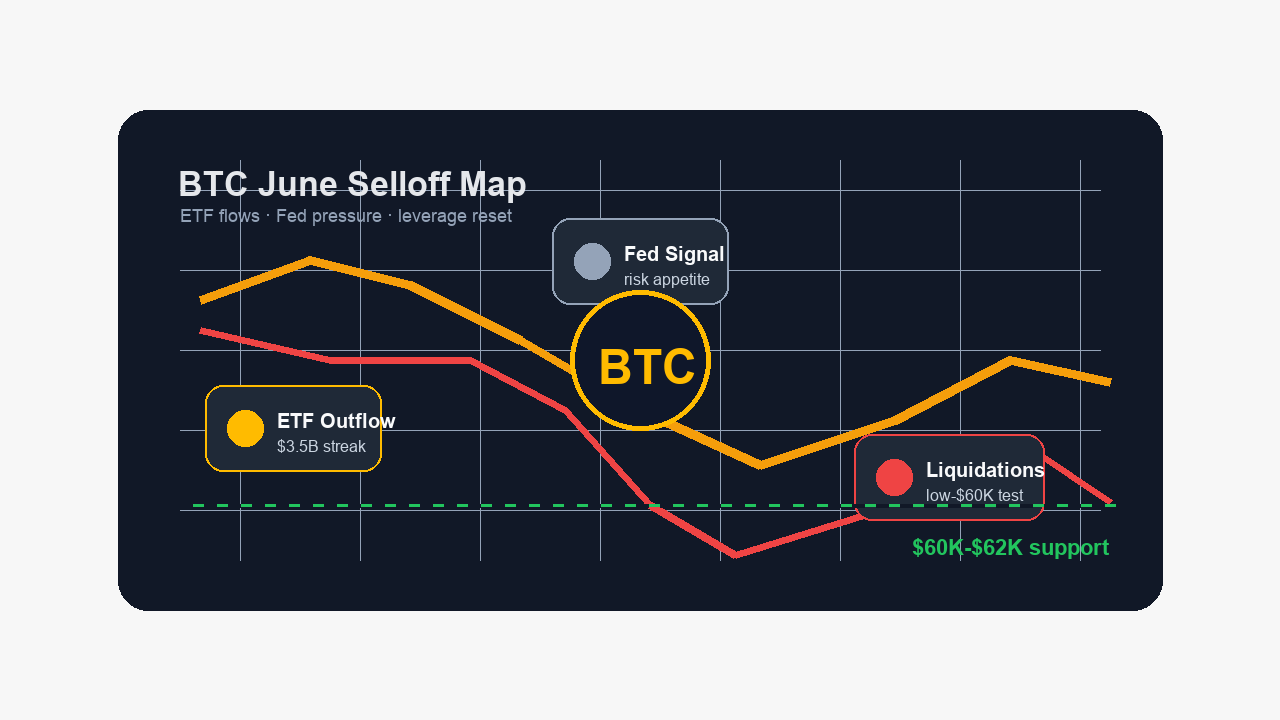
The most important point: Bitcoin is not dropping because of only one factor. ETF outflows weakened spot demand, Fed uncertainty reduced risk appetite, and leveraged positions amplified the move once key levels broke.
ETF Outflows Put Pressure on BTC Demand
Spot Bitcoin ETFs have become a major demand channel for BTC. When ETF inflows are strong, they can support sentiment because traders see institutional money entering the market. When outflows dominate, the opposite happens.
Earlier in June 2026, Tapbit Learn noted that Bitcoin ETF outflows reached roughly $3.5 billion across an 11-session streak, while BTC was sliding from the $65,000-$70,000 zone toward the low-$60,000s. That kind of outflow streak can pressure Bitcoin in two ways:
- Mechanically: redemptions may reduce spot demand or create BTC selling pressure.
- Psychologically: traders may assume institutional conviction is cooling.
ETF outflows do not always mean long-term investors are abandoning Bitcoin. Some flows reflect profit-taking, portfolio rebalancing, or hedge adjustments. But in a weak market, red ETF headlines can accelerate selling.
Fed Pressure and Risk-Off Sentiment Hit Crypto
Bitcoin also reacted to macro pressure. When traders expect interest rates to stay higher for longer, risk assets often struggle. A stronger dollar, higher yields, or cautious Fed language can make investors reduce exposure to volatile assets such as crypto.
This is why Bitcoin often moves with broader liquidity conditions. BTC may be a long-term digital asset, but short-term traders still treat it like a high-beta market when macro uncertainty rises.
Two macro signals are especially important now:
- Fed communication: less dovish language can reduce appetite for speculative assets.
- Dollar and yield strength: when cash and bonds look more attractive, crypto risk appetite can cool.
This does not erase Bitcoin's long-term narrative. It simply means the June selloff is happening in a market that is less forgiving of leverage and weaker inflows.
Leverage and Liquidations Made the Drop Faster
The futures market can turn a normal pullback into a sharper decline. When many traders are long BTC with leverage, a quick price drop can trigger forced position closures. Those closures add more selling pressure, which may trigger more liquidations.
This is why BTC can fall faster than the news alone seems to justify. A weak ETF-flow headline or macro event may start the move, but futures positioning can extend it.
Traders are watching:
- Funding rates: overheated funding can show crowded long positioning.
- Open interest: rising open interest during weakness can signal unstable leverage.
- Order book depth: thin liquidity can make price moves more violent.
- Support reactions: the $60,000-$62,000 range is the key zone to defend now, while $65,000-$67,000 becomes the first rebound test.
For broader market structure, Tapbit Learn's guide to Bitcoin dominance can help explain why BTC weakness often affects altcoin sentiment too.
What Traders Are Watching Next
The next move depends on whether BTC stabilizes or loses the June support range.
| Signal to Watch | Bullish Read | Bearish Read |
|---|---|---|
| BTC price | Reclaims $65,000-$67,000 | Loses $60,000-$62,000 |
| ETF flows | Outflows slow or reverse | Redemptions continue |
| Futures market | Funding normalizes | Liquidations continue |
| Macro tone | Fed language softens | Dollar and yields stay firm |
If Bitcoin holds the low-$60,000s while ETF outflows slow, the market may treat June as a reset. If $60,000 fails with heavy volume, traders may watch the $56,000-$58,000 area as the next reaction zone.
The institutional context matters too. Tapbit Learn's coverage of Harvard Bitcoin ETF holdings shows how large investors often adjust exposure gradually rather than all at once.
How to Trade BTC Volatility on Tapbit
Active traders can monitor BTC through Tapbit, but the product choice matters. BTC futures are more flexible for volatility trading, while BTC spot is simpler for direct BTC/USDT exposure. You can create an account and view crypto prices before deciding which market fits your plan.
BTC Futures Steps
Use BTC futures if you understand leverage and want to trade both long and short views.
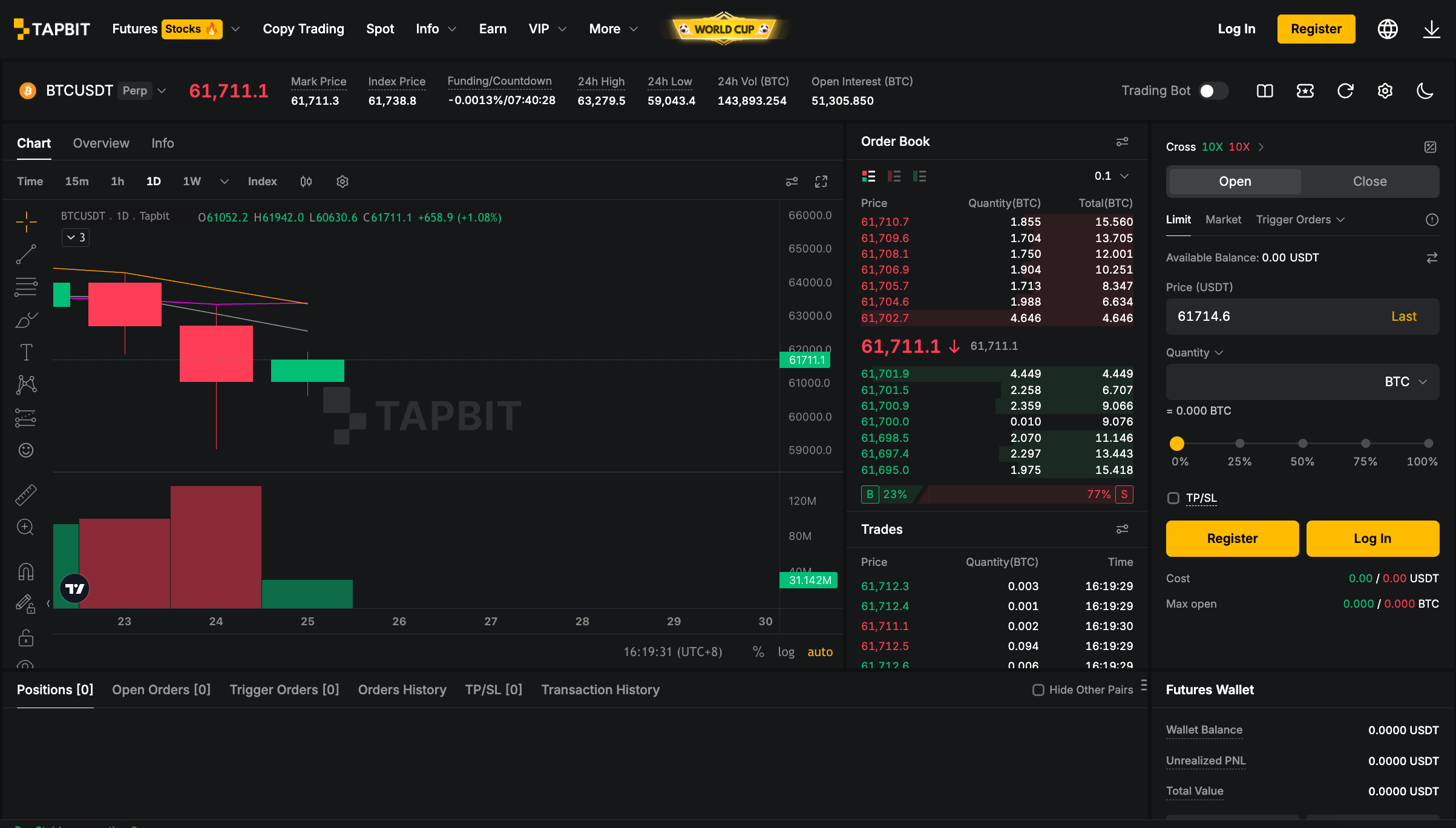
- Open the BTCUSDT futures market and check price, funding, order book depth, and 24H volume.
- Choose isolated or cross margin, then set conservative leverage.
- Select order type and direction based on your support/resistance plan.
- Set TP/SL before opening a long or short position.
BTC Spot Steps
Use BTC spot if you want direct BTC/USDT exposure without futures leverage.
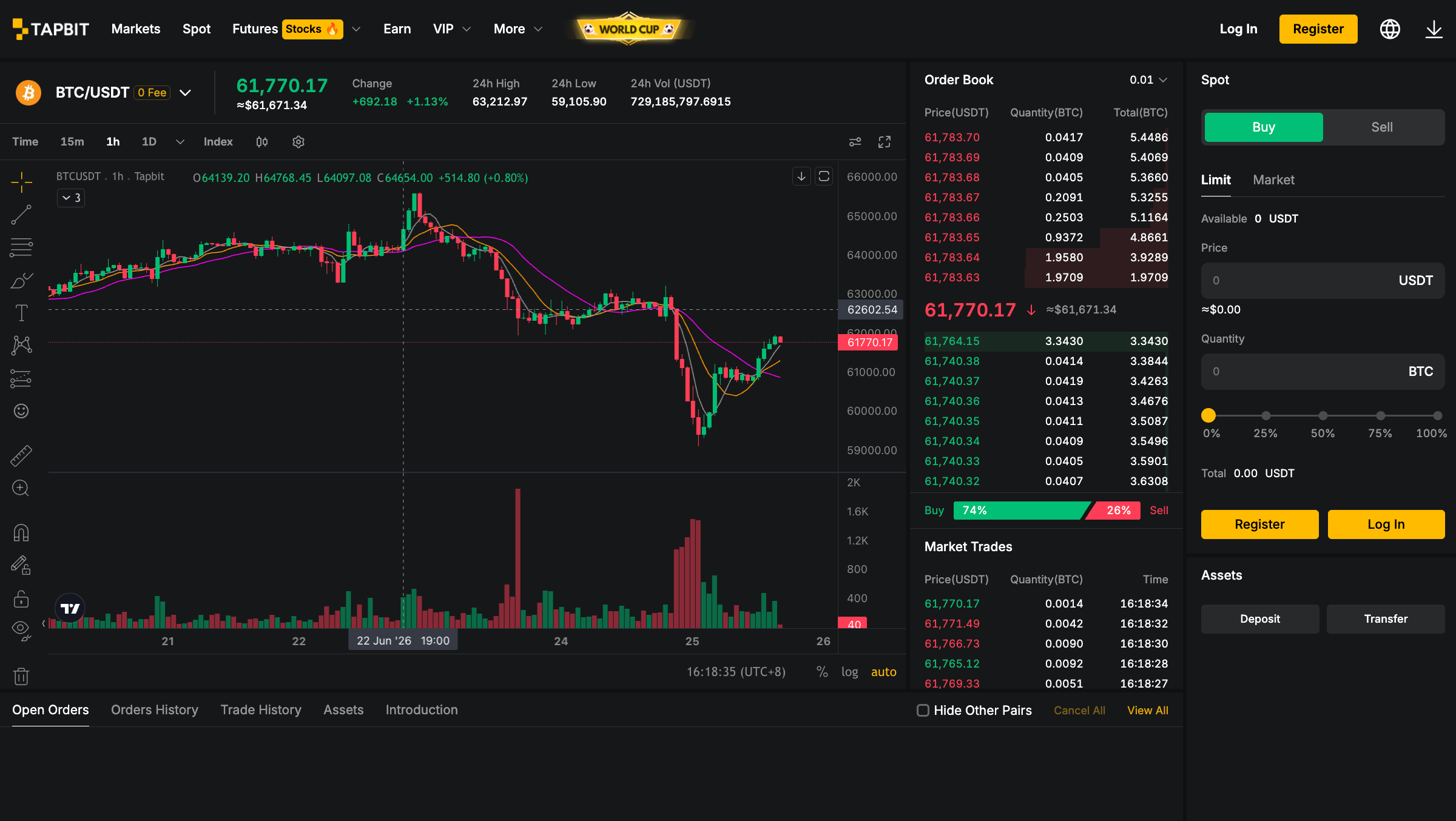
- Open the BTC/USDT spot market and review current price, spread, and volume.
- Choose market or limit order depending on execution needs.
- Enter the BTC or USDT amount and confirm the order details.
- Track the position and avoid making decisions from one short-term candle.
What This Means for July
The June selloff sets up a clear July question: can BTC rebuild demand above support, or will sellers force another liquidity sweep?
If ETF outflows slow and macro conditions calm, Bitcoin may first attempt to reclaim $65,000-$67,000, then $70,000-$72,000. If outflows persist and leveraged selling continues, the market may test $56,000-$58,000 before stronger buyers return.
For now, why is Bitcoin dropping June 2026 comes down to flow, macro, and leverage. Bitcoin is dropping because institutional demand cooled, macro confidence weakened, and futures positioning amplified the move. The next confirmation will come from price behavior around support, ETF-flow data, and whether BTC can recover above resistance.
FAQ
Why is Bitcoin dropping so much in June 2026?
Bitcoin is dropping because ETF outflows, Fed uncertainty, lower risk appetite, and leveraged liquidations are hitting the market together.
Are Bitcoin ETF outflows causing the BTC selloff?
ETF outflows are one major factor, but not the only one. Macro pressure, liquidity, and futures positioning are also important.
Will Bitcoin recover in July 2026?
Bitcoin may recover if it holds the $60,000-$62,000 area and then reclaims $65,000-$67,000. A clean break below $60,000 would weaken the short-term setup.
Is now a good time to buy Bitcoin?
That depends on your strategy and risk tolerance. Traders should watch support, resistance, ETF flows, and macro data before making decisions.
Can I trade BTC futures on Tapbit?
Yes. Tapbit offers BTC futures, but futures involve leverage and can increase both gains and losses.


