
Betfin addresses a core challenge for online casinos: funding the payout to winning players. Traditional operators rely on their own bankroll. Betfin V2 offers a different approach — casinos, sportsbooks and prediction markets can connect to a shared community liquidity pool, with bets mirrored and settled via Polygon smart contracts.
The BET token sits within that system. Operators need it to mirror gaming activity on-chain. Liquidity providers use it to back wagers. Affiliates receive it for user acquisition.
That creates a plausible link between casino activity and token demand, but the full picture is more nuanced. The same activity that requires operators to obtain BET can also release additional BET from protocol reserves.
So for traders looking at BET, the real question isn't whether the token has utility — it does. It's whether that utility can generate more lasting demand than the new supply it releases.
BET Has Utility, but the Market Remains Thin
BET is a Polygon token with a fixed maximum supply of approximately 777.78 billion tokens. Its contract does not include a mint function, so the total supply cannot be increased beyond the amount created at launch.
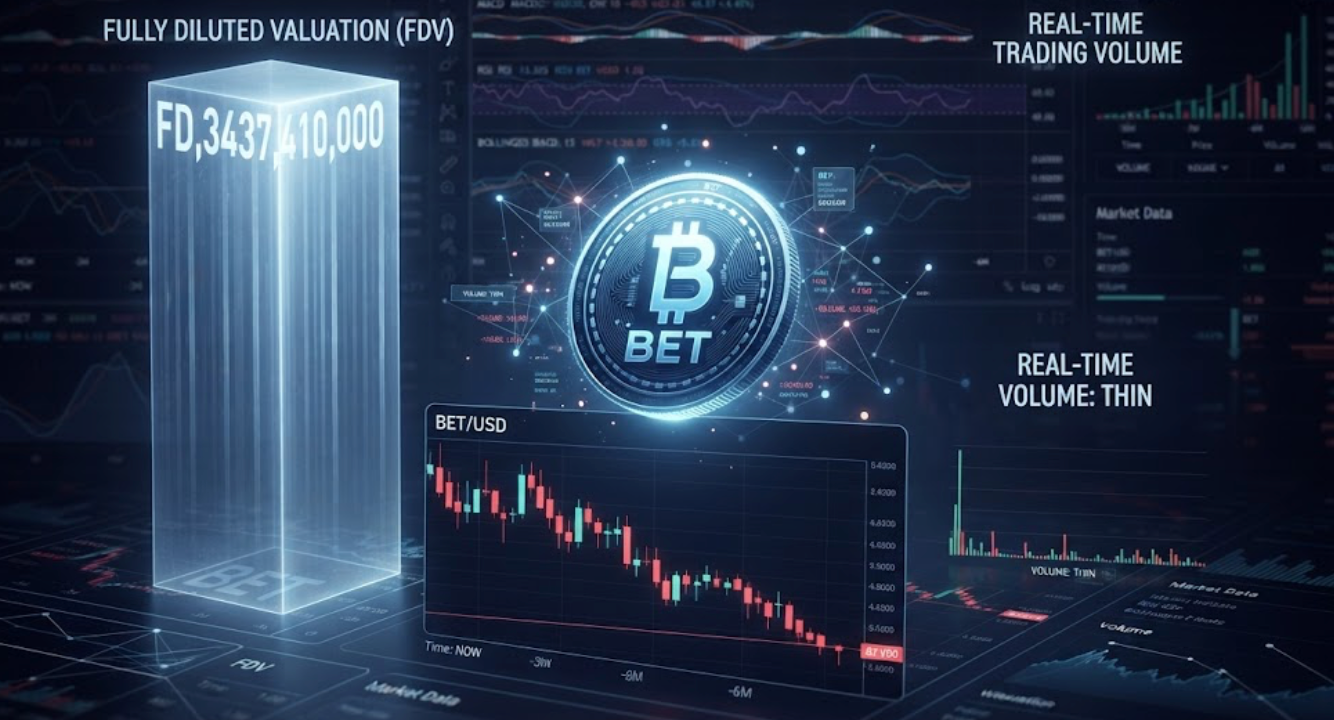
The BET price is near $0.000145, roughly 95% below its February 2025 high. Daily trading volume was around $4,500, while its fully diluted valuation remained above $112 million.
CoinMarketCap displayed a market cap of approximately $23.7 million using a self-reported circulating supply of 155 billion BET, but that figure should not be treated as independently confirmed.
This distinction matters. A $112 million FDV can appear substantial, but BET’s daily trading volume is tiny by comparison. Low volume can make the price sensitive to relatively small orders and limits how easily larger positions can enter or exit.
The token therefore has two very different profiles. Inside Betfin, it is the operating unit for games, staking and rewards. Outside the protocol, it remains a lightly traded asset with uncertain circulating supply.
Betfin Is Moving Beyond Its Original Casino Model
Betfin began as a decentralized gaming platform where players used BET and community members supplied the funds behind the games.
Its V2 strategy is broader. Betfin now wants to become the liquidity and settlement layer used by third-party gaming operators.
Under this model, a partner can keep its familiar Web2 interface, manage its own customers and operate under its own legal structure. The partner then connects to Betfin through smart contracts. Bets placed on the external platform are mirrored into the Betfin protocol, where the community liquidity pool absorbs the results.
The partner does not need to maintain the entire gaming bankroll. It concentrates on acquiring players and running the customer-facing service, while Betfin supplies the underlying capital and settlement infrastructure.
This is a more ambitious proposition than launching another crypto casino. If the model works, one liquidity network could support multiple operators without requiring users to interact directly with a blockchain.
It also gives BET a clearer job. The partner must source BET to mirror wagers through the protocol. More partner volume could therefore create recurring token demand. That is the bull case. It begins with real bets rather than social-media attention.
How Casino Volume Could Create Demand for BET
Imagine that a partner accepts deposits from players in the currencies supported by its own platform. When those players place bets, the operator’s service wallet mirrors the activity into Betfin using BET.
The partner can acquire BET for each transaction or maintain an inventory that it periodically replenishes. Either way, sustained gaming volume requires continued access to the token.
This gives BET a transactional role tied to protocol usage. The demand does not rely entirely on traders buying the token in anticipation of a future product. In principle, it comes from operators using Betfin’s liquidity.
The relationship can be expressed simply: More active partners generate more wagers. More wagers create more mirrored transactions. More mirrored transactions require more BET.
What remains unknown is the scale. Betfin has explained the mechanism in detail, but independent public data on partner betting volume, protocol revenue, active players and total liquidity remain limited. Without those figures, it is difficult to estimate how much BET an operator must purchase or how often that demand reaches the open market.
A working contract establishes utility. It does not establish meaningful economic demand.
BET Demand Comes With a Supply Counterweight
Betfin V2 does not only consume BET. It also distributes BET.
According to the project’s explanation of the partner model, operators receive a share of the game’s mathematical edge. Those rewards are released from the Core contract reserve when verifiable betting volume passes through the protocol.
The project describes this as activity-based distribution rather than ordinary scheduled emissions. If a partner brings no volume, it earns no corresponding release.
That design is more disciplined than paying rewards regardless of usage, but it still increases the amount of BET held outside reserve contracts. Operators receiving BET may retain it to support future activity, use it for incentives or sell it to cover operating expenses.
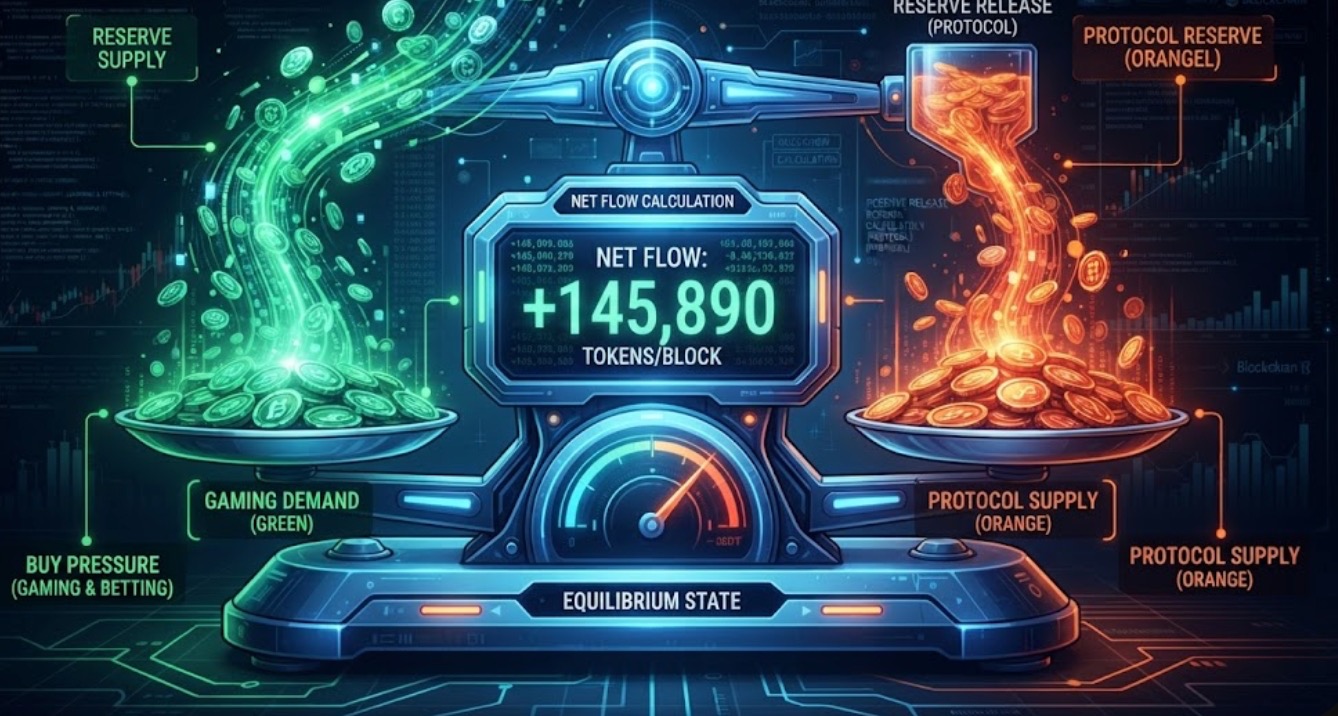
The same wager can therefore affect both sides of the market. The operator may need to acquire BET to mirror the bet, while the protocol releases BET as compensation for the volume generated.
Token value accrual depends on which flow is larger. If partners consistently buy more BET than they receive and sell, protocol growth could tighten the available market. If rewards cover most operating requirements or are regularly sold, higher gaming volume may increase token circulation without creating equivalent net demand.
Betfin has built a mechanism that links issuance to activity. It has not removed issuance from the equation.
The Affiliate Pool Is Larger Than Every Other Allocation
BET’s initial distribution makes this supply question more important. Betfin assigned 49% of the total supply to its affiliate pool. Another 21% was designated for airdrops, 18% for the team, 6% for partners and 6% for bonuses.
The affiliate program pays users for direct referrals and activity generated through their wider network. The project’s documentation describes an invitation-based structure that includes direct commissions and binary matching rewards based on staking and betting volume.
This model may help Betfin acquire users without relying on a central marketing company. It also means almost half of the token supply is connected to recruitment and network activity.
A strong affiliate system can bring players to partner casinos. It can also create participants whose main interest is earning and selling BET rewards rather than using the gaming infrastructure.
The useful metric is not how many accounts join the affiliate tree. It is how much outside gaming volume those accounts produce after incentives are considered.
If rewards rise while genuine player activity remains weak, token distribution becomes the product. If partners attract users who would play without BET incentives, the affiliate pool functions more like a customer-acquisition budget.
wtf.games Is the First Test of the V2 Thesis
In May 2026, Betfin identified wtf.games as the first third-party operator using its V2 infrastructure. The project said the operator would connect its casino to Betfin’s community liquidity through partner and mirroring contracts. A sportsbook was expected to follow, with prediction markets planned later.
The current Anjouan Gaming register lists wtf.games under Spinlab Management LLC, with a B2C license issued on June 12, 2026 and scheduled to remain valid until June 11, 2027. This confirms that the domain appears in that particular register.
It does not confirm how many users the casino has, how much volume is being mirrored through Betfin or whether the partnership generates material demand for BET.
The description “regulated operator” also needs context. Anjouan’s offshore licensing system has faced questions over its legal standing and supervisory standards. A 2026 Le Monde investigation reported broader concerns about the authority behind these licenses.
For BET holders, the most relevant evidence will come from the blockchain rather than the license announcement. The market needs to see wagers entering the protocol, BET being sourced for settlement and measurable fees reaching liquidity providers.
wtf.games matters because it can turn Betfin V2 from a design into an operating business. That transition should be judged through usage, not launch language.
Team Unlocks Are Not Immediate, but They Are Visible
Betfin assigned approximately 140 billion BET, or 18% of supply, to the team. The published schedule sets a three-year initial lock followed by quarterly releases over five years. Using June 1, 2024 as the stated starting point, team unlocks should begin around June 2027.
That removes the team allocation as an immediate August 2026 catalyst, but it places a clear date on the longer-term supply calendar.
Other allocations can enter circulation through different mechanisms before then. Affiliate, partner, airdrop and bonus pools together account for 82% of total BET supply. Their release depends partly on protocol activity and program rules rather than one simple vesting chart.
Investors therefore need more than a team-unlock calendar. They need current reserve balances and a record of how much BET enters circulation through each channel.
Betfin V2 Has Reached the Part That Matters
The architecture behind Betfin V2 is more interesting than the price chart alone suggests.
It attempts to separate the customer-facing casino from the capital that backs its games. Operators bring users. Community members provide liquidity. Smart contracts record bets and distribute the game’s edge. BET connects the pieces.
Now the model has to work at commercial scale. The token is trading near a record low, around 95% below its peak, while its fully diluted valuation still exceeds $100 million. That gap leaves little room for vague adoption claims. Partner volume, token flows, reserve releases and liquidity-provider results need to become visible.
Betfin has explained why casinos might use its infrastructure. The next task is proving that their usage creates durable demand for BET rather than another channel through which BET enters circulation.
Readers can follow crypto market research and educational coverage through Tapbit. Existing users can log in here, while new users can create an account.
Frequently Asked Questions
What is Betfin V2?
Betfin V2 is designed as a blockchain-based liquidity and settlement layer for online casinos, sportsbooks and prediction platforms. Instead of operating only as a consumer-facing casino, Betfin wants partner platforms to use its liquidity pools and BET token infrastructure.
What is the BET token used for?
BET is used across the Betfin ecosystem for liquidity provision, incentives and partner casino operations. Under the V2 model, partner platforms may need to obtain BET when mirroring wagers through Betfin’s system.
How could Betfin V2 create demand for BET?
Demand could grow if partner casinos acquire BET to support betting activity routed through the protocol. The strength of that demand will depend on how many partners join, how much volume they generate and whether BET is purchased from the open market.


