

Bittensor has pushed back above $200 after spending much of July below that level.
As of August 22, TAO was trading near $230 — up roughly 17% over the past week. 24‑hour volume had risen to about $280 million, and the token briefly hit $250 before giving back some of those gains. Still, TAO remains nearly 70% below its April 2024 high of $759.
The rally coincided with a broader crypto market recovery, so attributing the entire move to Bittensor alone would oversimplify things. Bitcoin and several major altcoins were already advancing as capital rotated back into risk assets.
That said, Bittensor has given traders project-specific reasons to take notice. A series of protocol upgrades has changed how subnet emissions are distributed, how Root staking rewards are handled, and how subnet ownership can change. Meanwhile, Grayscale is pursuing an ETF version of its Bittensor Trust.
These developments help explain why TAO is back above $200. Whether it can hold there depends on a more fundamental question: is Bittensor building a sustainable market for useful machine intelligence, or is most of the current activity still being sustained by token emissions?
What Is Bittensor?

Bittensor is a decentralized network built around specialized markets known as subnets. Each subnet defines a particular task. Depending on its design, that task might involve AI inference, data collection, prediction, model evaluation, search, computing resources or another form of machine intelligence.
Miners compete to produce useful outputs. Validators evaluate those outputs and determine how rewards should be allocated. TAO provides the common economic asset connecting the network, while individual subnets also have their own alpha tokens.
This structure allows different approaches to machine intelligence to compete without forcing the entire network to use one model or one evaluation method. It also makes Bittensor more complicated than a conventional blockchain or an ordinary AI token.
TAO’s value depends not only on interest in artificial intelligence. It also depends on staking behavior, subnet prices, emission rules, liquidity and whether subnet services attract demand beyond participants earning protocol rewards.
Why Is TAO Rising?
TAO’s move above $200 appears to reflect both market conditions and changes inside the Bittensor economy.
The wider crypto rally provided the immediate backdrop. As Bitcoin strengthened, capital returned to altcoins and familiar market themes. Decentralized AI was one of those themes, and TAO remains among its most liquid assets.
Crossing $200 then added a technical element. The level had acted as a psychological barrier throughout the previous recovery attempt. Once TAO moved through it with higher volume, breakout traders and short covering may have helped accelerate the move.
Bittensor’s protocol upgrades supplied a more durable narrative. During July and August, the network changed how subnets compete for rewards and how Root staking interacts with subnet markets. These changes do not guarantee higher TAO prices, but they alter the incentives beneath the network.
That makes the current rally different from one based entirely on a partnership announcement or social-media excitement. The protocol’s economic design is being actively rebuilt, and the market is trying to decide what those changes are worth.
V431 Made Subnet Ownership Contestable
The V431 upgrade changed both Bittensor’s operating software and parts of its subnet economy. Subnet ownership can now become contestable through a mechanism called conviction. Participants lock subnet alpha in support of a chosen hotkey, and that commitment accumulates conviction over time.
Once an eligible subnet is more than one year old and the required conviction threshold is reached, ownership can transfer to the hotkey with the strongest support. The mechanism is intended to prevent subnet control from remaining permanently with a founder who may no longer be the best operator.
V431 also simplified the way emissions are divided among subnets. A subnet’s emission share became primarily a function of its moving-average market price, adjusted for miner-burning behavior. That gives the market a stronger role in deciding where TAO emissions go. Subnets attracting more capital can receive more rewards, while weaker subnets lose relative share.
The drawback is that price and emissions can reinforce each other. A rising alpha price may produce a larger emission allocation, which can attract more capital. The same feedback can work in reverse when a subnet loses liquidity.
Market price is useful information, but it is not the same as proof that a subnet has paying users or valuable AI output.
The Emission Gate Reduced Rewards for Weak Subnets
The V440 upgrade introduced an Emission Gate intended to reduce subsidies for subnets sitting near the bottom of the market.
Under the previous model, every registered subnet continued receiving a portion of emissions. Even a subnet with limited activity could collect rewards simply by holding a slot. That increased dilution and made unused subnet positions more expensive to replace.
The gate keeps emissions linked to market demand but makes the curve much steeper. Lower-ranked subnets still receive something, although their allocation may fall to a small fraction of what the old formula provided.
Bittensor’s V440 simulation showed the share going to lower-ranked subnets declining from 38.4% to 12.5% under the default parameters. The share directed to the top eight increased from 32.8% to 52.7%.
This is a meaningful change. Teams can no longer assume that registering a subnet will generate a useful level of passive emissions. They must attract enough demand to remain above the gate.
The policy may improve capital efficiency by directing more rewards toward successful subnets. It also concentrates a larger part of the network’s issuance among a smaller group. If the market misprices a subnet, rewards can become concentrated for reasons that have little to do with service quality.
Root Reborn Changed the Source of Subnet Selling
Root stakers receive economic exposure to Bittensor’s subnet system. Under the earlier mechanism, part of the subnet alpha earned through Root was regularly sold into liquidity pools and converted back to TAO. Those sales created a mechanical drain on subnet markets regardless of whether individual stakers wanted to exit.
The official Root Reborn release estimated that the old structure was selling alpha equal to roughly 983 TAO per day at the time of its July 24 snapshot.
Under the new structure, each Root validator is associated with a fund that can hold subnet alpha rather than selling every reward immediately. At launch, these funds use a neutral strategy: rewards remain in the subnet where they were earned.
This removes a recurring source of automatic selling from subnet pools. It does not create an equivalent amount of new TAO buying, nor does it guarantee that subnet alpha prices will rise. The rewards can still be realized when positions are claimed or reallocated.
Root validators are expected to take a more active role in deciding where capital should go. They will eventually be able to publish allocation weights across selected subnets, giving stakers exposure to validator-managed baskets. That allocation feature was initially disabled, allowing the network to establish the neutral baseline before opening active curation.
The result is a more sophisticated staking system, but also one that introduces new choices and risks. Root returns may increasingly depend on how well validators assess subnet markets.
Bittensor Is Tightening Its Economic Accounting
The August V446 release is less visible to traders but still relevant. It repairs historical alpha issuance and burning records, changes how eligible conviction is calculated for ownership challenges and gives subnet operators more control over which consensus period informs Liquid Alpha.
These adjustments do not introduce a new TAO demand mechanism. Their purpose is to make the network’s economic state more faithful to what actually happened on-chain.
That matters because Bittensor’s token economy has become increasingly complex. Subnet prices, alpha issuance, burns, emissions, conviction and Root positions all interact. Incorrect accounting could distort ownership thresholds or the information used by applications and market participants.
V446 should therefore be seen as an infrastructure and reliability update, not a direct price catalyst.
What Is the Grayscale Bittensor Trust?
Institutional access is another part of the TAO narrative. Grayscale already operates the Grayscale Bittensor Trust, which holds TAO and gives eligible investors exposure through trust shares. Its shares trade on the OTC market under GTAO, but the product is not currently an ETF listed on a national securities exchange.
Grayscale has applied to convert the trust into an exchange-traded product and list it on NYSE Arca. A revised S-1 registration statement was filed with the U.S. Securities and Exchange Commission on April 2, 2026.
The filing describes a structure that would hold TAO and could include staking under certain conditions. It also proposes the creation and redemption process generally associated with exchange-traded products.
However, an application is not approval. The SEC filing does not show that the registration statement has become effective or that the NYSE Arca listing has been approved.
GTAO may make Bittensor easier to follow for traditional investors, but anticipated ETF demand should not be counted as an existing capital inflow.
Can TAO Hold Above $200?
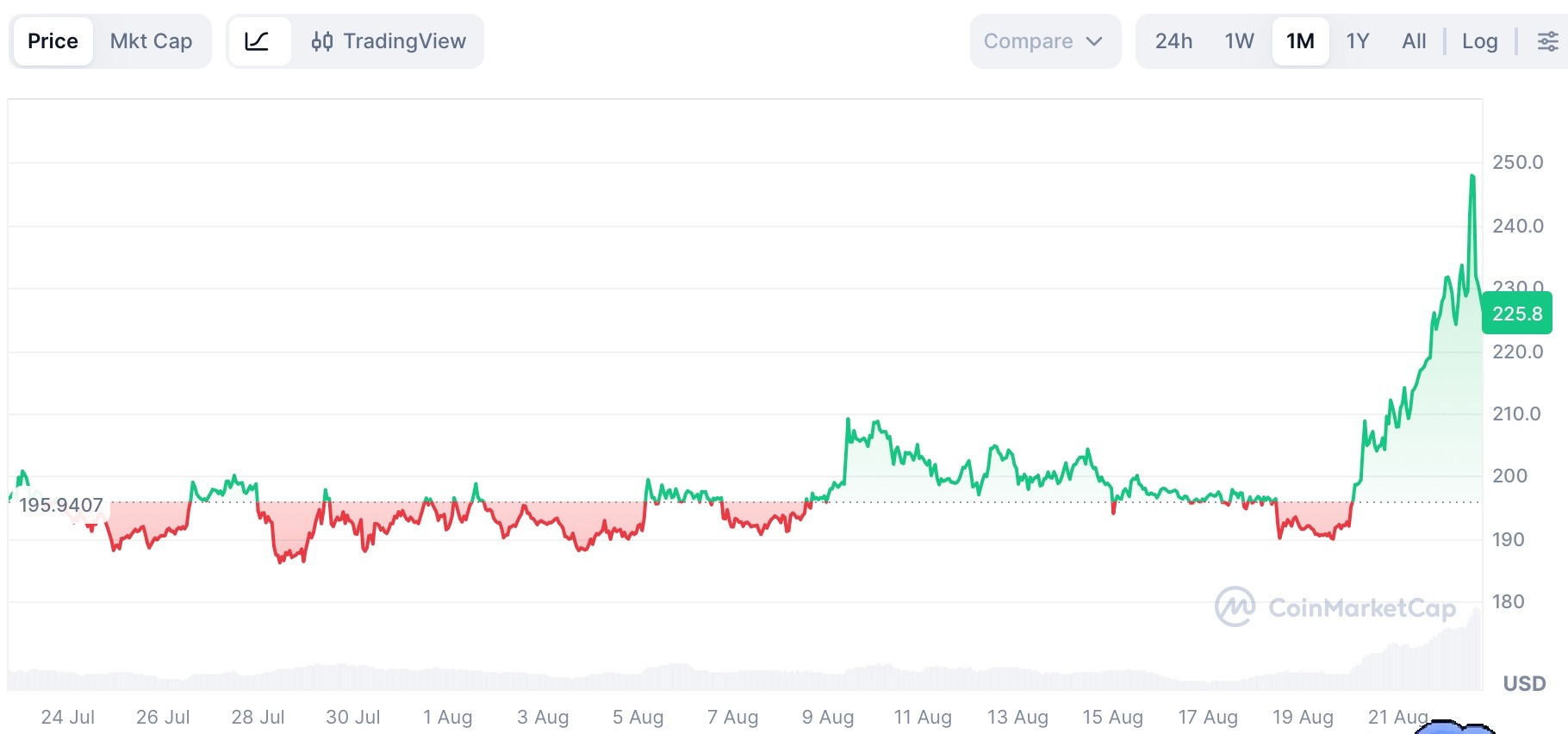
The recovery above $200 has improved TAO’s short-term structure. Around August 22, recent trading placed support near $205. TAO encountered resistance around $233 and briefly reached almost $250 before pulling back. A sustained move above the recent high could bring the area around $268 into focus.
These levels will change as new trading develops. They should be treated as market reference points rather than forecasts.
Holding above $200 would indicate that buyers are willing to defend the former resistance area. Falling back below it, particularly on rising volume, would weaken the breakout and suggest that the move was driven mainly by the broader altcoin rally.
TAO’s performance relative to Bitcoin also deserves attention. Although TAO gained in dollar terms during the week, CoinLore data showed that it underperformed Bitcoin over the same period. That suggests part of the rise came from the market lifting most crypto assets rather than TAO attracting uniquely strong capital.
Risks Behind the Bittensor Rally
Bittensor’s economic upgrades are ambitious, but they are not risk-free. The Emission Gate concentrates rewards among fewer subnets. This may punish inactive projects, but it could also strengthen incumbents and make it harder for new teams to build enough liquidity to compete.
Price-based emissions can produce reflexive markets. Subnet prices influence rewards, while expected rewards influence prices. Thin liquidity or coordinated trading could distort that process.
Root Reborn reduces automatic alpha selling, although it also turns validators into more active capital allocators. Poor allocations, concentrated baskets or delayed exits could affect staker returns.
The GTAO exchange-traded product remains subject to regulatory approval. Treating it as a confirmed ETF would overstate the current institutional catalyst.
TAO also remains highly volatile and trades far below its historical high. A reversal in Bitcoin or a broader decline in AI-related assets could quickly outweigh progress inside the network.
What Will Decide TAO’s Next Move?
TAO has cleared $200 because market conditions improved at the same time Bittensor was redesigning its internal economy.
V431 made subnet ownership contestable and tied emissions more closely to market price. The Emission Gate reduced rewards for the weaker end of the subnet market. Root Reborn removed a source of mechanical alpha selling and prepared Root validators to manage subnet allocations.
These changes give capital a stronger role in determining which subnets succeed. They may improve the use of TAO emissions, but they also make the network more dependent on accurate and liquid subnet markets.
The next stage cannot be measured by TAO price alone.
Traders should watch whether $200 develops into support, whether the current volume continues and whether the Grayscale registration advances. Longer-term research should focus on subnet revenue, external users, alpha liquidity and how rewards are distributed after the latest upgrades.
Bittensor has built a competitive economy for machine intelligence. It still has to show that this economy can support lasting demand beyond the tokens it issues.
Readers can follow crypto market research and educational coverage through Tapbit. Existing users can log in here, while new users can create an account..
Frequently Asked Questions
Why is Bittensor TAO above $200?
TAO has benefited from a broader crypto market recovery, renewed interest in AI-related assets and higher trading volume. Bittensor’s recent changes to subnet emissions and Root staking have also given traders project-specific developments to evaluate.
What is TAO crypto?
TAO is the native asset of the Bittensor network. It is used throughout the network’s staking, incentive and subnet economy, connecting specialized markets for AI models, data, inference, prediction and computing services.
What are Bittensor subnets?
Subnets are specialized markets within Bittensor. Each subnet defines a task, its evaluation method and the roles of miners and validators. Subnets also have individual alpha tokens that interact with TAO through liquidity pools.


