
Yes, some UOTF tokens can be sold, but “sellable” does not mean every holder can exit at the price shown on a chart. United Oil Trust Fund is a name used by more than one Solana token, and each contract can trade in a different pool with different liquidity. Before selling, holders need to identify the exact token mint, request a live swap quote, and compare the expected proceeds with the wallet’s displayed value.
UOTF is not currently presented here as a supported Tapbit trading pair. Traders who want access to broader listed crypto markets and account-level risk tools can create a Tapbit account while treating any small-cap UOTF position as a separate, high-risk decentralized-market trade.
Can You Sell UOTF Coin Right Now?
The practical answer depends on three things: whether a decentralized exchange can find a route for the exact contract, whether that route has enough liquidity, and whether the token itself allows transfers. If a wallet or aggregator returns a quote from UOTF into USDC or SOL, a sale may be possible. The important number is not the headline token price but the amount of USDC or SOL the quote says you would actually receive.
Listings observed for UOTF-labelled tokens illustrate the problem. A GeckoTerminal UOTF/USDC pool for mint UoTfXNNGNjv9zuS6GqYNfoiS1Lb7Z1SVocwcrPY3cjV recently showed liquidity in the low five figures. Meanwhile, Solflare displayed other tokens using the same UOTF name with different contracts, prices, and liquidity. These are point-in-time market readings, not proof that one contract is official or that liquidity will still be available when a holder tries to sell.
The First Question: Which UOTF Contract Do You Hold?
A ticker is only a label. On Solana, the mint address is the asset’s real identifier. Two tokens called UOTF can have identical names and logos while being unrelated contracts. If a holder checks the wrong chart, the quoted price and liquidity can be completely irrelevant to the token in their wallet.
Copy the mint address directly from the wallet’s token details and compare it with the address shown by the pool, block explorer, and the project’s verifiable public channels. Do not rely on a search result, direct message, or token logo. Anyone can create a token with a familiar name, and fake “support” accounts may direct holders to malicious swap pages.
Liquidity Determines Whether an Exit Is Practical
Liquidity is the capital available on both sides of a trading pool. In a UOTF/USDC automated market maker, the pool needs enough USDC to pay sellers. A token can display a multimillion-dollar market capitalization while the pool contains only a small fraction of that amount in usable quote assets. Market cap is a calculation; liquidity is the capital available for trades.
| Sell Size Relative to Pool | Likely Execution Result | Main Concern |
|---|---|---|
| Very small | May fill near the displayed quote | Fees and normal slippage |
| Moderate | Quote worsens as the order consumes liquidity | Visible price impact |
| Large | Execution price may fall sharply | Severe slippage and MEV exposure |
| Comparable to pool depth | Route may be uneconomic or unavailable | Position may not be practically liquid |
Why Wallet Value Can Be Misleading
Wallet apps often multiply the latest observed price by the number of tokens held. That produces an estimated portfolio value, not a guaranteed redemption amount. Thin markets can record a high price from a very small transaction. The value shown in the wallet may therefore be much higher than the amount a real sell quote offers.
How Slippage and Price Impact Work
Price impact is the change caused by the order itself. Slippage is the difference between the expected and final execution price, which can include both price impact and market movement while the transaction is being processed. A DEX’s slippage tolerance sets how much deterioration a trader will accept before the transaction fails.
Raising tolerance can help a transaction execute in a fast market, but it does not create liquidity. Setting it excessively high may expose the trade to a very poor fill or sandwich-style MEV activity. If the quote already shows a large loss, increasing tolerance is not a solution; it simply authorizes a worse outcome.
Why a UOTF Sell Can Fail
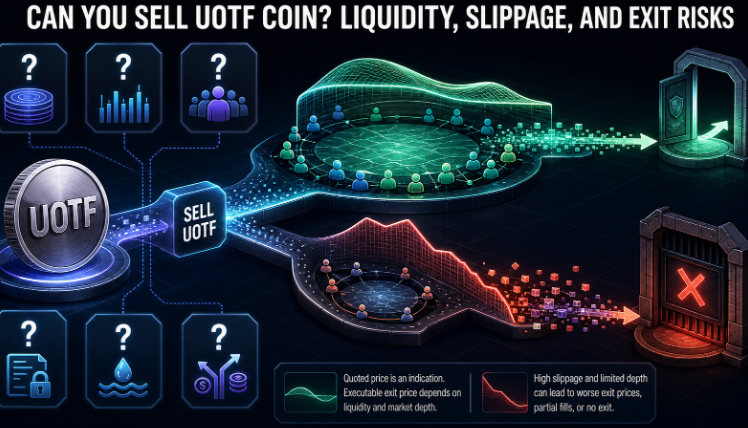
A failed sale is not automatically proof of a honeypot. Common causes include selecting the wrong contract, having too little SOL for network fees, an expired quote, congestion, a broken routing path, or slippage set below current volatility. However, repeated failures can also point to transfer restrictions, frozen token accounts, concentrated control, or a pool with no meaningful quote-asset reserves.
Check the transaction simulation and explorer error instead of following instructions from unsolicited support accounts. If multiple reputable aggregators cannot find a route for the same verified mint, the token may be functionally illiquid even if a chart continues to show a price.
How to Test Whether Your UOTF Is Sellable
Start by verifying the mint address, then request a quote for a small amount into a liquid asset such as USDC or SOL. Review the route, price impact, minimum received, network fee, and the destination token before signing. Make a small test sale and confirm that the output arrives in the wallet.
Next, quote the intended full amount without signing. Compare its implied price with the test trade. If the larger quote deteriorates sharply, divide the position cautiously or reconsider the exit. Splitting trades can reduce the impact of one large order, but it cannot fix insufficient liquidity and may add fees or prolong exposure.
Exit Risks Beyond a Failed Transaction
Even when selling works, holders face changing liquidity, volatile pricing, smart-contract risk, fake interfaces, and the possibility that publicity around “oil backing” has no verifiable connection to redeemable oil assets. A token’s name does not establish ownership of reserves, legal claims, audited collateral, or a redemption right.
Conclusion
UOTF may be sellable when the exact contract has an active pool and sufficient quote liquidity, but there is no universal answer for every token using the name. Contract confusion, shallow pools, changing liquidity, and nonlinear price impact can make a position worth far less on exit than its wallet estimate suggests. Verify the mint, inspect a live quote, test a small sale, and judge the position by executable proceeds—not by market cap or a chart headline.
FAQ
Can I sell UOTF for USDC?
Possibly. A sale requires a live route from the exact UOTF mint into USDC and enough pool liquidity to absorb the order. Check the current quote rather than assuming all UOTF contracts share the same market.
Why does my UOTF wallet value exceed the sell quote?
The wallet may use the latest traded price, while the sell quote accounts for the size and depth of the pool. Thin liquidity can create a large gap between estimated value and executable value.
Does a failed UOTF swap mean the token is a scam?
Not by itself. Insufficient SOL, expired routing, congestion, or tight slippage can cause failures. Repeated failures combined with transfer restrictions or missing liquidity require deeper contract checks.
Should I increase slippage to sell UOTF?
Only with care. Higher tolerance may allow a volatile trade to execute, but it also permits a worse fill. It cannot compensate for an empty or extremely shallow pool.
How can I check UOTF liquidity?
Use the verified mint address to locate the exact pool on a reputable Solana explorer or DEX analytics service. Review quote-asset reserves, recent volume, trade count, pool age, and a live sell quote for your actual position size.


