
ONDO has made its way back onto the radar after recovering from recent lows and moving toward $0.40.
As of August 22, ONDO was trading near $0.39 — up roughly 20% over the past week. Its 24‑hour volume climbed above $400 million, signaling that the rebound has solid market participation behind it. Still, the token remains more than 80% below its December 2024 all‑time high of roughly $2.14.
That creates an interesting dynamic. Ondo Finance is actively expanding its tokenized asset offerings, regulated infrastructure and trading services, but ONDO itself continues to trade far below its peak.
The market isn't necessarily ignoring Ondo's progress. It may simply be pricing the business and the token as separate propositions.
Why Is ONDO Rising Now?

The move has taken place alongside a wider recovery in Bitcoin and major altcoins. As risk appetite returned, traders rotated into themes that had previously underperformed, including real-world asset tokens. ONDO, one of the most recognizable RWA-related assets, was a natural beneficiary of that rotation.
Recent developments within the Ondo ecosystem have added support to the narrative. Ondo has launched new trading infrastructure, expanded its tokenized products to additional networks and secured regulatory authorizations through one of its subsidiaries.
Trading activity has also increased. ONDO’s 24-hour volume more than doubled during the latest move, suggesting that the rally involved more than a slow recovery in spot demand. Higher derivatives activity and leveraged positions may have contributed as well.
That can accelerate a rebound, but it also raises the risk of liquidation-driven volatility if momentum reverses.
Ondo Finance Is Expanding Beyond Tokenized Treasuries
Ondo Finance initially became known for OUSG and USDY, products designed to provide blockchain-based access to assets linked to U.S. government securities.
Its business now extends well beyond tokenized Treasury exposure. DeFiLlama recorded approximately $3.46 billion in combined value across Ondo products in August 2026. Ethereum remained the largest network for these assets, followed by Stellar, BNB Chain, Sei, XRP Ledger and Solana. The figure includes several Ondo product categories and should not be confused with the market capitalization of the ONDO token.
Ondo has also expanded into tokenized stocks, ETFs, commodities and perpetual futures. This broader product range positions the company around a larger idea: moving traditional market exposure onto digital settlement and trading infrastructure.
The business case is no longer limited to whether investors want tokenized Treasury yields. It increasingly depends on whether tokenized securities can attract sustained trading, collateral use and institutional distribution.
Ondo Network and Ondo Perps Open a New Direction
Ondo introduced the Ondo Network in July 2026 as an execution layer for financial applications. The design differs from a conventional public blockchain. Instead of placing every part of order execution on a public ledger, it uses trusted execution environments and a group of independent attestors to verify the code handling transactions and asset transfers.
The first application running on this infrastructure is Ondo Perps, a platform offering perpetual futures linked to stocks, ETFs and commodities. It is designed for eligible non-U.S. users and supports stablecoins and selected tokenized assets as collateral.
As the official Ondo Network announcement states, the system aims to combine private, low-latency execution with verifiable rules and non-custodial asset control.
This is an important expansion for the Ondo ecosystem, but it does not yet establish a direct use for ONDO. The token is not currently required to pay trading fees, access Ondo Perps or secure the Ondo Network.
For ONDO holders, the question is therefore not only whether Ondo Perps succeeds. It is whether that success eventually creates an economic role for the token.
Regulatory Progress Strengthens the RWA Business
In July, the company announced that Oasis Pro Markets, its SEC-registered broker-dealer subsidiary, had received additional FINRA authorizations. These authorizations support activities involving tokenized equities and funds under U.S. regulatory oversight.
They may eventually allow Ondo to offer a wider range of primary issuance and secondary trading services to U.S. institutions and retail investors. However, authorization does not mean every proposed tokenized security is already available to the public.
The commercial impact will depend on which products launch, how they are distributed and whether they attract meaningful liquidity.
Ondo has also partnered with SBI Group to explore Japanese equity tokenization and the use of a yen stablecoin for settlement and collateral. Meanwhile, USDY became available on BNB Chain in August with instant minting, redemption and cross-chain support.
Taken together, these developments show that Ondo is building across products, jurisdictions and networks rather than relying on a single RWA offering.
Why Business Growth Has Not Fully Reached ONDO
The gap between Ondo Finance and ONDO begins with the token’s current utility.
ONDO is primarily a governance token. It gives holders voting rights within the Ondo DAO, including authority over certain Flux Finance parameters, treasury decisions and ONDO emissions. The Ondo Foundation does not describe the token as equity in Ondo Finance or as a claim on company revenue.
Using OUSG or USDY does not require a large ONDO balance. Trading tokenized stocks or perpetual futures does not automatically produce buying demand for ONDO. Fees generated by Ondo products are not currently distributed to ONDO holders as a standard feature.
This means the ecosystem can grow without creating proportional token demand.
That does not make ONDO irrelevant. Governance can become valuable when it controls meaningful capital, incentives or infrastructure. But the link has to be demonstrated through active proposals and economic decisions, not assumed from the size of Ondo’s business.
January 2027 Token Unlock Remains a Major Risk
ONDO has a maximum supply of 10 billion tokens. DeFiLlama’s unlock tracker shows that approximately 48.7% had been unlocked by August 2026.
The next major release is scheduled for January 17, 2027. It is expected to involve approximately 1.71 billion ONDO, divided among ecosystem growth, protocol development and private-sale allocations.
That amount represents about 17.1% of the maximum supply and approximately 35% of the current float, based on the tracker’s methodology.
An unlock does not mean every token will immediately be sold. Some assets may remain held, be used for ecosystem programs or move according to separate internal plans. Nevertheless, the size of the release creates uncertainty about future liquid supply.
For the market, the relevant question is whether new demand can absorb the additional tokens. Product announcements alone may not be enough unless they lead to measurable ONDO use, deeper liquidity or a credible value-capture mechanism.
Has ONDO’s Long-Term Downtrend Ended?
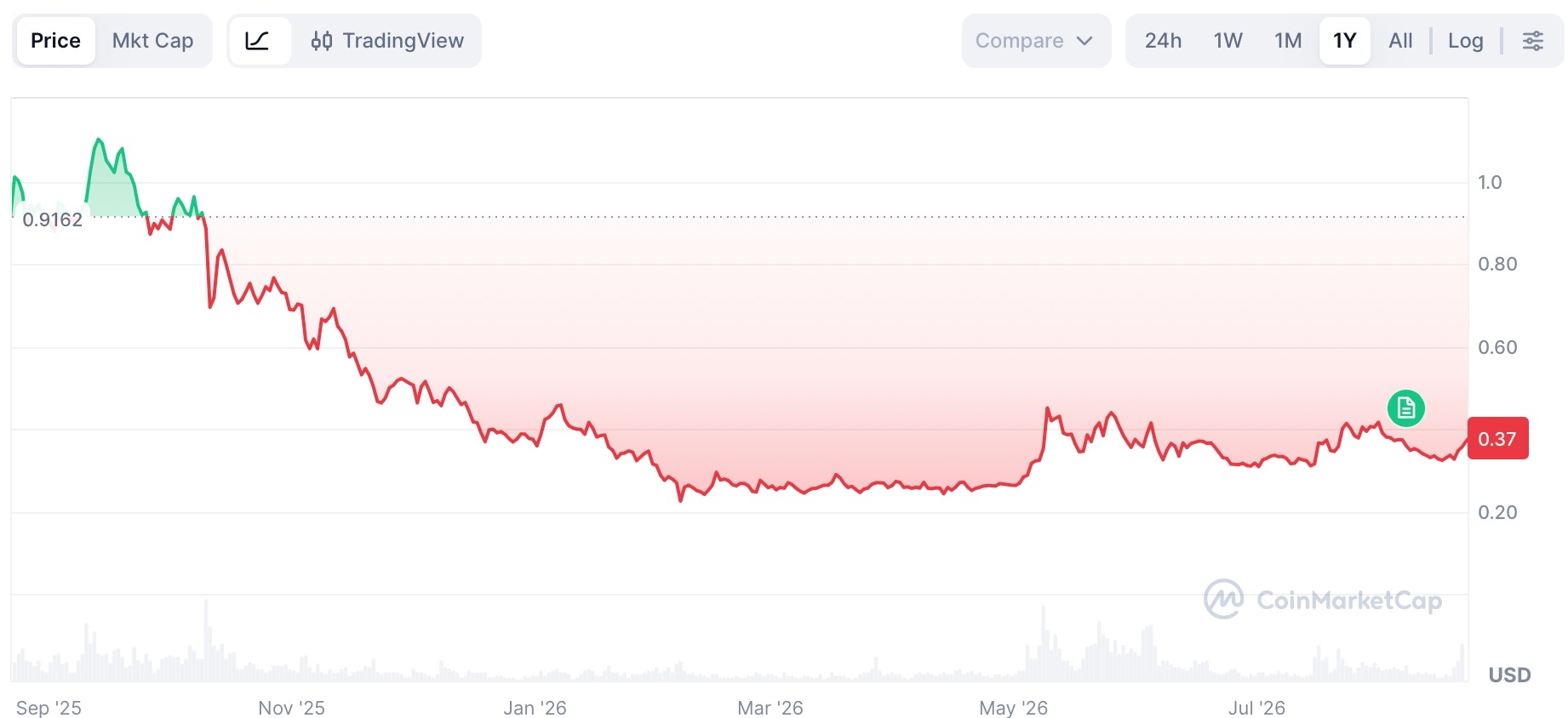
ONDO’s short-term market structure has improved, but one strong week does not settle the larger trend. The token has recovered from its recent low and returned above several short-term averages. Trading volume has increased, and the RWA narrative remains active. These are constructive signals.
However, ONDO is still far below its historical peak and has underperformed Bitcoin over the past year. It has also not yet established a consistent series of higher highs over a longer time frame.
Around August 22, recent market data placed short-term support near $0.37 to $0.38 and resistance near $0.46. These are reference points based on recent trading, not permanent levels or price predictions.
A sustained move above resistance with continued spot volume would provide stronger evidence of a trend change. A return below the recent breakout area could show that the rally was mainly driven by wider market momentum and leveraged positioning.
What Could Support ONDO From Here?
The strongest development would be a clearer economic function for ONDO.
That could come through governance-approved fee use, network staking, trading benefits, collateral roles or another mechanism that creates demand without relying solely on speculation. None of these possibilities should be treated as confirmed until they appear in official documentation or pass governance approval.
Operational performance also matters. Traders should watch whether Ondo Stocks and Ondo Perps generate recurring volume, whether USDY continues to expand across networks and whether newly authorized U.S. services move from regulatory approval to commercial use.
The quality of growth is more important than the number of announcements. A product that attracts repeated trading, collateral deposits and integration partners provides more evidence than a partnership that has not yet reached users.
Final Thoughts
Ondo Finance has developed one of the broadest product portfolios in the RWA sector. Its ecosystem now covers tokenized Treasuries, stocks, ETFs, cross-chain yield products and perpetual futures.
ONDO has not captured the full value of that expansion because the token remains primarily connected to governance. The market is waiting for evidence that product growth can produce recurring token demand while absorbing future supply.
The latest rebound shows that traders have not abandoned the RWA narrative. It does not yet prove that ONDO’s long-term downtrend is over.
The next useful signals will come from product usage, formal governance decisions and supply data. The fee-switch debate is worth following, but only an approved and implemented mechanism would change the current token model. The January unlock, meanwhile, remains visible well in advance and will continue to shape valuation discussions.
Readers can follow crypto market research and educational coverage through Tapbit. Existing users can log in here, while new users can create an account.
Frequently Asked Questions
Why is ONDO rising?
ONDO’s latest rebound appears to be supported by a broader crypto market recovery, renewed interest in RWA tokens and higher trading activity. Ondo’s recent product and regulatory developments have strengthened the narrative, but no single announcement fully explains the move.
What is ONDO crypto?
ONDO is an Ethereum-based governance token associated with the Ondo ecosystem. Holders can participate in Ondo DAO decisions involving Flux Finance, treasury management, supported markets and token emissions.
What does Ondo Finance do?
Ondo Finance develops infrastructure and products for tokenized real-world assets. Its offerings include Treasury-linked products such as OUSG and USDY, tokenized stocks and ETFs, as well as Ondo Perps for equity, index and commodity perpetual futures.


