

Chainlink has long been the dominant provider of data feeds for lending platforms, derivatives protocols and stablecoins. That core business still matters, but it no longer accounts for all the interest LINK is drawing.
The project is expanding into institutional tokenization, cross-chain settlement, reserve verification and compliance infrastructure. Recent tie-ups — with DTCC and Hong Kong's Tokenized Securities Framework — have reinforced that narrative.
The investment case is more nuanced. Chainlink can win significant infrastructure business without creating a proportional increase in LINK demand. Recognizing that gap is crucial when deciding whether LINK is undervalued or fairly priced.
Why Is Chainlink Back in Focus?

The latest interest is tied to the gradual movement of tokenized finance from controlled demonstrations into production environments.
Financial institutions do not only need a blockchain on which to issue assets. They need reliable market data, identity checks, compliance controls, asset servicing, cross-chain communication and connections to existing settlement systems.
Chainlink is attempting to provide that connective layer. Its products include price feeds, high-frequency Data Streams, Proof of Reserve, the Cross-Chain Interoperability Protocol and the Automated Compliance Engine.
The opportunity is larger than supplying a price to a DeFi application. Chainlink wants to become part of the infrastructure used to issue, verify, transfer and service financial assets across public blockchains, private networks and traditional systems.
DTCC Moves Tokenization Into Production
DTCC announced that it had converted securities held at the Depository Trust Company into digital tokens and used them in live production transactions on July 15, 2026. The exercises covered collateral pledges, securities lending, Treasury and repo delivery-versus-payment trades, equity transactions and central counterparty margin workflows.
More than 30 organizations participated, including Chainlink, BlackRock, Goldman Sachs, J.P. Morgan, Nasdaq, the New York Stock Exchange, Vanguard, Circle and several blockchain infrastructure providers. DTCC plans to launch its Tokenization Service in October 2026.
This was more meaningful than another laboratory trial. The transactions used DTC-held assets in a production environment and were designed around real capital-market processes.
Still, the announcement needs to be read carefully. DTCC identified Chainlink as one of many participants but did not say that Chainlink powered every transaction. It also did not disclose how much revenue or LINK demand the work generated.
The development supports Chainlink’s institutional thesis. It does not yet provide a clean method for valuing the token.
Chainlink Joins Hong Kong’s Tokenized Securities Framework
FORMS HK, Chainlink, Apex Group and CSpro launched the Tokenized Securities Framework, or TSF, in August 2026. The initiative is intended to support the issuance, distribution, servicing and settlement integration of tokenized securities.
Chainlink contributes two relevant technologies. CCIP provides interoperability between networks, while the Automated Compliance Engine can support identity and policy controls across on-chain and off-chain systems.
This gives Chainlink a role in more than asset transfers. Institutional securities may need to restrict participation to approved investors, apply jurisdictional rules and maintain consistent records as assets move between systems. Those requirements make compliance and identity infrastructure just as important as the blockchain itself.
TSF should not be described as an official Hong Kong regulatory framework. Its organizers state that it is a private-sector technology and market-development initiative. It is not an exchange, broker, clearing system or regulated financial institution. Secondary-market trading is also outside its current scope.
The framework is designed to support regulated activity, including pilots and sandbox deployments, but licensed institutions remain responsible for regulated services.
That distinction does not make the initiative unimportant. It shows where the work currently stands: closer to practical implementation, but not yet a fully operating tokenized securities market.
CCIP Is Central to the Chainlink Thesis
Crypto liquidity is spread across Ethereum, Layer 2 networks, Solana, appchains and private institutional ledgers. That fragmentation creates demand for secure communication between networks.
CCIP allows tokens and instructions to move across supported blockchains. It can be used for stablecoin transfers, collateral movement, fund subscriptions, redemptions and communication between private and public systems.
Chainlink expanded CCIP to Robinhood Chain mainnet in July, adding another network to its interoperability coverage. The protocol now supports access across more than 70 blockchains, according to Chainlink.
This multi-chain position separates Chainlink from a typical Layer 1 investment. A Layer 1 token generally benefits when activity moves onto its own network. Chainlink can potentially benefit from several competing networks operating at the same time.
More supported chains, however, do not automatically mean more economic value. The numbers that matter are active integrations, transaction volume, fee generation and recurring commercial use.
Chainlink Reserve Addresses an Old LINK Question
For years, the weakness in the LINK investment case was easy to identify: Chainlink adoption did not necessarily require institutions to purchase large amounts of LINK.
Chainlink Reserve is an attempt to narrow that gap. Under Chainlink’s Payment Abstraction model, users can pay for services using different assets or conventional payment arrangements. Part of that revenue can then be converted into LINK and deposited into an on-chain reserve.
This creates a more visible connection between network use and the token. Enterprise customers do not necessarily need to manage LINK directly, while service revenue can still produce LINK purchases behind the scenes.
The mechanism is a meaningful improvement, but its effect should not be overstated. Chainlink does not publish public-company-style financial statements showing revenue by product, customer costs, operating margins and the percentage of revenue converted into LINK.
The reserve proves that some revenue is being converted. It does not yet reveal how much LINK demand the full business can generate over time.
What Does Staking Add to LINK?
Participants lock LINK to support the security of Chainlink services and receive rewards. Chainlink Staking v0.2 currently has a capacity of 40.875 million LINK. The official interface showed that allocation as full, with a variable reward rate of approximately 4.32% at the latest available snapshot.
A full staking pool removes some LINK from liquid circulation and shows demand from holders willing to commit tokens to the network.
The present system remains limited in scope. Staking v0.2 is still described as a beta, and it does not yet secure every Chainlink product or institutional workflow. Community stakers are also treated differently from node operators under the current slashing structure.
The long-term argument becomes stronger if staking expands across more services and rewards rely increasingly on customer fees instead of token incentives.
Is LINK Undervalued?
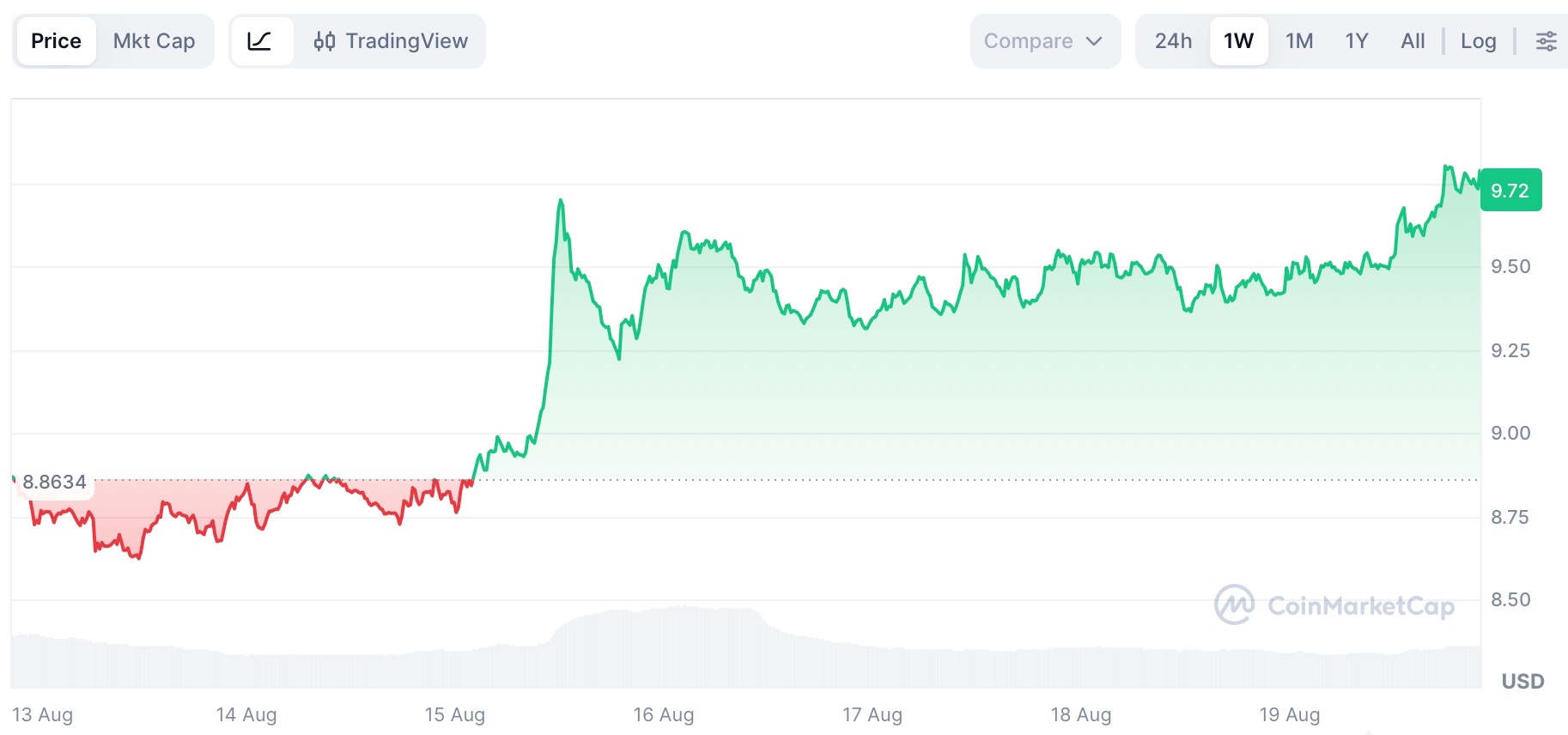
LINK traded around $8 in mid-August 2026, with a market capitalization of approximately $6.1 billion. Roughly three-quarters of its maximum one-billion-token supply was circulating.
That valuation may look modest beside the financial markets Chainlink wants to connect. DTCC alone sits at the center of the US securities system, while tokenized funds, stablecoins and cross-chain assets represent a growing market for data and interoperability services.
Yet a large addressable market does not make a token undervalued by itself.
LINK does not represent equity in Chainlink Labs. Token holders do not own its corporate revenue, intellectual property or profits. The relevant question is how much adoption translates into service fees, reserve accumulation, staking demand and LINK purchased by users or infrastructure providers.
The recent institutional developments make Chainlink more difficult to dismiss. They do not settle the valuation debate.
Risks That Could Weaken the Chainlink Thesis
Institutional adoption can move slowly. Banks and market infrastructure providers often spend years testing technology before committing to broad commercial deployment. Some pilots never progress beyond a limited environment.
Competition is another concern. Financial institutions may build proprietary systems, adopt alternative interoperability protocols or use blockchain networks with native data and messaging tools.
Chainlink also carries technical risk. A serious oracle failure, corrupted data source or cross-chain security incident could damage confidence in systems expected to protect high-value financial assets.
The economic model remains the most important uncertainty. Chainlink could become widely used while LINK captures only a limited share of the value created. Reserve growth and staking help, but investors still lack complete information about service revenue and token demand.
What Matters Next for LINK
The next phase of the Chainlink story will be measured by implementation rather than announcements.
DTCC’s planned Tokenization Service launch in October will be worth monitoring, particularly if Chainlink’s role becomes clearer. Hong Kong’s TSF will need to move from framework development and sandbox testing into identifiable issuance or settlement activity.
CCIP volume, Chainlink Reserve growth and staking expansion can provide more direct evidence of how infrastructure adoption affects LINK. Greater disclosure around service fees would make the relationship easier to evaluate.
Chainlink already occupies an important position in DeFi and is building credible links to traditional finance. Whether LINK remains undervalued depends on what happens after those links are established: how often they are used, what customers pay and how much of that activity reaches the token.
Readers can follow crypto market research and educational coverage through Tapbit. Existing users can log in, while new users can create an account.
Frequently Asked Questions
Why is Chainlink receiving attention in 2026?
Chainlink is participating in institutional tokenization projects involving market infrastructure, regulated securities and cross-chain settlement. Recent developments include its participation in DTCC production transactions and Hong Kong’s private-sector Tokenized Securities Framework.
What is Chainlink CCIP?
CCIP is Chainlink’s cross-chain communication protocol. It enables tokens and instructions to move between supported blockchains and can be used for stablecoins, tokenized funds, collateral transfers and institutional settlement workflows.
Did Chainlink power DTCC’s tokenized securities transactions?
DTCC listed Chainlink among more than 30 participating organizations. Its announcement did not state that Chainlink powered every transaction, so the extent of Chainlink’s role should not be overstated.


