

The AMD stock forecast for the next 12 months is a contest between rapid AI growth and a valuation that already expects strong execution. AMD has moved beyond being mainly a PC-chip company. Its data-center business now drives a large share of revenue, and the market is pricing in further gains from Instinct accelerators, EPYC server processors and rack-scale AI systems.
Our base scenario is constructive but demanding: AMD can keep growing through 2027 if it converts product launches into repeat customer deployments and protects gross margin. A stronger result requires faster adoption of its AI systems. A weaker result would follow if customers delay projects, competitors defend market share or product mix pushes margin lower.
AMD’s Starting Point in September 2026
AMD traded near $477.57 at 11:06 UTC on September 8, 2026. That price was about 4.7% above the previous close. The snapshot matters because a forecast is not just a view on the company; it is also a view on how much growth the current price already reflects.
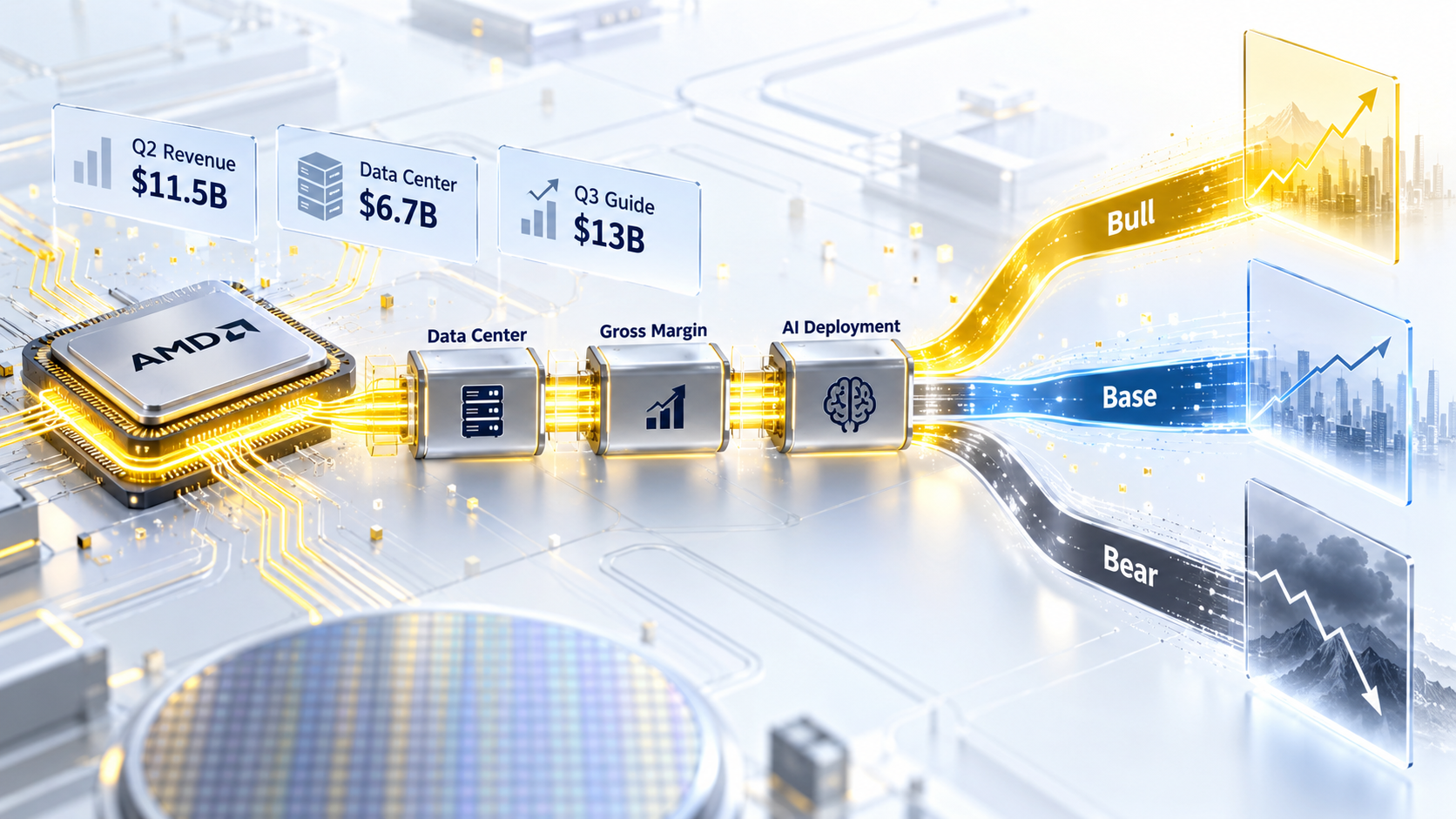
AMD’s Q2 2026 revenue rose about 50% year over year to roughly $11.5 billion. Data-center revenue reached about $6.7 billion, an increase of roughly 107%. Management then guided to approximately $13 billion in Q3 revenue and about 56% non-GAAP gross margin. These figures make the next stage clear: investors now need evidence that AI revenue can stay large and profitable.
For more context on the latest quarter, read Tapbit Learn’s analysis of AMD stock after Q2 earnings. The broader competitive picture is covered in our guide to AI chip stocks.
What Could Drive AMD Through 2027?
1. Instinct AI Accelerator Deployments
AI accelerator announcements only become durable revenue when customers install systems, run workloads and order more capacity. AMD therefore needs a growing base of production deployments, not only test projects. Large orders can lift revenue quickly, but repeat orders show that the hardware and software are working together at scale.
2. EPYC Server CPU Demand
EPYC provides a second growth engine. Every AI data center still needs CPUs to manage storage, networking and general computing tasks. Strong EPYC demand can make AMD’s data-center results less dependent on one accelerator cycle and can improve its relationship with cloud providers and enterprise customers.
3. Gross Margin
Revenue tells investors how much AMD sells. Gross margin shows how much value remains after the direct cost of producing those products. If data-center sales rise while margin holds near or above guidance, the earnings base can expand quickly. If margin falls, the company may be winning business through a less favorable product mix or higher costs.
4. Rack-Scale Systems
Customers increasingly buy complete AI systems rather than isolated chips. AMD’s opportunity is therefore larger than a single processor, but execution is harder. It must coordinate accelerators, CPUs, networking, memory, cooling and software. This is also why developments across semiconductor stocks and the AI supply chain matter to the forecast.
Three AMD Stock Forecast Scenarios
| Scenario | Business outcome | Market interpretation | What confirms it |
|---|---|---|---|
| Bull | AI accelerator and EPYC sales remain above expectations; margin expands. | AMD is valued as a durable second large AI compute platform. | Repeated customer deployments, higher guidance and improving margin. |
| Base | Data-center growth stays strong but normalizes as comparisons become harder. | Earnings grow, while the valuation multiple stops expanding rapidly. | Guidance is met, margin stays near target and product launches remain on schedule. |
| Bear | Deployment delays or pricing pressure reduce growth and margin. | The market resets expectations before business growth fully recovers. | Lower guidance, slower customer ramp or weaker data-center mix. |
The base case does not require AMD to overtake the market leader. It requires AMD to become a reliable second platform in a market large enough to support several suppliers. The bull case needs more: software adoption, system availability and customer confidence must improve together.
The Valuation Test
At a high earnings multiple, a good quarter may simply confirm what investors already expected. This is why the most useful AMD stock outlook compares business growth with the growth embedded in the share price. If earnings rise faster than the valuation falls, shareholders can still receive a positive return. If expectations rise faster than earnings, strong operations may produce a flat stock.
A practical forecast should therefore update after each earnings report. Start with revenue and margin. Then check whether management raised or lowered the next quarter’s outlook. Finally, compare the new earnings path with the market value. That sequence is clearer than reacting to a headline beat alone.
What to Watch Next
- Data-center revenue: the fastest measure of AMD’s AI and server momentum.
- Gross margin: the bridge between higher sales and higher earnings.
- Deployment language: production use and repeat orders carry more weight than early evaluations.
- Product schedule: delays can shift revenue into later quarters and change the one-year forecast.
Follow AMD-USDT on Tapbit
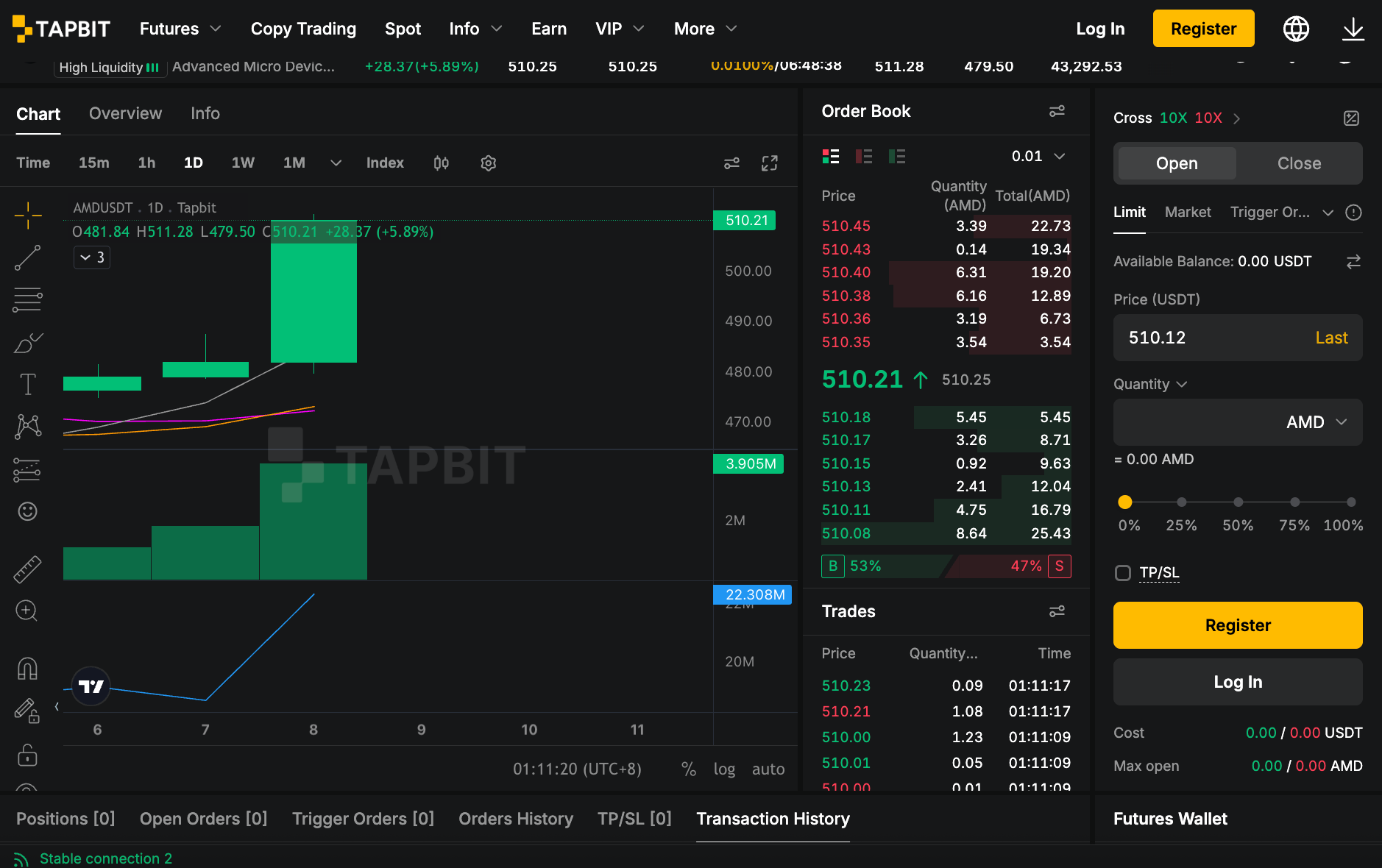
Tapbit users can follow AMD-linked market moves through the AMD-USDT futures page. Open the market, choose a direction and order type, enter the position size, then review the selected margin, order price and total exposure before confirming.
Conclusion
The AMD stock forecast for 2026–2027 remains tied to a simple question: can fast AI revenue growth turn into sustained earnings growth? The base case expects continued expansion with less dramatic valuation gains. The bull case needs faster deployments and stronger margin. The bear case starts when guidance, margin or customer adoption moves in the wrong direction. Quarterly data will show which path is forming.


