

AI Chip Stocks: Start With the Business, Not the Label
AI chip stocks attract attention because artificial intelligence requires computing capacity. But the phrase groups businesses with different products, customers and economics. Buying more accelerators can benefit a chip designer, create memory demand and generate server orders at the same time. The profit captured at each stage need not grow at the same rate.
The useful question is not simply which company has AI in its presentation. It is which bottleneck the company addresses and how solving that bottleneck turns into revenue, margin and cash flow. That framework separates a technical success from a stock-market conclusion.
This article compares NVIDIA, AMD, Micron and Supermicro, then explains why SOXL belongs in a separate product category. It does not combine their price forecasts or treat a strong industry narrative as evidence that every related share is attractively valued.
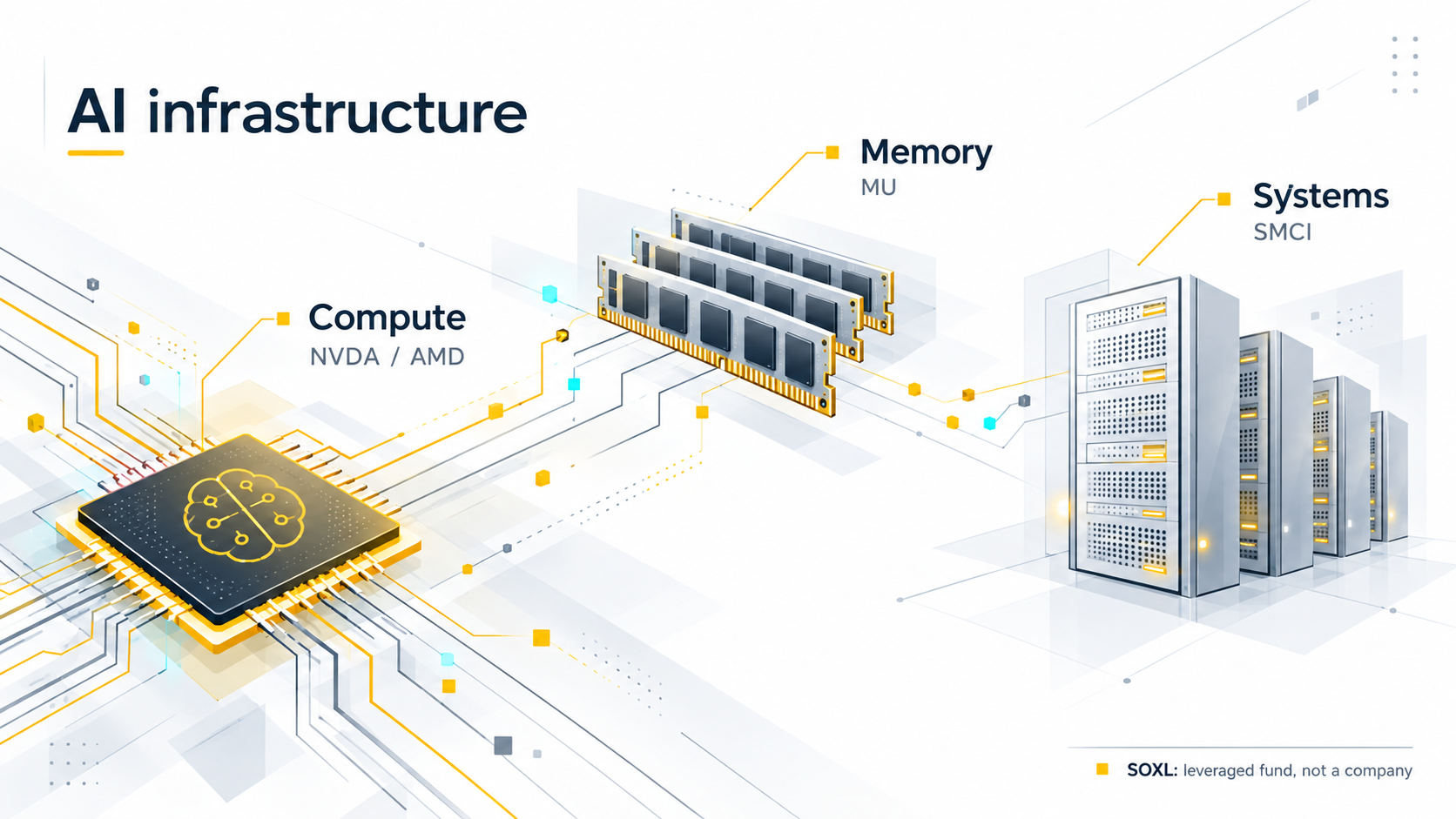
NVIDIA and AMD: Computing Platforms
NVIDIA describes a data-center portfolio spanning processors, networking and software. AMD’s Instinct documentation describes accelerators for AI and high-performance computing. These official product descriptions establish their role in the compute layer; they do not, on their own, establish relative investment returns.
For analysis, compare more than a headline performance figure. A customer buys a working system: hardware, software compatibility, deployment support, energy use and availability all matter. A chip that performs well in one benchmark can still face practical switching costs in a customer’s existing environment.
The financial questions are correspondingly specific. Is revenue growth coming from more units, higher prices or product mix? Do customers have concentrated purchasing power? Are commitments translating into deliveries and collections? Distinguish company guidance from completed results, and keep benchmark claims tied to their stated test conditions.
Micron: The Memory Constraint
Micron’s June 2025 announcement described its HBM3E memory being designed into AMD’s MI350 platform. That provides a concrete example of memory demand accompanying accelerator deployment. It is a historical product reference, not a claim about the latest quarter’s sales.
Memory helps processors access the data needed for workloads. A fast processor can be underused if the surrounding system cannot deliver data efficiently. That gives memory an economic role distinct from the processor itself.
The investment lens should therefore include capacity, qualification requirements, yields and pricing, not just the number of AI systems announced. A supplier can spend heavily to expand production before the resulting capacity generates cash. Meanwhile, product mix and supply discipline can change profitability even if demand remains healthy.
Supermicro: Turning Components Into Deployable Systems
Supermicro’s GPU-server portfolio shows the system-integration layer: computing components must be assembled into platforms customers can install and operate. This makes SMCI related to AI chip spending without making it a direct equivalent of a semiconductor designer.
Execution questions include delivery schedules, component availability, system configuration and the ability to support installations. Investors also need to examine working capital. Building and shipping hardware can require inventory and create receivables before cash arrives.
For illustration, a company reporting $1 billion of sales at a 10% gross margin has $100 million of gross profit. If sales increase to $1.2 billion but the margin falls to 8%, gross profit is $96 million. These are hypothetical figures, not Supermicro results. The example explains why more revenue is not automatically better economics.
SOXL Is a Different Kind of Exposure
Direxion states that SOXL seeks 300% of its semiconductor index’s daily performance before fees and expenses. The objective is daily, not a promise of three times the return over a month or year.
A simple illustration shows why the distinction matters. If an index rises 10% and then falls 9.09%, it approximately returns to its starting level. Ignoring fees and tracking differences, a daily 3x product would rise 30% and then fall about 27.27%, ending approximately 5.45% below its starting point.
SOXL is therefore not another chip company in a valuation table. It is a leveraged fund whose performance depends on the path of daily returns. A Tapbit contract linked to such a product introduces another layer of contract mechanics and possible margin risk. Do not assume that selecting low contract leverage removes the underlying fund’s leverage.
A Focused Comparison Checklist
Use the same reporting period when comparing revenue and margins. Separate company forecasts from published results, and distinguish total company revenue from an AI-related segment. Different definitions can make a chart look precise while answering the wrong question.
For compute platforms, examine product adoption and customer economics. For memory, examine qualified supply and pricing. For systems, examine delivery and cash conversion. For leveraged funds, examine the daily objective, costs and holding-period effects.
This framework narrows the analysis without predicting a winner. Several companies can benefit from the same spending cycle, but at different times and with different financing needs. A business may grow while its share price falls if expectations or valuation were too demanding.
Related Contracts on Tapbit
User-confirmed routes include NVDA-USDT, AMD-USDT and MU-USDT. The product list also includes SMCI-USDT and SOXL-USDT. These are contract routes, not traditional brokerage share purchases.
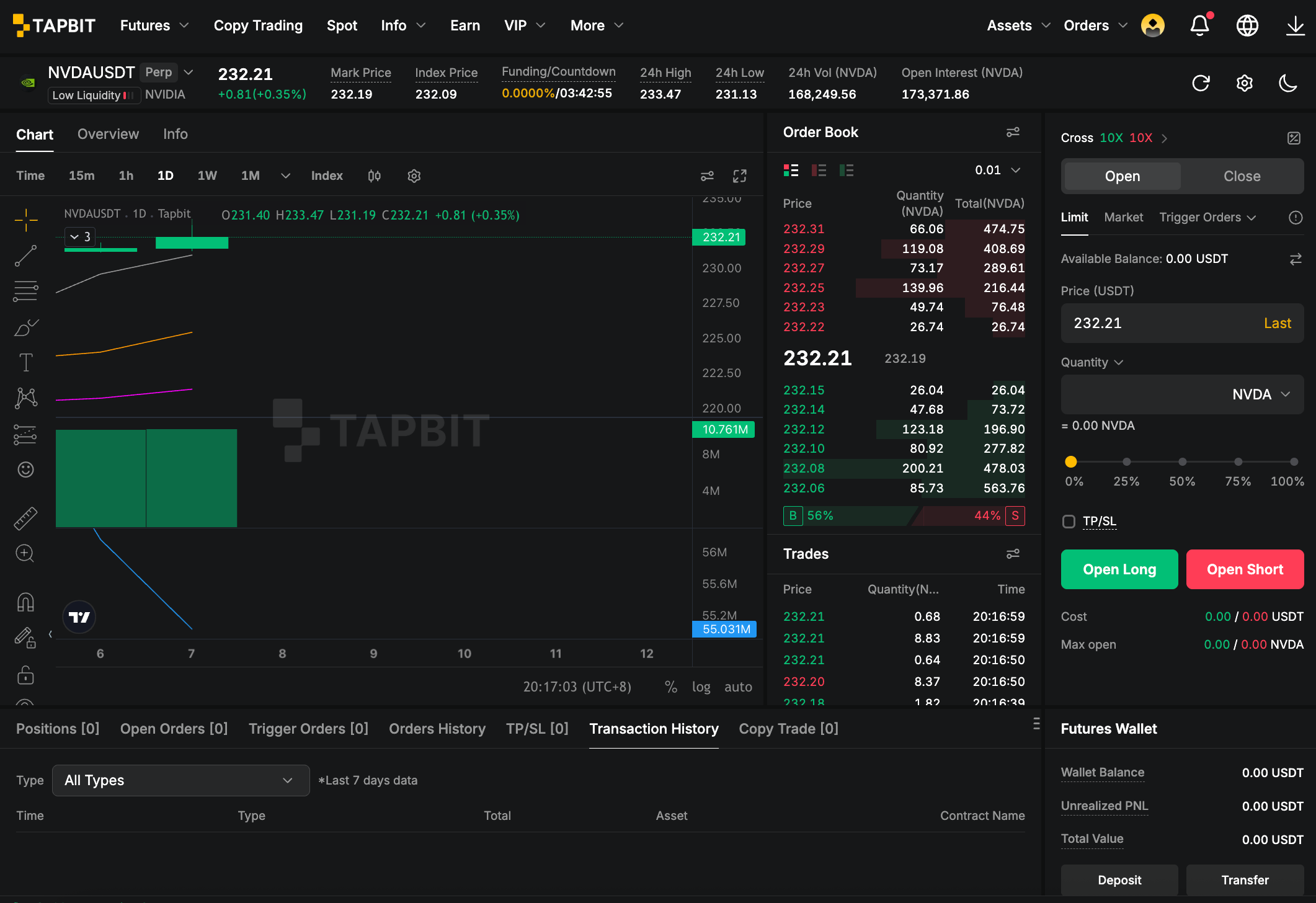
Before placing an order: (1) log in and confirm eligibility; (2) inspect the selected contract’s reference, mark/index prices, costs and market hours; (3) calculate position size and margin before choosing direction and order type; (4) set risk limits and monitor liquidation exposure.
Do not infer shareholder voting rights or dividends from a ticker. Live product rules determine the contract’s treatment. This article is educational analysis, not a recommendation to buy any of these exposures.
FAQ
Are all AI semiconductor stocks comparable? No. Business roles, margin structures and capital requirements differ.
Is SMCI a GPU designer? It should be analyzed here as server and system exposure, not treated as interchangeable with NVIDIA or AMD.
Is SOXL suitable for a simple annual three-times calculation? No. Its stated objective is daily, and compounding affects longer holding periods.


