
Touch Grass (GRASS) crypto is a newly traded token on Robinhood Chain, but investors should approach it as a high-risk, unverified asset rather than an established project token. The name overlaps with an existing location-based Web3 game and with other crypto assets that use “Grass” branding. That creates an immediate identity problem: a ticker alone is not enough to prove which token someone is buying.
The Robinhood Chain token discussed here is associated with contract address 0x16391c40e85fb2246a2c8c17bfa2594c5d3ef84b. Available primary information does not clearly establish that it is issued, endorsed or supported by the team behind the Touch Grass game. Anyone researching GRASS should begin with that distinction.
Touch Grass (GRASS) Crypto at a Glance
| Item | What is currently known |
|---|---|
| Network | Robinhood Chain |
| Contract | 0x16391c40e85fb2246a2c8c17bfa2594c5d3ef84b |
| Primary narrative | Community or meme-style token linked by name to the Touch Grass theme |
| Official connection to the Touch Grass game | Not clearly established in the game’s public website or documentation |
| Main risks | Token confusion, limited trading history, thin liquidity and concentrated ownership |
Readers who want to explore established crypto markets can create a Tapbit account and review the assets supported by the platform. This link does not mean GRASS is listed on Tapbit.
Is GRASS the Official Token of the Touch Grass App?
The official Touch Grass website describes a location-based game built around Robinhood Chain. Players visit real-world locations and can receive fragments connected to tokenized stock assets. Its public materials also state that the game is not affiliated with Robinhood Markets or the companies represented by those stock tokens.
What the documentation does not clearly do is identify the Robinhood Chain GRASS contract above as an official utility token. That missing link matters. A project name, logo or social-media reference can be copied by anyone, while a verifiable announcement from the project’s official channels is much harder to fake.
Until the game’s official website or verified accounts publish the same contract address, it is safer to describe GRASS as a token using the Touch Grass name—not as a confirmed token of the application.
Why the GRASS Price Is Easy to Misread
The chart supplied with this article shows a seven-day price ending near $0.00041. However, that chart appears to belong to a different asset listed as TOUCHGRASS on Solana. It should not be used as proof of the price, return or market history of Robinhood Chain GRASS.
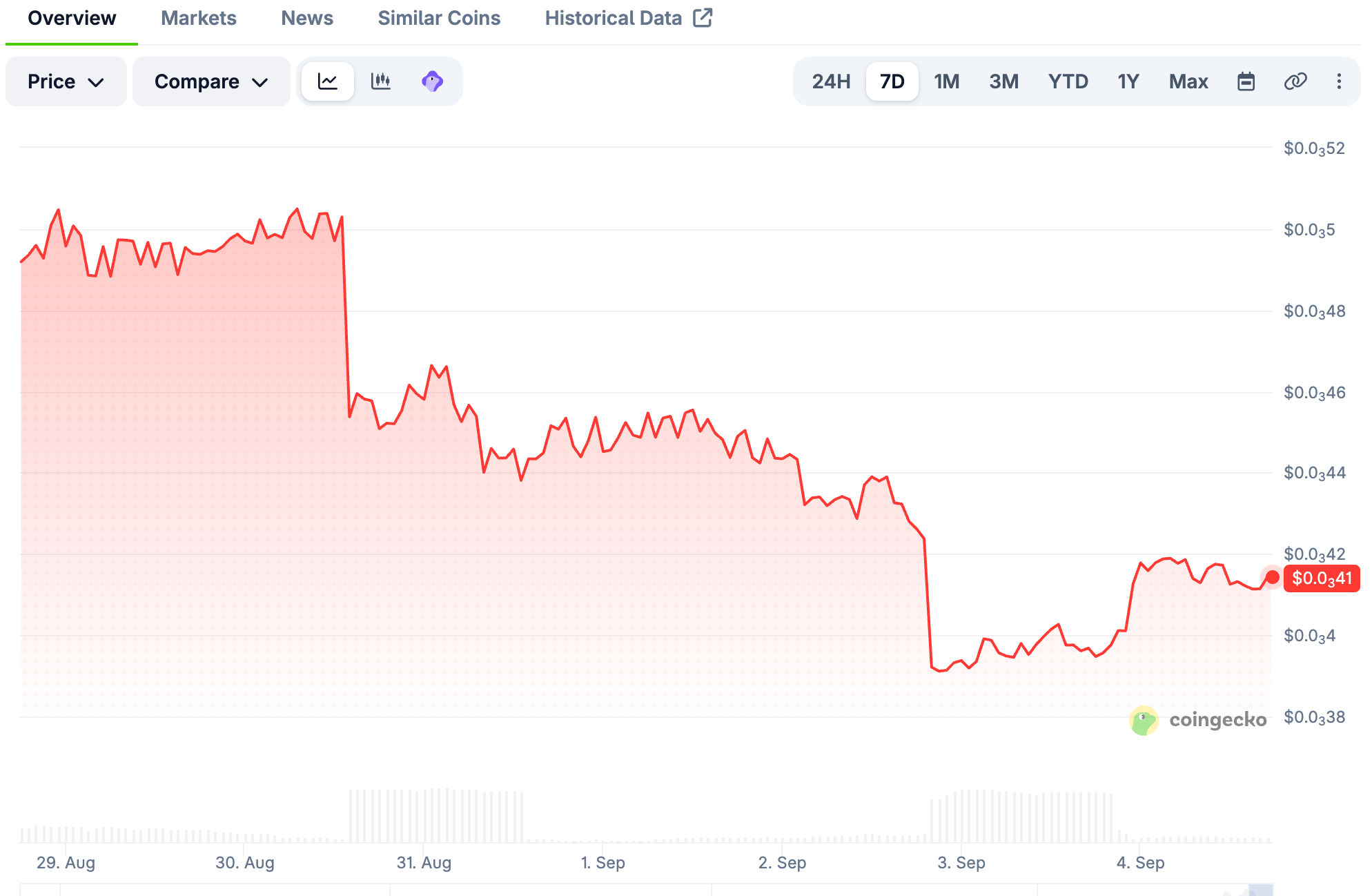
This is a common problem with small-cap tokens. Two assets can share nearly identical names while having different tickers, networks, contract addresses, liquidity pools and teams. Price websites may also index one token before another, causing search results to mix their data.
Before quoting any GRASS price, confirm that the market page shows Robinhood Chain and the exact contract ending in f84b. If either detail is different, the price belongs to another token.
What Could Drive the Robinhood Chain GRASS Token?
GRASS may attract attention because Robinhood Chain is a new ecosystem and tokenized stocks are a popular narrative. New networks often produce short bursts of speculative trading as users test bridges, decentralized exchanges and launchpad tokens. A memorable name can amplify that effect.
Those factors can create demand, but they do not establish lasting value. There is no confirmed evidence here that GRASS gives holders a claim on revenue, equity, stock tokens or rewards from the Touch Grass game. Without documented utility, price performance depends largely on community interest, liquidity and the willingness of later buyers to enter.
Liquidity, Holders and Contract Risk
Small tokens can display an impressive quoted price while remaining difficult to sell. The meaningful question is how much liquidity sits in the active pool and how much a realistic trade moves the price. A modest pool can turn a market order into severe slippage, especially during a rush for the exit.
Holder distribution is equally important. If a few wallets control a large share of supply, one sale can overwhelm available bids. Traders should check whether the deployer or related wallets still hold substantial balances and whether liquidity-provider tokens are locked, burned or freely controlled.
Contract permissions deserve a separate review. Depending on the token design, an owner may be able to mint more supply, pause transfers, blacklist wallets or change fees. A successful purchase does not prove a successful sale is possible, so a small test transaction and a simulated sell can reveal problems before a larger commitment.
Is Touch Grass Crypto a Scam?
There is not enough verified evidence to declare Robinhood Chain GRASS a scam. There is also not enough evidence to treat it as an officially supported Touch Grass asset. The responsible conclusion is that its status is unverified and its risk is high.
The biggest warning sign is identity ambiguity rather than a single proven act of fraud. The game, the Robinhood Chain GRASS contract, the Solana TOUCHGRASS token and the unrelated Grass Network ecosystem can all appear in similar searches. Fake accounts can exploit that confusion with copied branding, false contract addresses or promises of guaranteed returns.
Claims of an official partnership should be checked at the source. Screenshots, paid posts and token-tracker descriptions are not substitutes for an announcement that links directly to the correct contract.
How to Verify the Correct GRASS Token
Start from a project’s official website and verified social accounts, then compare the published contract character by character with the address shown in your wallet or decentralized exchange. Confirm the network is Robinhood Chain and inspect the same contract in a block explorer.
Next, review the largest holders, deployer activity, pool size, recent swaps and contract privileges. Search for multiple tokens using the same name, and never assume that the asset with the highest search ranking is the correct one. If there is no direct confirmation from the claimed project, treat the association as marketing rather than fact.
A cautious buyer would also use a fresh wallet, keep the first trade small, set a realistic slippage limit and test whether the token can be sold. Avoid links delivered through unsolicited messages and never enter a seed phrase on a token website.
Conclusion
Touch Grass (GRASS) may benefit from speculation around Robinhood Chain, but its official status, utility and relationship to the Touch Grass game remain unclear. The supplied chart appears to represent a separate Solana asset, illustrating why contract-level verification is essential.
For now, GRASS fits the profile of a newly launched, thinly documented token whose outcome depends more on liquidity and market attention than proven fundamentals. It may rise sharply, but the same conditions can produce rapid losses or make exits difficult. This article is for educational purposes only and is not financial advice.
FAQ
What network is Touch Grass (GRASS) on?
The GRASS token discussed in this article is on Robinhood Chain. Always confirm the chain and contract address before trading because similarly named tokens exist on other networks.
What is the Robinhood Chain GRASS contract address?
The contract identified in current market references is 0x16391c40e85fb2246a2c8c17bfa2594c5d3ef84b. Verify it again through official project channels before using it.
Is GRASS the official token of the Touch Grass game?
The game’s public website and documentation do not clearly confirm that relationship. Without an official announcement publishing the same contract, the connection should be treated as unverified.
Why does the GRASS price differ across websites?
Different assets use similar Touch Grass or Grass names. A Solana token called TOUCHGRASS appears to be the asset shown in the supplied chart, while the Robinhood Chain GRASS token uses a different contract and market.
Can Touch Grass crypto be a scam token?
It cannot be fairly labeled a scam without evidence, but name confusion, limited documentation, new-contract risk and potentially thin liquidity justify extreme caution.


