

A Michigan state court has converted its temporary restrictions on Kalshi into a preliminary injunction, requiring the prediction-market operator to keep sports-related event contracts unavailable to people located in Michigan. The September 1, 2026 order also requires state-compliant third-party geolocation and provides for a $500,000 fine for each day the court finds Kalshi failed to meet those requirements.
The order is significant, but it is not a final judgment on every legal issue surrounding prediction markets. The underlying case continues, and Kalshi’s broader argument that federally regulated event contracts fall under federal commodities law remains part of a wider national dispute.
What the Michigan Court Ordered
Ingham County Circuit Court Judge Rosemarie E. Aquilina issued the preliminary injunction after an earlier temporary restraining order imposed in June. According to the signed Michigan preliminary injunction, Kalshi must not design, launch or operate products that are functionally similar to internet sports betting for people located in the state.
The language covers familiar sports-market structures, including single-game positions, parlays, over-under contracts, moneyline-style markets, in-game markets and proposition-style products. Kalshi must use a third-party geolocation provider licensed by the Michigan Gaming Control Board and capable of meeting the state’s geofencing specifications.
Readers following fast-moving regulatory events and broader crypto markets can create a Tapbit account to explore supported assets and trading tools. Tapbit is not presented here as a venue for Kalshi event contracts.
When Does the $500,000 Daily Fine Apply?
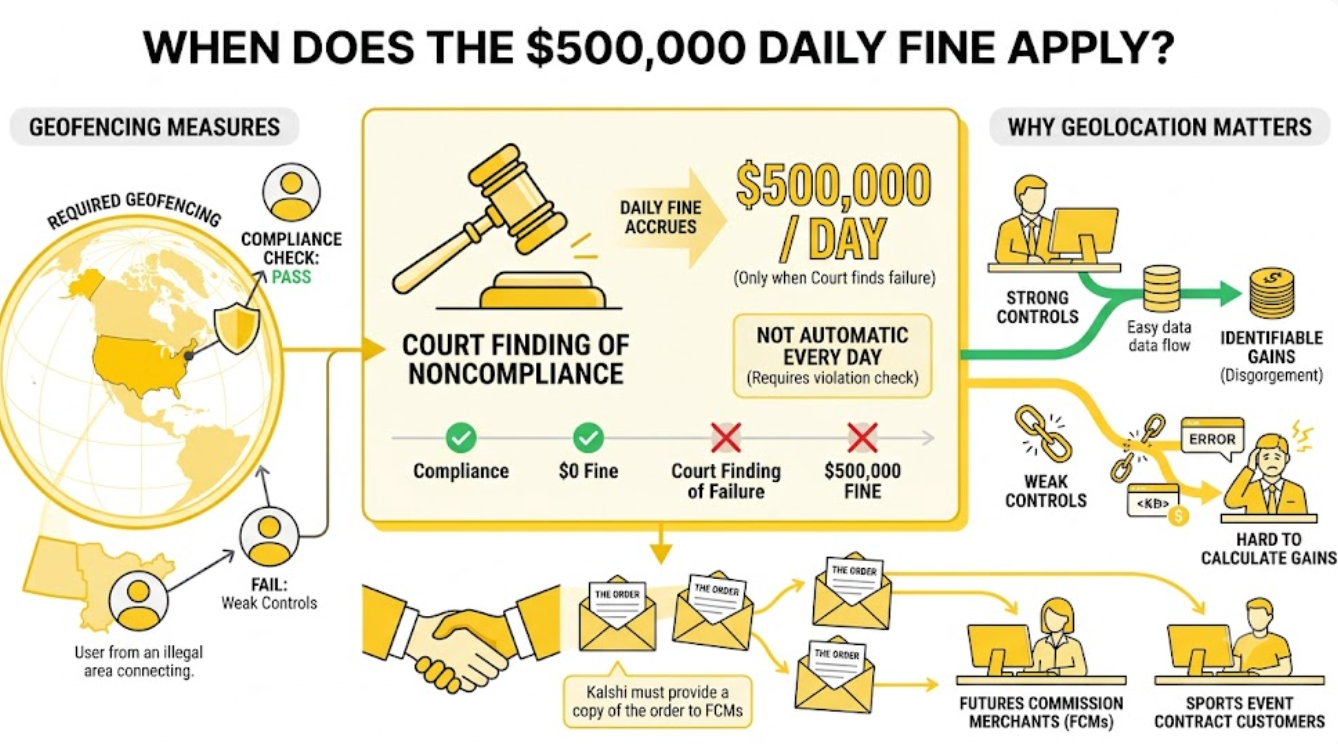
The fine is tied specifically to geolocation compliance. The order states that Kalshi must pay $500,000 for each day the court finds it failed to comply with the required geofencing measures. That is different from saying a fine automatically accrues every day regardless of conduct. A finding of noncompliance by the court is the trigger described in the order.
The court emphasized geolocation because weak controls could make it harder for the state to identify transactions and calculate gains subject to potential disgorgement. The order also requires Kalshi to provide a copy to futures commission merchants that make its sports event contracts available to their customers.
Why Michigan Treats the Markets as Sports Betting
Michigan’s position is that sports event contracts function like internet sports wagering when users put money on game outcomes, scores or player-related events. State officials argue that providers offering such products to Michigan residents must comply with state gaming laws, licensing rules, age restrictions and consumer protections.
The state has also pointed to tax revenue and tribal gaming interests. Licensed sportsbooks and tribal gaming operators function within a state regulatory framework, while Michigan alleges that an unlicensed prediction market can compete for the same users without carrying the same obligations.
Kalshi has disputed that characterization. Its core position is that it operates a federally regulated derivatives exchange overseen by the Commodity Futures Trading Commission, and that event contracts listed on such an exchange should be governed primarily by federal commodities law.
Why This Is a Federal-versus-State Dispute
The Michigan case reflects a difficult boundary question: when does a federally regulated event contract become a product that a state may regulate as gambling? Kalshi and state regulators give different answers because the same contract can be described through two legal frameworks.
Under the federal view, traders take positions on event outcomes through a designated contract market. Under the state view, a contract based on the result of a sporting event can operate like a sports bet regardless of the exchange terminology used. Courts in several states have been asked to address similar conflicts, and the outcomes have not produced one simple nationwide rule.
The preliminary injunction does not resolve that national question. It controls Kalshi’s conduct in Michigan while the case proceeds, unless the order is modified, stayed or overturned.
What Michigan Users Can Expect
Users physically located in Michigan should expect sports-related markets to remain restricted while the injunction is in force. Geolocation is important here: account information alone may not satisfy the order because the court requires technology capable of determining whether a user is inside the state.
The treatment of existing positions, withdrawals or non-sports markets can depend on Kalshi’s implementation and later legal orders. Users should rely on current platform notices and official court documents rather than assume that every product or account function is affected in the same way.
Attempting to bypass location controls can create account, legal and settlement risks. A market being visible on a screen does not necessarily mean a person is eligible to trade it.
What the Ruling Means for Kalshi
The immediate operational effect is a continuing need to block covered sports markets in Michigan and maintain compliant geofencing. The potential $500,000 daily penalty raises the cost of any failure and creates pressure to document compliance carefully.
The order may also affect distribution partners. Futures commission merchants receiving the court order must understand the restrictions, even though the decision recognizes that Kalshi does not control every customer decision made by an FCM. That creates a more complex compliance chain than a restriction enforced only on Kalshi’s own interface.
More broadly, state-by-state limits can fragment a national prediction-market product. Operators may need different market availability, identity controls and disclosures depending on the user’s location.
Could the Decision Affect Other Prediction Markets?
The Michigan order applies to the parties and facts before that court; it does not automatically ban every prediction market nationwide. Still, regulators elsewhere can study its reasoning, especially the focus on product function rather than labels and the requirement for licensed geolocation technology.
Other platforms offering sports-linked contracts may face similar questions about state gaming licenses, federal preemption and the practical handling of existing positions. A growing patchwork of orders could encourage appellate review or federal clarification, but neither outcome is guaranteed.
What Happens Next?
The injunction remains in place until the court issues a final order or another court changes its effect. The parties may continue litigating the merits, challenge procedural issues or pursue appeals. Future filings will matter because the present order establishes interim restrictions rather than a final nationwide precedent.
Key developments to watch include evidence of geolocation compliance, any request to stay or modify the injunction, appellate rulings and actions by the CFTC. Traders should also watch whether other states adopt similar enforcement strategies or reach different outcomes under their own laws.
Conclusion
Michigan’s latest order keeps Kalshi sports event contracts off limits to people located in the state and raises the potential consequence of inadequate geofencing to $500,000 per day of court-determined noncompliance. The ruling strengthens Michigan’s interim position, but the wider dispute over federal derivatives regulation and state gambling authority remains unresolved. For users, eligibility now depends not only on having an account but also on location and the specific market involved.
This article is for informational purposes only and is not legal, financial or trading advice. Court orders and platform availability can change, so users should consult current official notices and qualified counsel where appropriate.
FAQ
Is Kalshi completely banned in Michigan?
The preliminary injunction targets sports-related event contracts and functionally similar products for people located in Michigan. It should not be described as a final nationwide ban on the entire platform.
Does Kalshi automatically owe $500,000 every day?
No. The order ties the fine to each day the court finds Kalshi failed to comply with its geolocation requirements.
Why is geolocation required?
The court requires state-compliant third-party technology to prevent people physically located in Michigan from accessing covered sports markets.
Is this the final ruling in the case?
No. A preliminary injunction controls conduct while litigation continues. A later final order, appeal or stay could change the legal position.
Does the Michigan order apply in every US state?
No. The order applies to Michigan and the parties in the case. Other states may have different laws, litigation and market-access rules.


