

Ethereum has recovered above $2,500, but reaching $3,000 will require more than one strong move. The supplied Tapbit market snapshot shows ETH/USDT near $2,511, with a 24-hour high of $2,526.67 and a low of $2,390. The rebound has improved short-term momentum, yet price still faces several resistance zones before the $3,000 target becomes realistic.
Traders can view the ETH/USDT spot market on Tapbit for live price, volume and order-book data. Because the screenshot is a point-in-time snapshot, current quotes may differ.
ETH Price Rebounds Above $2,500
The chart shows a sharp advance from the late-August area near $1,900, followed by consolidation around $2,400–$2,500. That is constructive because ETH has not immediately surrendered the breakout. Rising volume during the initial move also suggests that the rally attracted genuine participation rather than drifting higher on thin activity.
Still, the current candle is close to the recent high. A clean daily close above roughly $2,525–$2,600 would provide stronger confirmation. Repeated rejection in this range could instead turn the rebound into a short-term relief rally.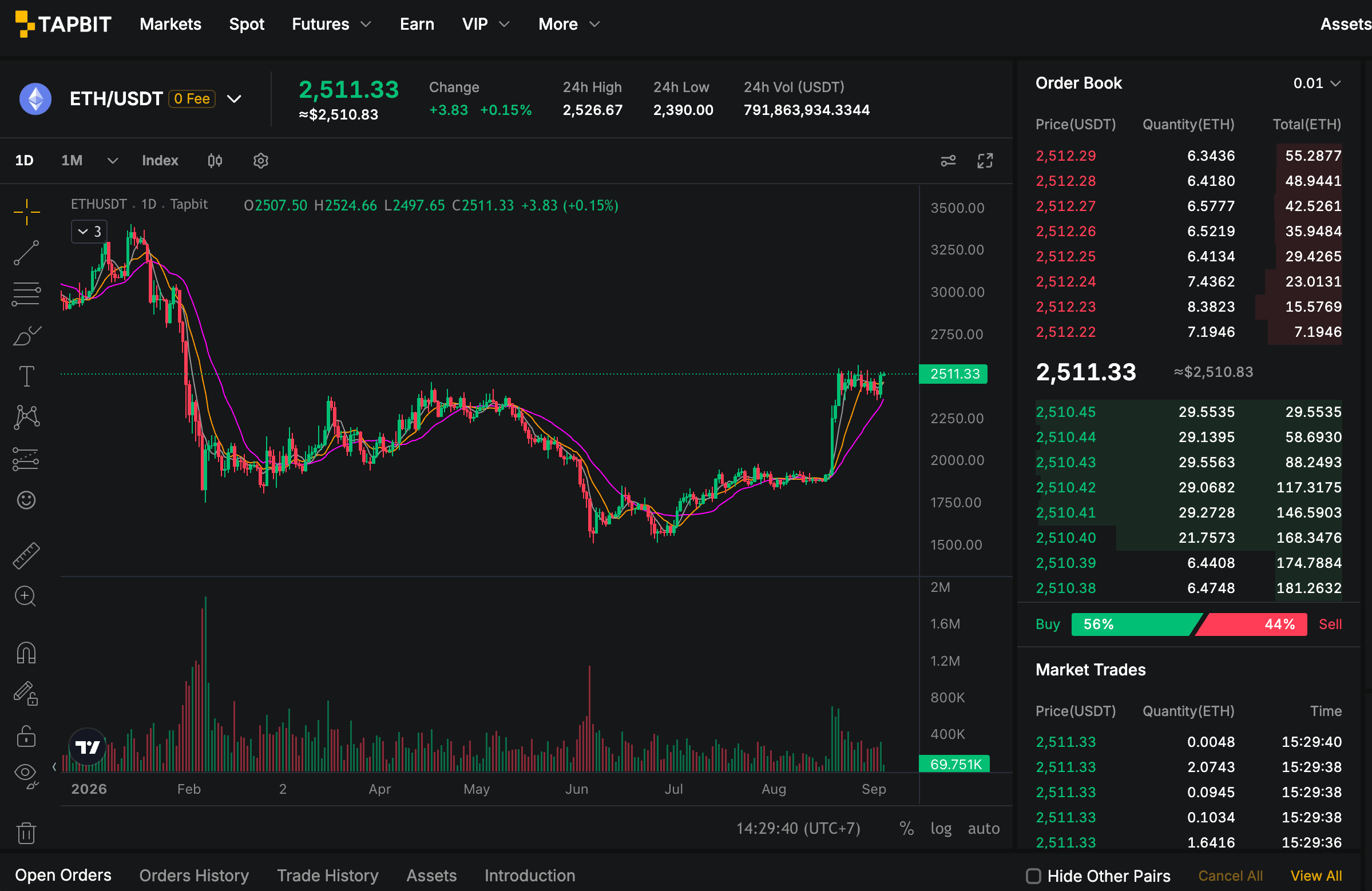
How Far Is Ethereum From $3,000?
From $2,511, ETH needs to rise about 19.5% to reach $3,000. That is achievable in a volatile crypto market, but the path is unlikely to be straight. The first task is to establish $2,500 as support rather than merely trade above it temporarily.
| Price level | Technical role | What it may signal |
|---|---|---|
| $2,400–$2,500 | Near-term support | Bulls are defending the breakout |
| $2,525–$2,600 | Immediate resistance | A close above it may extend momentum |
| $2,750 | Intermediate target | Recovery is broadening |
| $3,000 | Major psychological resistance | Full recovery milestone |
The $3,000 level matters because round numbers often attract profit-taking and new short positions. ETH may briefly touch the target without holding it, so traders should distinguish a wick above $3,000 from sustained closes and follow-through volume.
What Could Push ETH Toward $3,000?
The strongest bullish setup would combine firm spot buying, improving market liquidity and broader strength across Bitcoin and major altcoins. Ethereum-specific demand also matters. More stablecoin transfers, decentralized exchange activity, staking participation and Layer-2 settlement can reinforce the network’s economic relevance, although rising usage does not translate mechanically into immediate price appreciation.
Institutional flows can provide another catalyst when regulated investment products attract sustained net buying. Macro conditions remain important as well: lower real yields, a softer dollar or stronger appetite for risk assets generally make speculative assets easier to support.
Bull, Base and Bear Scenarios
| Scenario | Likely path | Key confirmation |
|---|---|---|
| Bull case | $2,600 → $2,750 → $3,000 | High-volume closes above resistance |
| Base case | $2,350–$2,700 consolidation | Support holds but momentum slows |
| Bear case | Retest of $2,250 or $2,000 | Daily breakdown below $2,400 |
In the bullish scenario, a confirmed break above $2,600 could open room toward $2,750 and then $3,000. The base case is less dramatic: ETH may spend time digesting the rally between $2,350 and $2,700. In the bearish scenario, failure to defend $2,400 could expose $2,250.
Volume, Momentum and False-Breakout Risk
Volume should expand when price clears resistance and contract during orderly pullbacks. If ETH moves above $2,600 while spot volume fades, the breakout may be vulnerable to reversal. Traders should also watch whether price forms higher lows.
Leverage can exaggerate both directions. A crowded long position may trigger liquidations if price slips below support, while heavy short positioning can fuel a squeeze. Spot order flow usually provides a cleaner measure of durable demand than a futures-led surge alone.
Could Ethereum Fall Back Below $2,500?
Yes. The rebound remains exposed to profit-taking, weaker crypto sentiment, regulatory headlines, smart-contract incidents and macro volatility. Ethereum also competes with faster or cheaper networks for users and liquidity.
The first warning would be repeated daily closes below $2,400. A move under $2,250 would suggest that buyers have lost control of the recovery structure. Risk management matters because a 19% upside target does not eliminate the possibility of a double-digit pullback first.
Is Ethereum Heading to $3,000?
The probability has improved after ETH reclaimed $2,500, but $3,000 is not confirmed. The most constructive path would be a controlled retest of $2,500, a higher low and then a decisive break above $2,600 with expanding spot volume. Without those signals, consolidation is more likely than an immediate straight-line rally.
Conclusion
ETH’s rebound above $2,500 is an encouraging technical development, and the $3,000 target requires a meaningful gain of about 19%. Holding the $2,400–$2,500 zone and clearing $2,600 would keep the bullish scenario active. Losing $2,250 would shift attention back toward downside protection. Traders should treat $3,000 as a scenario to confirm, not a guaranteed destination.
FAQ
How much must ETH rise to reach $3,000?
From approximately $2,511, Ethereum needs to gain about 19.5%.
What is the main ETH resistance before $3,000?
The first important area is around $2,525–$2,600, followed by an intermediate zone near $2,750.
What support level should Ethereum hold?
The $2,400–$2,500 range is the key near-term support zone. A loss of $2,250 would weaken the recovery.
Can ETH reach $3,000 quickly?
It can move quickly in a volatile market, but confirmation through price closes, spot volume and higher lows would make the move more credible.


