

The CLARITY Act faces its first major Senate floor test on September 15, 2026, but the scheduled action is not a final vote on the bill. At 2:15 p.m., senators are expected to vote on cloture for the motion to proceed to H.R. 3633. Reaching the 60-vote threshold would open the door to floor debate; failure would block the measure before final passage. For crypto markets, the result matters because the proposal would define how the SEC and CFTC divide authority over digital assets.
Regulatory headlines can move Bitcoin, altcoins and exchange-related tokens quickly. Readers monitoring that volatility can create a Tapbit account and follow markets while keeping position size and risk limits in mind.
The September 15 Senate Test Is Procedural
The Senate Daily Press schedule says the cloture motion ripens on Tuesday, September 15, after the chamber returns on September 14. Cloture would limit debate on whether the Senate should take up the bill. It does not approve the legislation itself.
If at least 60 senators support cloture, the Senate can move toward considering H.R. 3633, debating amendments and eventually holding a final passage vote. If the motion fails, the bill could remain stalled even though the House previously approved its own version.
What the CLARITY Act Would Change
The central goal is to replace years of case-by-case enforcement and overlapping jurisdiction with a statutory market structure. The legislation creates categories for digital assets, introduces registration routes for intermediaries and sets disclosure, custody and customer-protection requirements.
Supporters argue that clearer rules could encourage exchanges, brokers and token issuers to build in the United States. Critics say the definitions and exemptions could create loopholes, weaken investor protections or let securities migrate into a lighter commodities framework.
SEC vs CFTC: Where the Line Would Be Drawn
The proposed division is more nuanced than “SEC for tokens, CFTC for crypto.” The asset, transaction and stage of distribution all matter. The Senate Banking Committee’s CLARITY Act fact sheet describes the intended allocation:
| Area | Proposed lead regulator |
|---|---|
| Token fundraising and issuer disclosures | SEC |
| Digital asset securities and securities intermediaries | SEC |
| Digital commodities and secondary spot commodity markets | CFTC |
| Anti-fraud and anti-manipulation enforcement | Potentially shared or overlapping |
The table is a simplified reading of a complex bill, not a description of current law. The final allocation could change through amendments, negotiations or implementing rules.
Why the 60-Vote Threshold Matters
Market structure legislation has attracted bipartisan interest, but the Senate’s cloture threshold makes a narrow party-line path difficult. A successful vote would signal that supporters have assembled a workable coalition to begin debate. It would not prove that the same coalition will support every amendment or the final bill.
The Senate Banking Committee advanced the measure 15–9 in May. That committee result demonstrated momentum, yet floor consideration exposes the proposal to broader disputes over decentralized finance, ethics, illicit finance, consumer protection and the scope of federal pre-emption.
What the 13% Polymarket Odds Actually Mean
The supplied Polymarket screenshot shows a 13% market-implied chance that H.R. 3633 will be signed into law by December 31, 2026, down 52%, with roughly $12.53 million in volume. This is a point-in-time
market quote based on traders’ positions. It is not an official probability, a poll or a guarante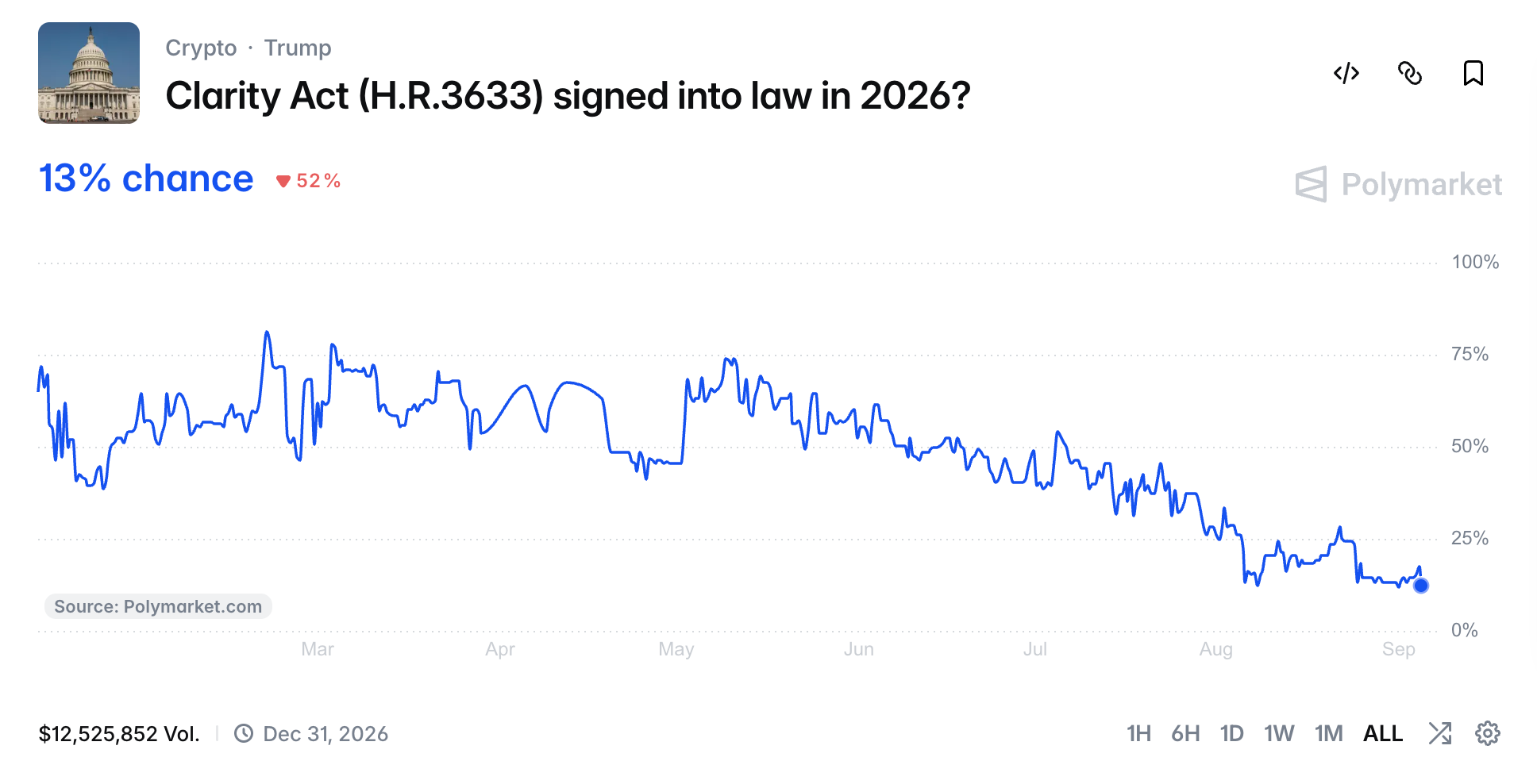 e of the Senate outcome.
Prediction-market odds can change sharply with new whip counts, amendments, scheduling news or a single large trade. They also combine several hurdles—cloture, debate, final Senate passage, reconciliation with the House and presidential action—into one yes-or-no contract.
Potential Impact on Bitcoin, Altcoins and Exchanges
A credible path toward federal market-structure rules could improve sentiment by reducing uncertainty for trading venues, custodians and institutional investors. Bitcoin may benefit from broader risk appetite, while tokens whose regulatory status is disputed could react more strongly because the bill speaks directly to classification and secondary-market oversight.
The opposite reaction is also possible. A failed procedural vote could revive concerns about legislative gridlock, while restrictive amendments could raise compliance costs. Short-term price moves may therefore reflect positioning and leverage rather than a settled judgment about the bill’s long-term economic value.
Why the Bill Still Faces Opposition
Democratic committee staff have argued that the proposal contains gaps involving investor protection, illicit finance, conflicts of interest and regulatory authority. Industry advocates, meanwhile, generally want durable registration paths and clearer treatment of decentralized networks. Those positions overlap in places but diverge on how much discretion regulators should retain.
The bill must also fit the Senate Agriculture Committee’s jurisdiction over the CFTC. Any merged or amended text has to satisfy lawmakers focused on both securities and commodities oversight, making the legislative route more complicated than a single committee vote suggests.
What Happens After the Senate Vote?
If cloture fails, supporters could renegotiate, revise the bill or try again later. If it passes, the Senate proceeds to consideration, where amendments and another vote on final passage would follow. A Senate version that differs from the House bill would then need House approval or reconciliation before it could reach the president.
Conclusion
September 15 is an important test of whether the CLARITY Act can reach the Senate floor, not the day the United States settles crypto regulation. The proposed SEC–CFTC split could reshape token issuance, exchange registration and spot-market oversight, but several legislative steps remain. Traders should treat both political headlines and prediction-market odds as changing inputs, not as certainty.
This article is for informational purposes only and does not constitute legal, investment or trading advice. Crypto assets are volatile, and regulatory outcomes can change quickly.
FAQ
Is the September 15 vote the final CLARITY Act vote?
No. It is scheduled as a cloture vote on the motion to proceed, which determines whether the Senate can move toward debating the bill.
Would the CFTC regulate every cryptocurrency?
No. The proposal distinguishes digital commodities from digital asset securities and preserves an SEC role in securities offerings, disclosures and intermediaries.
What does the 13% Polymarket figure mean?
It is the market-implied price of a contract asking whether H.R. 3633 will be signed into law in 2026. It can move rapidly and is not an official forecast.
Could the bill affect crypto prices?
Yes. Clearer rules may influence risk appetite and business planning, while delays or restrictive amendments could create volatility. Price effects are not guaranteed.


