
A sidecar trading curb is a Korean stock-market safeguard that temporarily makes certain program-trading orders ineligible for execution when index futures move abruptly. It is designed to slow the transmission of a futures-market shock into the cash-equity market. A sidecar is not the same as closing the entire exchange.
The mechanism returned to attention after the KOSPI fell 10.84% to 6,023.66 on July 28, 2026, during a severe semiconductor sell-off. The decline showed why investors need to distinguish among Korea’s volatility controls. A sidecar targets program orders for a short period, while a circuit breaker can halt much broader market trading.
What Is a Sidecar in the Korean Stock Market?
Program trading uses pre-programmed rules to submit baskets of stock orders, often in connection with index futures or options. The strategy can include arbitrage between the futures market and a basket of shares, or non-arbitrage orders involving many index constituents at once.
That connection creates a transmission channel. When futures suddenly fall, automated strategies may send large sell baskets into the cash market. When futures rise sharply, the reverse can happen through program buying. The sidecar gives the market a short pause before those qualifying orders can affect price discovery.
On the KOSPI, Korea Exchange describes program trading as index-arbitrage trading and certain non-arbitrage trading in which the same participant trades more than 15 KOSPI stocks concurrently. KOSDAQ uses a related definition involving at least 10 index constituents. The exact rule matters because the sidecar does not suspend every order submitted by every investor.
How Does a Sidecar Trading Curb Work?
KOSPI and KOSDAQ use different trigger conditions. Both mechanisms require the relevant move to continue for one minute, and both normally restrict affected program orders for five minutes.
KOSPI Sidecar Trigger and Five-Minute Restriction
For the KOSPI market, a sidecar can be activated when the designated futures-market reference rises or falls by more than 5% from its base price and remains beyond that threshold for one minute.
If the futures reference rises, the validity of qualifying program-buy orders is suspended. If it falls, qualifying program-sell orders are suspended. The restriction normally lasts five minutes. After that period, the affected orders can participate in execution according to their original receipt sequence.
The direction is important. The rule attempts to reduce the type of program flow that could reinforce the futures move. It is not a permanent ban on buying or selling, and it does not decide where the market should trade after the pause.
KOSDAQ Sidecar Trigger
KOSDAQ uses a two-part test. KOSDAQ 150 index futures must rise or fall by at least 6% from the relevant base price, while the KOSDAQ 150 cash index must simultaneously move at least 3% from the previous closing value. Both conditions must continue for one minute.
The relevant program bids or offers are then made ineligible for execution for five minutes. Under the KOSDAQ rule, cancellation and correction instructions for the affected orders are also restricted during the pause. When the five minutes end, the orders return to the price-discovery process in receipt order.
Does a Sidecar Halt the Entire Stock Market?
No. This is the most important distinction for readers following breaking-news headlines. A sidecar restricts the validity of specified program-trading orders. It does not automatically stop every cash-equity order, every individual stock or every manually entered retail trade.
Other orders can continue to shape prices, which means the index can still move during the five-minute sidecar window. The mechanism may reduce one source of automated pressure, but it does not remove fundamental news, discretionary selling, margin calls or overseas-market volatility.
A sidecar can also be released under conditions specified by the exchange, including the normal expiry of the five-minute period. KRX rules prevent the mechanism from being newly exercised during the final 40 minutes before the market close, when sufficient time for closing-price formation becomes a priority.
Sidecar vs Circuit Breaker: What Is the Difference?
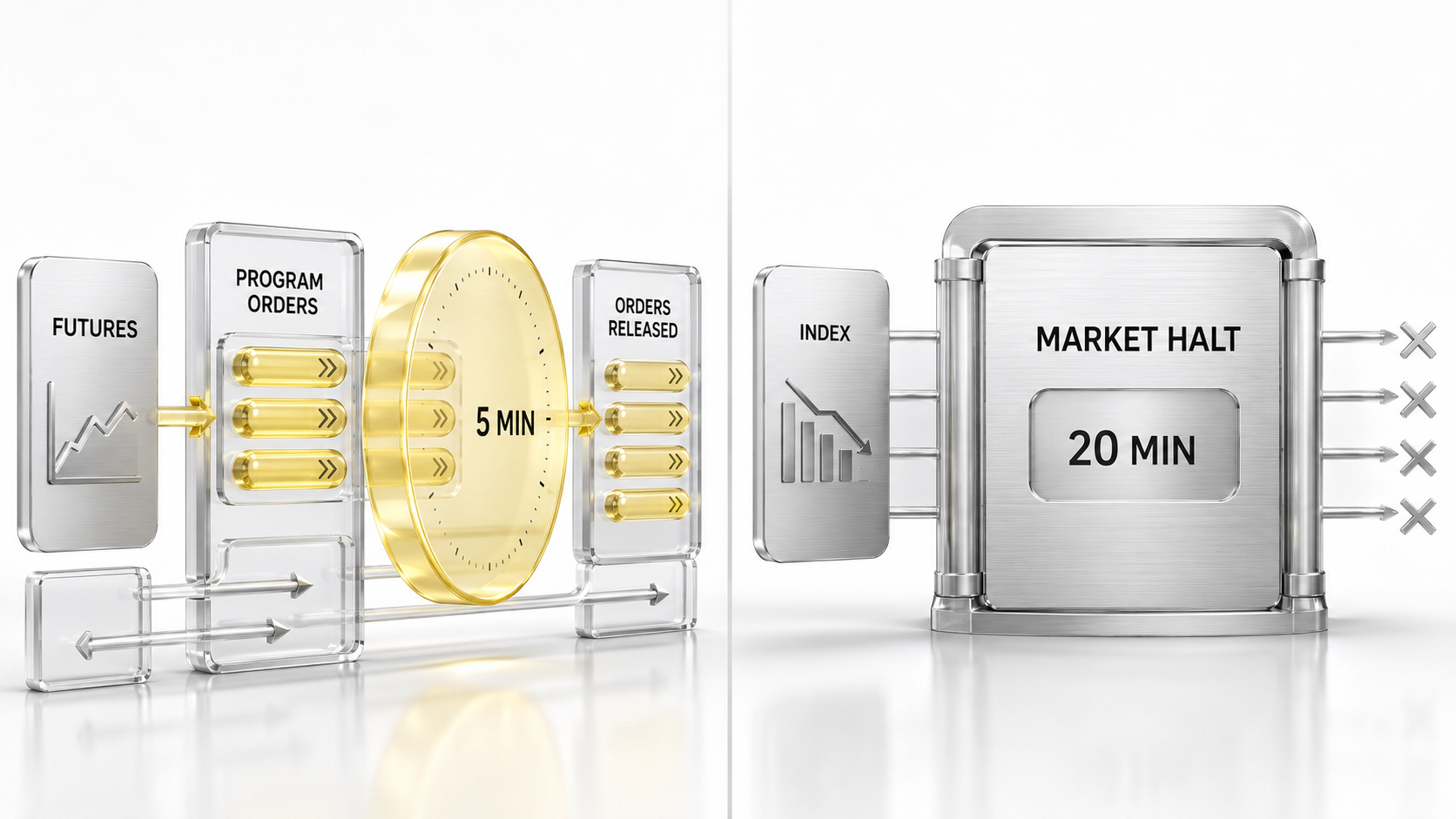
A circuit breaker is broader. On the KOSPI, the first circuit-breaker phase can be triggered when the index falls more than 8% from the previous close and the condition lasts for one minute. The second and third phases involve 15% and 20% declines with additional conditions.
| Feature | Sidecar | Circuit Breaker |
|---|---|---|
| Main trigger | Sharp move in the relevant index-futures reference; KOSDAQ also requires a cash-index move | Severe decline in the cash-market index |
| What is restricted | Qualifying program-trading orders | Broad market order receipt and trading, depending on the phase |
| Normal initial duration | Five minutes | Twenty minutes for KOSPI phases 1 and 2 |
| Main purpose | Slow futures-driven automated order pressure | Create a wider cooling-off period during market disorder |
During a phase 1 or phase 2 KOSPI circuit breaker, the exchange halts order receipt in the stock market and linked futures and options trading for 20 minutes, subject to the official rules. That is very different from a five-minute sidecar aimed at a subset of program orders.
What Happens When the Five Minutes End?
A sidecar is a delay, not a cancellation of the market’s view. When the restriction expires, the paused program orders can participate again according to their receipt sequence. If the underlying news remains negative, selling may resume. If liquidity improves and buyers step in, the market may stabilize.
This is why a sidecar should never be interpreted as a guaranteed rebound signal. It can reduce the speed of one feedback loop, but it does not change company earnings, financing conditions, geopolitical risk or the global semiconductor cycle.
How Sidecar Events Affect Stock-Linked Futures Traders
Stock-linked futures can behave differently from the underlying cash share during a Korean market disruption. The cash market has local trading hours, while a derivative venue may remain available at other times. New information can therefore be reflected first in the derivative, overseas-listed instrument or related sector market.
Tracking differences may also widen when the cash reference is temporarily less liquid or unavailable. Leverage adds another layer: a price gap that would be manageable in an unleveraged share position can cause rapid margin pressure in a futures contract.
Readers following the semiconductor sell-off can review Tapbit Learn’s explanations of the HBM memory outlook and the broader AI chip-stock cycle. Those fundamentals remain relevant even when an exchange safeguard temporarily changes order flow.
How to Review SKHYNIX-USDT During Korean Market Volatility
Tapbit’s SKHYNIX-USDT stock-linked futures are a derivative linked to SK Hynix-related price movement. The contract is not a Korean ordinary share or a U.S.-listed depositary share. It provides no direct company ownership, voting rights or dividends.
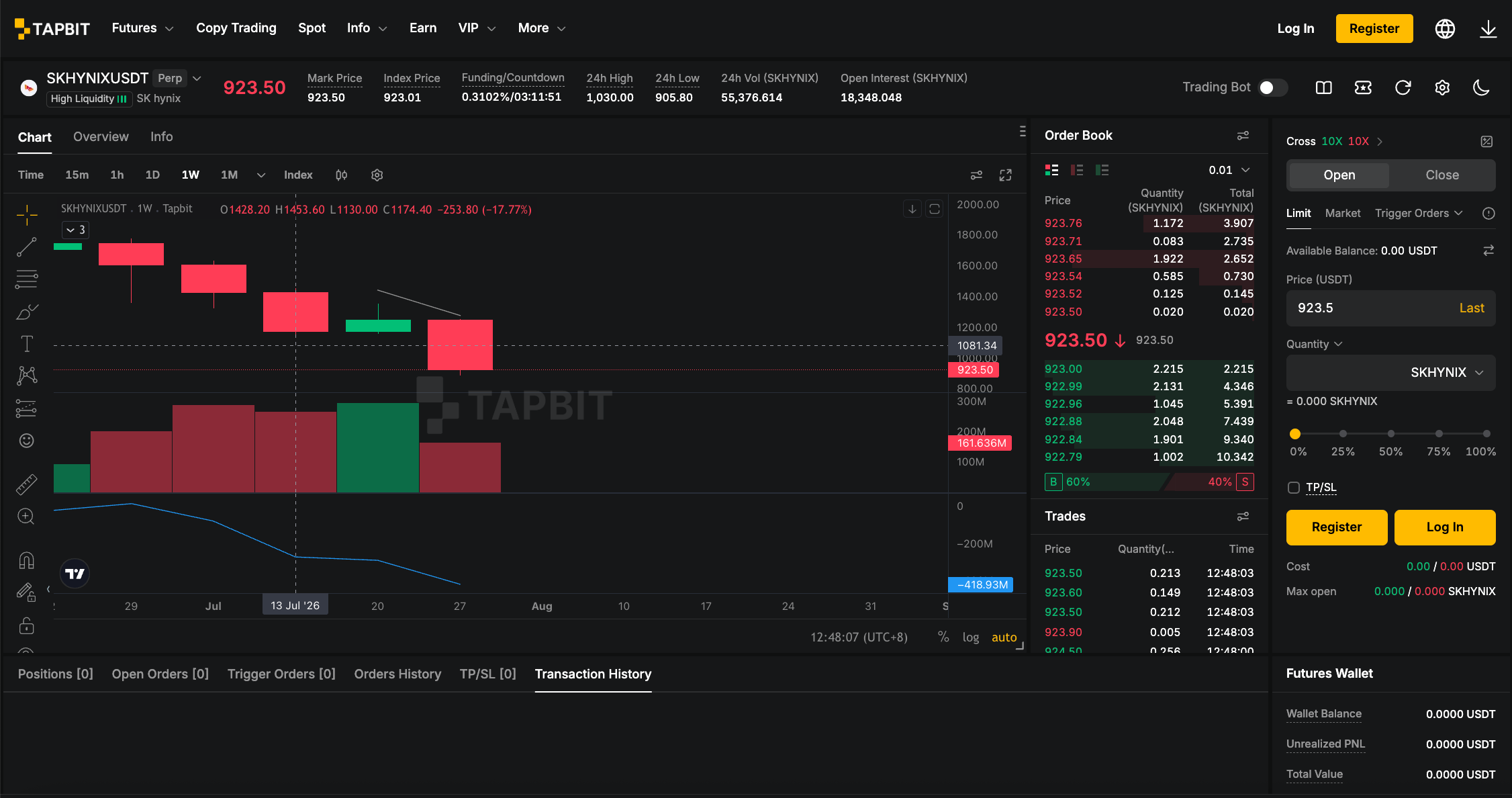
A KRX sidecar does not automatically halt this Tapbit contract. Traders should therefore check both the Korean cash-market status and the derivative’s own reference price, liquidity and risk conditions.
- Step 1: create an account and fund the futures account.
- Step 2: Open SKHYNIX-USDT and review the contract price, reference source, funding information, order book and available leverage.
- Step 3: Check whether the Korean cash market is open and whether a sidecar or circuit breaker has affected normal price discovery.
- Step 4: Define the position size and invalidation level before entering, then monitor tracking differences and liquidation risk.
The practical takeaway is simple: a sidecar is a short restriction on program-order validity, not a complete market closure. Understanding that distinction helps traders interpret Korean market headlines without assuming that every order or every related derivative has stopped trading.


