
SOXX is the ticker for the iShares Semiconductor ETF, a fund designed to track a U.S. semiconductor-sector index. It trades on Nasdaq like a stock, but it is not one semiconductor company. Each share represents an interest in a portfolio of chip and chip-equipment businesses.
As of July 24, 2026, iShares reported 30 holdings. The fund’s official exposure breakdown was approximately 78.44% semiconductor companies and 21.43% semiconductor-equipment companies, with a small cash or derivatives balance. Its expense ratio was 0.34%.
What Is the SOXX ETF?
SOXX seeks to track the NYSE Semiconductor Index. The basic purpose is to give investors sector exposure without requiring them to choose a single company. Instead of relying only on one GPU designer, memory producer or equipment supplier, the fund spreads capital across multiple businesses in the semiconductor value chain.
That diversification is useful, but it should not be confused with broad-market diversification. Every major holding is still connected to the chip cycle. A fall in AI capital expenditure, memory pricing, foundry utilization or equipment orders can affect many holdings at the same time.
How Does SOXX Work?
Investors buy and sell SOXX shares on an exchange. The market price is determined through trading, while the fund also calculates a net asset value based on the value of its portfolio. The two figures normally remain close, although small premiums or discounts can appear.
SOXX Holds Semiconductor and Equipment Companies
The fund spans two main official categories. Semiconductor companies include businesses involved in chip design, processors, networking, memory and manufacturing. Semiconductor-equipment companies supply tools and systems used to fabricate advanced logic and memory chips.
This structure means SOXX can benefit from several different parts of the AI buildout. More accelerators can support compute-chip demand. Larger models increase networking and memory requirements. New fabrication capacity can support equipment orders. The same structure can also transmit a sector downturn across the basket.
SOXX Expense Ratio, Distributions and Tracking
The current prospectus expense ratio is 0.34%. The fee is not normally charged as a separate invoice to the investor; it is reflected in the fund’s operating expenses and performance. Over a long holding period, even a relatively small annual fee creates a difference from the benchmark.
SOXX has a quarterly distribution frequency. The amount is not fixed. As of June 30, 2026, iShares reported a 12-month trailing yield of 0.23%, which shows that the primary investment case is sector price exposure rather than a high-income strategy.
What Companies and Industry Segments Are Inside SOXX?
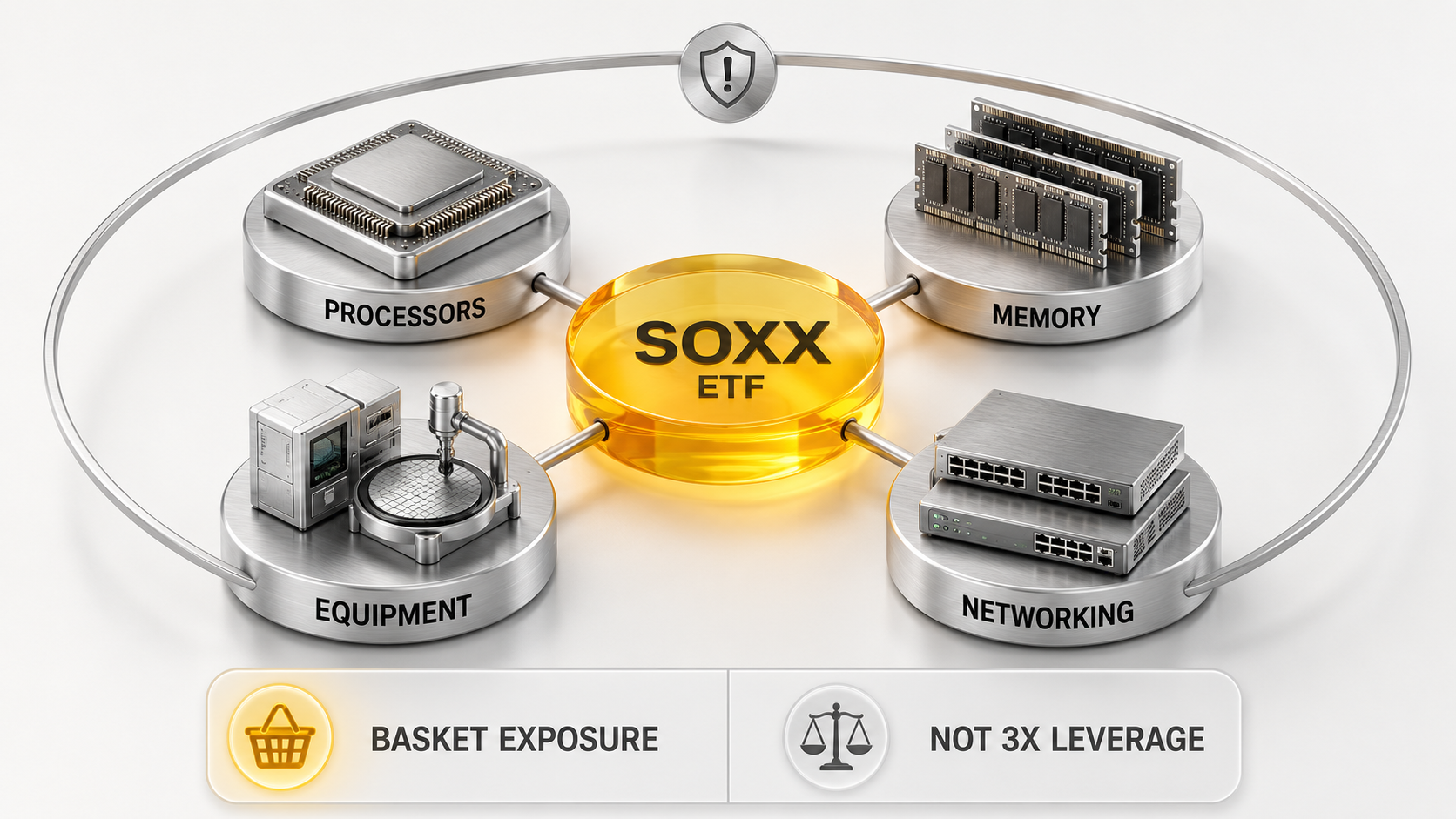
Holdings and weights change, so a durable analysis should focus on the economic roles inside the portfolio rather than treating one dated list as permanent.
| Segment | Role in the Semiconductor Chain | Main Risk |
|---|---|---|
| AI processors and accelerators | Provide compute for training and inference | AI capital-expenditure slowdown or stronger competition |
| Memory | Supply HBM, DRAM and NAND for servers and devices | Pricing cycles and capacity expansion |
| Semiconductor equipment | Provide lithography, deposition, etching and testing tools | Fab spending delays and export controls |
| Networking and connectivity | Move data among servers, accelerators and storage | Data-center budget changes and product transitions |
The current official sector split shows why SOXX is broader than a pure Nvidia trade but narrower than a general technology ETF. It captures both chip demand and the capital equipment required to produce chips.
Is SOXX Only an Nvidia ETF?
No. Nvidia can have a large influence on semiconductor sentiment, especially during an AI-led market, but SOXX is a basket. Memory companies may rise when HBM pricing improves even if GPU expectations are stable. Equipment suppliers may react to foundry capital expenditure or export rules. Networking companies can move on their own product cycles.
Still, holding 30 securities does not eliminate concentration. The portfolio is concentrated by industry and can also be concentrated in its largest positions. When the whole semiconductor theme becomes crowded, correlations among the holdings often rise.
SOXX vs SOXL: What Is the Difference?
SOXX and SOXL are connected to the semiconductor sector, but their structures and intended uses are very different.
| Feature | SOXX | SOXL |
|---|---|---|
| Structure | Non-leveraged semiconductor ETF | Leveraged ETF targeting 300% of daily benchmark performance before fees and expenses |
| Daily reset | No 3X daily objective | Yes |
| Main use | Sector exposure | Short-term leveraged semiconductor trading |
| Compounding risk | Normal ETF tracking and fee effects | Path dependence and volatility decay can materially change multi-day results |
Tapbit Learn’s SOXL glossary explains why a daily 3X target does not guarantee three times the benchmark return over weeks or months.
What Are the Main Risks of SOXX?
Sector concentration: The fund can fall sharply when investors reduce semiconductor exposure, even when the broader market is relatively stable.
High volatility: As of June 30, 2026, iShares reported a three-year equity beta of 2.00 and a three-year standard deviation of 35.47%. These figures can change, but they illustrate that SOXX has recently moved much more aggressively than a lower-volatility broad-market fund.
Valuation risk: Strong AI expectations can push prices ahead of near-term earnings. A company may report growth and still fall if the market had expected more.
Cycle risk: Semiconductor supply takes time to build, but new capacity can eventually create oversupply. Memory and equipment businesses are particularly sensitive to changes in pricing and capital expenditure.
Policy risk: Export controls, trade restrictions and national semiconductor policies can affect equipment sales, customer access and supply chains.
For a broader view, Tapbit Learn’s SOXX alternatives guide explains the difference between owning ETF shares and using other instruments for semiconductor price exposure.
SOXX ETF Ownership vs Semiconductor Stock-Linked Futures
Owning SOXX through a brokerage means holding shares of the ETF under the applicable fund, custody and market rules. A stock-linked futures contract is different. It is a derivative tied to the price movement of one company rather than ownership of the SOXX basket.
Tapbit’s confirmed semiconductor-related contracts include NVDA-USDT, SKHYNIX-USDT, MU-USDT and SNDK-USDT. These products represent different company exposures and do not recreate the diversification or distribution profile of SOXX.
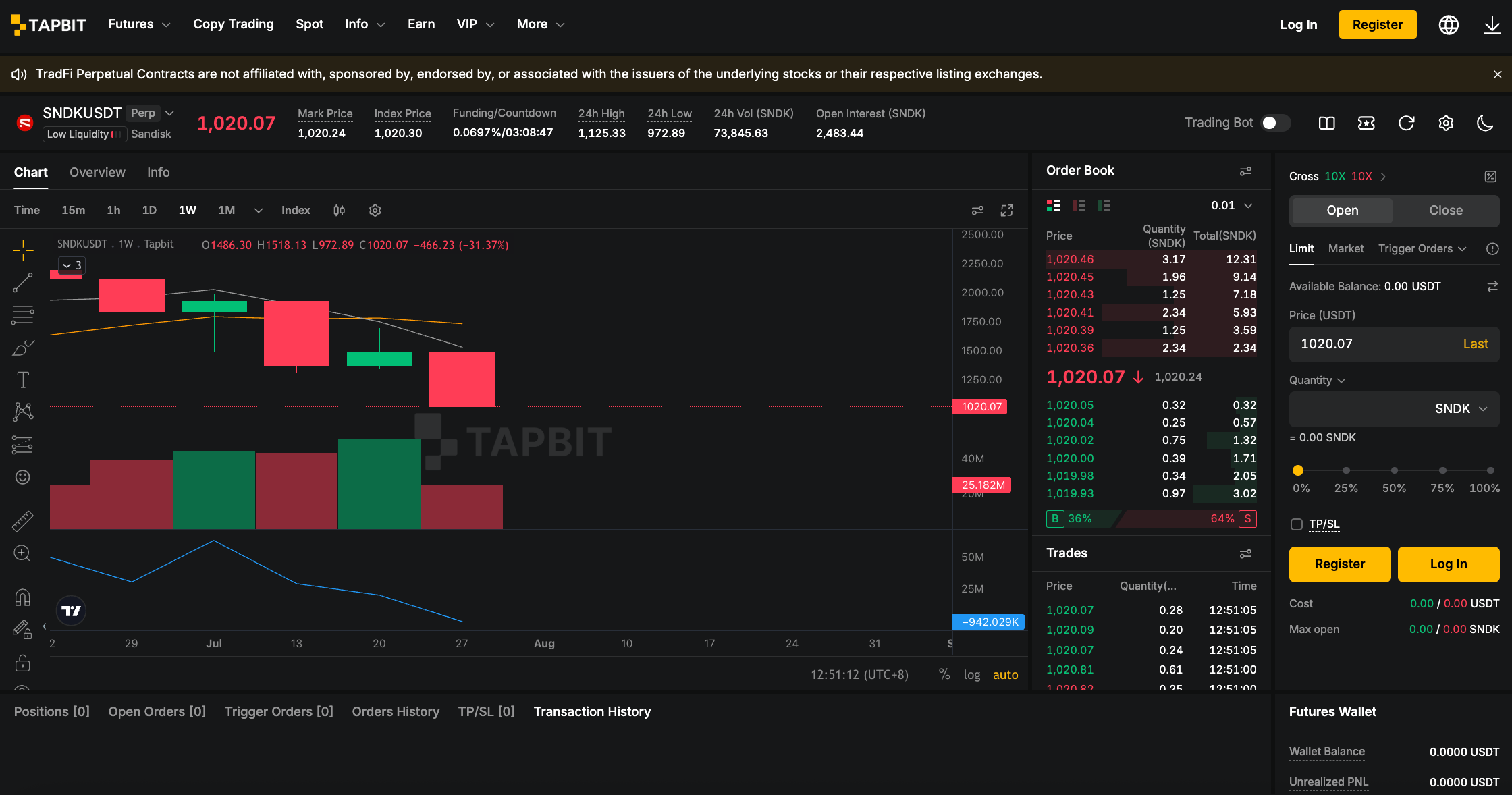
Each contract is a derivative, not direct ownership of the underlying company. It does not provide shareholder voting rights, direct dividends or an ETF interest.
How to Review Semiconductor Stock-Linked Futures on Tapbit
- Step 1: create an account and fund the futures account.
- Step 2: Select a confirmed contract based on the specific exposure required: AI compute, HBM, diversified memory or NAND storage.
- Step 3: Review the contract’s reference price, liquidity, funding, margin mode and leverage instead of assuming it behaves like SOXX.
- Step 4: Define the maximum loss and invalidation level, then monitor company news and the wider semiconductor sector.
SOXX is best understood as a concentrated semiconductor basket. It reduces the risk of relying on one company, but it remains highly sensitive to AI spending, memory pricing, equipment demand and policy changes across the chip industry.


