
HBM memory remains central to the artificial intelligence hardware boom, but the latest stock-market move shows why strong demand and rising share prices are not always the same thing. On July 14, 2026, SK Hynix traded near ₩1.729 million after a 12.66% decline. In the U.S. session on July 13, Micron traded near $937 and Nvidia near $203.53, with both stocks falling as investors reduced exposure to AI-linked names.
The market is not arguing that AI systems suddenly stopped needing memory. It is asking a more difficult question: how much growth is already priced into HBM suppliers, and can production, pricing and margins continue beating expectations?
This article explains the HBM market outlook, why supply is difficult to expand, how HBM3E and HBM4 change the competitive landscape and what investors should monitor in SK Hynix, Micron, Samsung and Nvidia. Price references are based on July 13–14, 2026 snapshots and should be refreshed before publication.
HBM Memory Market Snapshot
High-bandwidth memory has moved from a specialist component into a major financial-market theme. AI accelerators process enormous amounts of data, and those processors need memory that can deliver information quickly enough to prevent expensive computing cores from sitting idle.
| Market Reference | Latest Snapshot | Why It Matters to HBM |
|---|---|---|
| SK Hynix 000660 | About ₩1.729M, down 12.66% | Leading HBM supplier and direct memory-cycle signal |
| Micron MU | About $937, down 4.3% | U.S.-listed HBM and DRAM exposure |
| Nvidia NVDA | About $203.53, down 3.5% | Major AI accelerator demand signal |
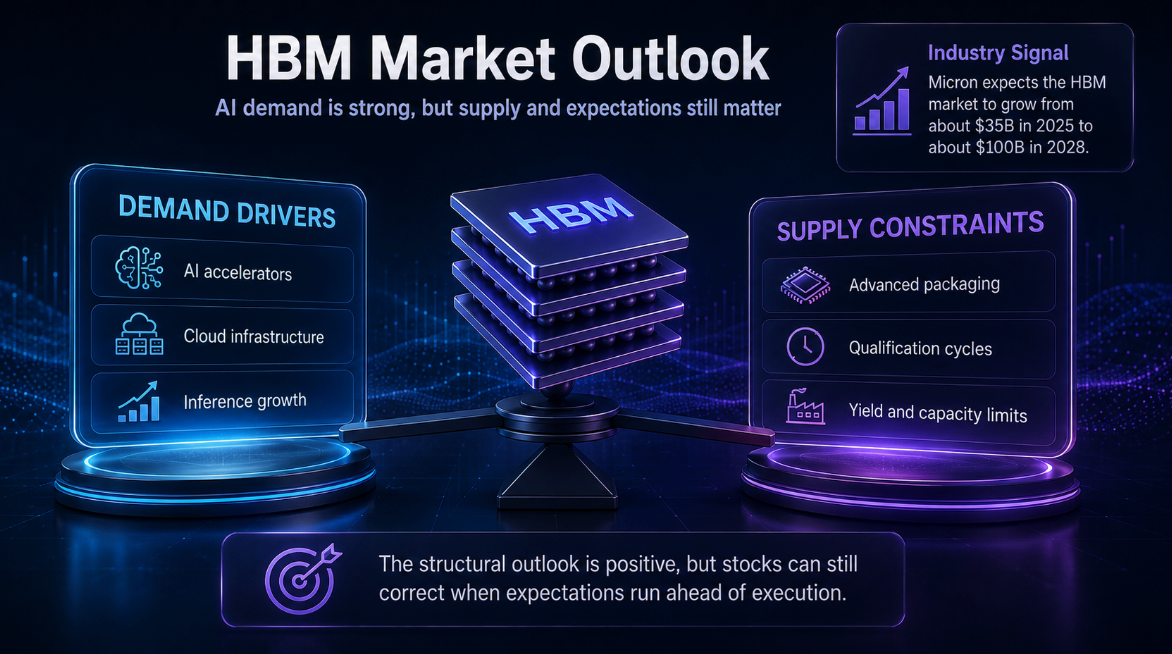
| Micron HBM market forecast | About $35B in 2025 to $100B in 2028 | Shows the expected scale of industry growth |
The stock declines do not contradict the market-size forecast. Share prices react to the difference between expectations and reality. If investors expect HBM revenue to grow extremely fast, merely strong growth may not be enough to push valuations higher.
Why HBM Memory Demand Is Growing
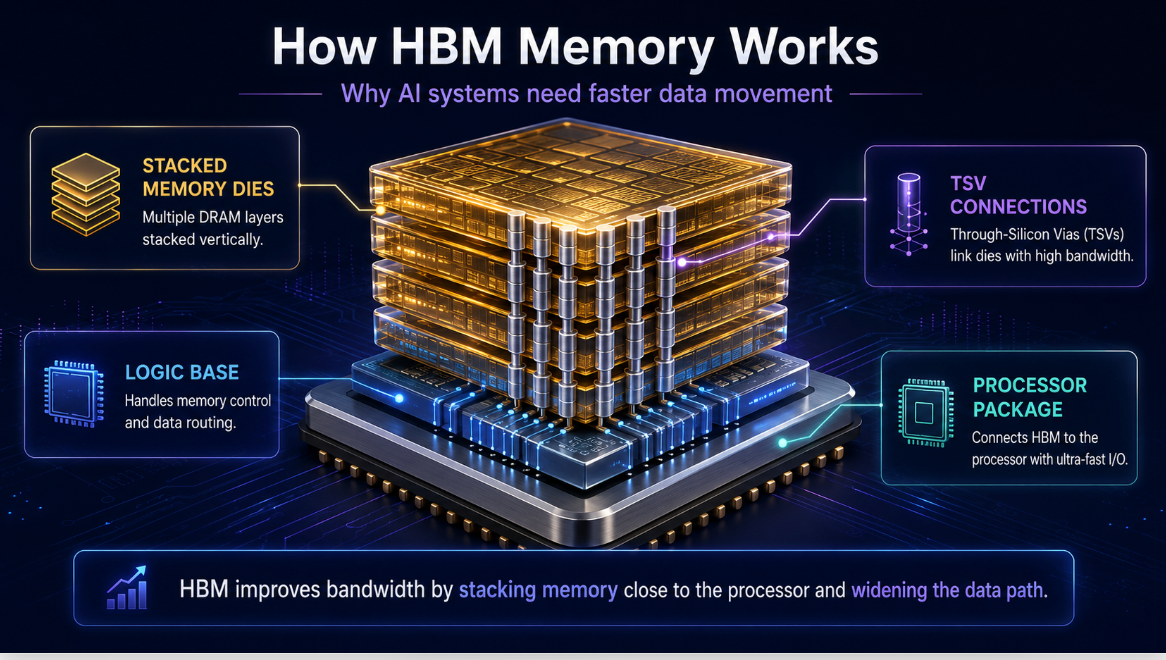
HBM solves a basic AI-computing problem: moving data. A modern accelerator can perform vast numbers of calculations, but it needs a constant flow of model weights, activations and intermediate results. Conventional memory designs can become a bottleneck because the connection between the processor and memory is too narrow or too power-hungry.
HBM places stacked memory very close to the processor and uses an unusually wide interface. Instead of forcing data through a narrow road at extreme speed, the design creates many lanes. That allows more data to move at once and can improve energy efficiency for large parallel workloads.
Demand is rising for several reasons:
- AI models are becoming larger and more memory-intensive.
- Inference workloads are expanding beyond initial model training.
- Cloud providers are building larger accelerator clusters.
- New AI systems use more memory per accelerator package.
- Customers want better performance per watt as power becomes a data-center constraint.
HBM is therefore not a temporary accessory to GPUs. It is part of the system-level performance equation.
Why HBM Supply Cannot Expand Quickly
Producing more HBM is not as simple as adding ordinary memory chips to a production line. The process combines advanced DRAM manufacturing with stacking, vertical connections, packaging, testing and customer qualification.
Stacking and TSV Complexity
HBM uses multiple memory dies stacked vertically. Through-silicon vias, usually called TSVs, create electrical paths through the dies. The stack must be thin, aligned and reliable. A defect in one layer can affect the value of the complete package, making yield management extremely important.
Advanced Packaging Capacity
The memory stack must be integrated close to an accelerator through advanced packaging. Packaging capacity, substrates, interposers and testing equipment can become bottlenecks even when DRAM wafer supply is available.
Customer Qualification
AI customers do not buy a new HBM generation only because a supplier announces it. The product must pass performance, thermal, reliability and system-level qualification. That process can take time and can delay revenue even when engineering samples are ready.
This supply complexity is why the broader semiconductor stocks cycle matters. Equipment, foundry, packaging and memory companies are connected. A bottleneck in one part can change pricing and delivery schedules across the chain.
HBM3E, HBM4 and HBM4E
HBM generations represent more than a simple speed upgrade. Each transition can change interface design, power requirements, stack height, packaging and how closely memory suppliers work with processor designers.
HBM3E remains important for current AI accelerators. HBM4 expands the design challenge by increasing bandwidth and introducing more logic and customization at the base-die level. HBM4E pushes the roadmap further for future systems.
SK Hynix announced in June 2026 that it shipped samples of 12-layer HBM4E to major customers. The announcement supports the view that competition is moving toward earlier co-development and more customized products. It also raises the execution bar. A supplier must deliver performance, yield, heat management and timely mass production at the same time.
SK Hynix, Micron and Samsung HBM Strategies
| Company | Strategic Strength | Key Risk | Market Signal |
|---|---|---|---|
| SK Hynix | Established HBM leadership and fast product roadmap | Very high investor expectations and concentration in AI-memory sentiment | 000660 and SKHY price action |
| Micron | U.S. market access, HBM growth and broader memory portfolio | Capital intensity and traditional memory-cycle exposure | MU earnings, margins and HBM guidance |
| Samsung | Large manufacturing scale and broad semiconductor capabilities | Execution and customer-qualification pressure | Korean chip-sector performance and qualification updates |
SK Hynix
SK Hynix has become the clearest pure market symbol for the HBM theme. Its advantage is product leadership and close alignment with major accelerator demand. Its risk is that the share price can react violently when investors think future growth is already fully reflected.
Micron
Micron expects the HBM market to grow rapidly and has said its 2026 HBM supply was covered by price-and-volume agreements. The company also expects a Singapore facility to contribute meaningfully to HBM packaging capacity in the first half of 2027. That supports growth, but it also shows that additional supply is coming.
Samsung
Samsung has scale, manufacturing depth and a broad memory portfolio. Its key question is execution: whether new HBM products can meet customer requirements and enter high-volume systems on schedule. Strong competition from Samsung can expand total supply and pressure pricing, even if it is positive for the AI industry.
How HBM Prices Affect Memory Stocks
HBM can improve the product mix of a memory company because it is more specialized than ordinary commodity DRAM. Strong contract pricing and tight supply can support gross margins. That creates operating leverage: a relatively small increase in price or high-value product mix can produce a much larger increase in profit.
The reverse is also true. If capacity expands too quickly, customer demand slows or yield improves across the industry, the scarcity premium can fall. Stocks may decline before reported HBM revenue peaks because equity markets try to anticipate the next stage of the cycle.
This explains why AI chip stocks can sell off during a period of strong industry revenue. The market is not only pricing today’s demand; it is pricing whether future growth will be better or worse than expected.
HBM Memory Market Outlook for 2026
The structural outlook remains positive, but the path is unlikely to be smooth.
| Scenario | HBM Market Conditions | Likely Stock Impact |
|---|---|---|
| Bull case | AI capex accelerates, HBM4 supply stays tight and pricing remains firm | Memory earnings estimates rise and leading suppliers recover strongly |
| Base case | Demand grows while new supply gradually enters | Revenue expands but stocks trade in wide valuation ranges |
| Bear case | AI projects slow, capacity ramps faster than demand or qualification delays emerge | Pricing expectations weaken and high-multiple stocks correct |
Bull Case
The bull case requires cloud companies and model developers to keep raising infrastructure budgets. HBM4 would need to remain difficult to supply, allowing leading producers to maintain pricing power. Strong customer agreements and limited packaging capacity would keep the market tight.
Base Case
The base case is continued HBM growth with more normal stock volatility. Revenue increases, but suppliers invest heavily and customers gain more options. The industry remains attractive without producing uninterrupted price appreciation.
Bear Case
The bear case is not that AI disappears. It is that the rate of investment slows while production capacity catches up. Memory is historically cyclical. If too much supply arrives after a period of scarcity, prices and margins can fall quickly.
Signals to Watch
Investors should track evidence rather than broad AI slogans:
- HBM shipment and revenue guidance from SK Hynix and Micron;
- customer qualification of HBM4 and HBM4E;
- gross margin and capital expenditure;
- Nvidia and hyperscaler data-center demand;
- advanced-packaging capacity and lead times;
- DRAM and NAND contract pricing;
- changes in analyst earnings estimates.
The wider AI stocks narrative can influence sentiment, but HBM suppliers should be judged on memory-specific economics.
Trading HBM-Related Stock Exposure on Tapbit
Tapbit users can review several confirmed stock-linked futures markets connected to the AI-memory theme:
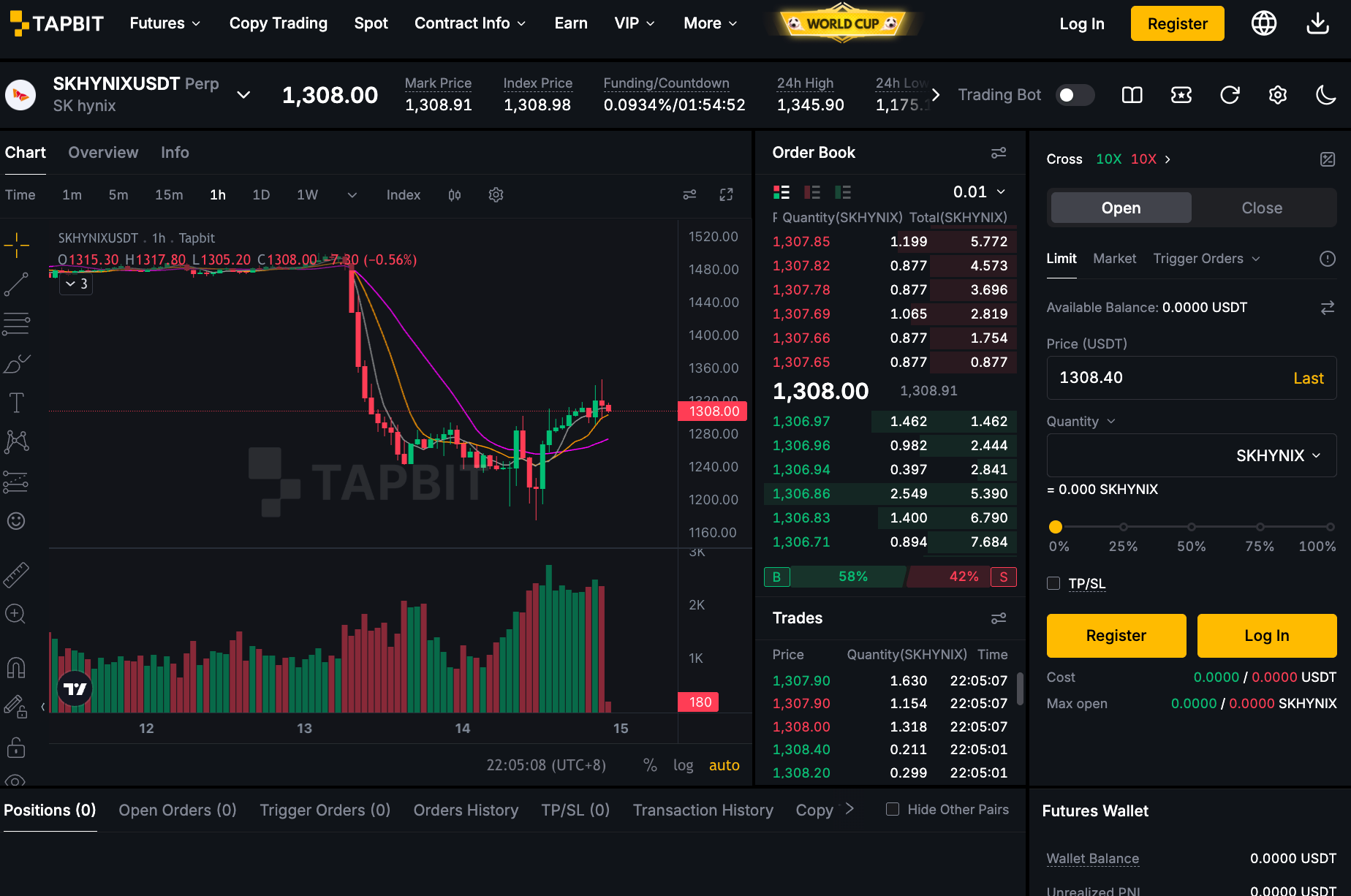
These contracts provide price exposure only. They are not direct ownership of SK Hynix, Micron or Nvidia shares and do not provide shareholder voting rights or dividends. Traders can create an account, then review the contract specification, leverage, funding, liquidity and regional availability before opening a position.
Final HBM Memory Outlook
HBM memory remains one of the strongest structural growth areas in semiconductors. Micron’s forecast of a market expanding from about $35 billion in 2025 to around $100 billion in 2028 shows why investors continue to focus on the sector.
The investment conclusion is more balanced. Strong demand can support revenue and margins, but high expectations, new capacity and memory cyclicality can create sharp stock corrections. The 2026 base case is continued market expansion with volatile supplier valuations. The bull case requires tight HBM4 supply and rising AI spending. The bear case begins if capacity growth overtakes demand or customers delay major projects.
FAQ
What is HBM memory used for?
HBM is used in AI accelerators, high-performance computing and other systems that need very high memory bandwidth and energy-efficient data movement.
Is there still an HBM shortage?
Supply remains constrained by advanced manufacturing, stacking, packaging and customer qualification, although new capacity is being built.
Which companies make HBM?
The main large suppliers are SK Hynix, Samsung and Micron.
Why can HBM stocks fall when AI demand is strong?
Stocks price future expectations. They can fall if growth is already priced in, valuation is high or investors expect future supply to reduce margins.
Could HBM become oversupplied?
Yes. If capacity expands faster than AI demand, HBM pricing and supplier margins could weaken. The timing is uncertain because production and qualification are complex.


