

A meme stock is a publicly traded security that becomes unusually popular through social media, online communities and retail-investor discussion. The label does not describe a formal asset class. It describes a market behavior in which attention, community narratives and positioning can become as important as earnings or valuation over short periods.
Investor.gov links meme stocks with strong online popularity and elevated trading activity. The most famous examples involved GameStop and AMC, but the underlying mechanism can appear in any stock with a compelling narrative, concentrated retail interest, limited float or heavy short positioning.
How Does a Stock Become a Meme Stock?
A stock usually becomes a meme stock when several conditions overlap. The company may have a recognizable consumer brand, a turnaround story or a conflict between retail investors and institutional short sellers. Online communities then turn the stock into a shared narrative.
Attention alone is not enough. The market structure must allow that attention to move price. A stock with a small free float, high short interest or active options market can respond more violently than a very large, liquid company with widely distributed ownership.
- Rapid growth in social posts and search interest
- Unusually high trading volume
- Heavy short interest or crowded bearish positioning
- Large call-option purchases
- A simple narrative that spreads quickly
- Strong price momentum that attracts new participants
How Social Media Affects Meme-Stock Prices
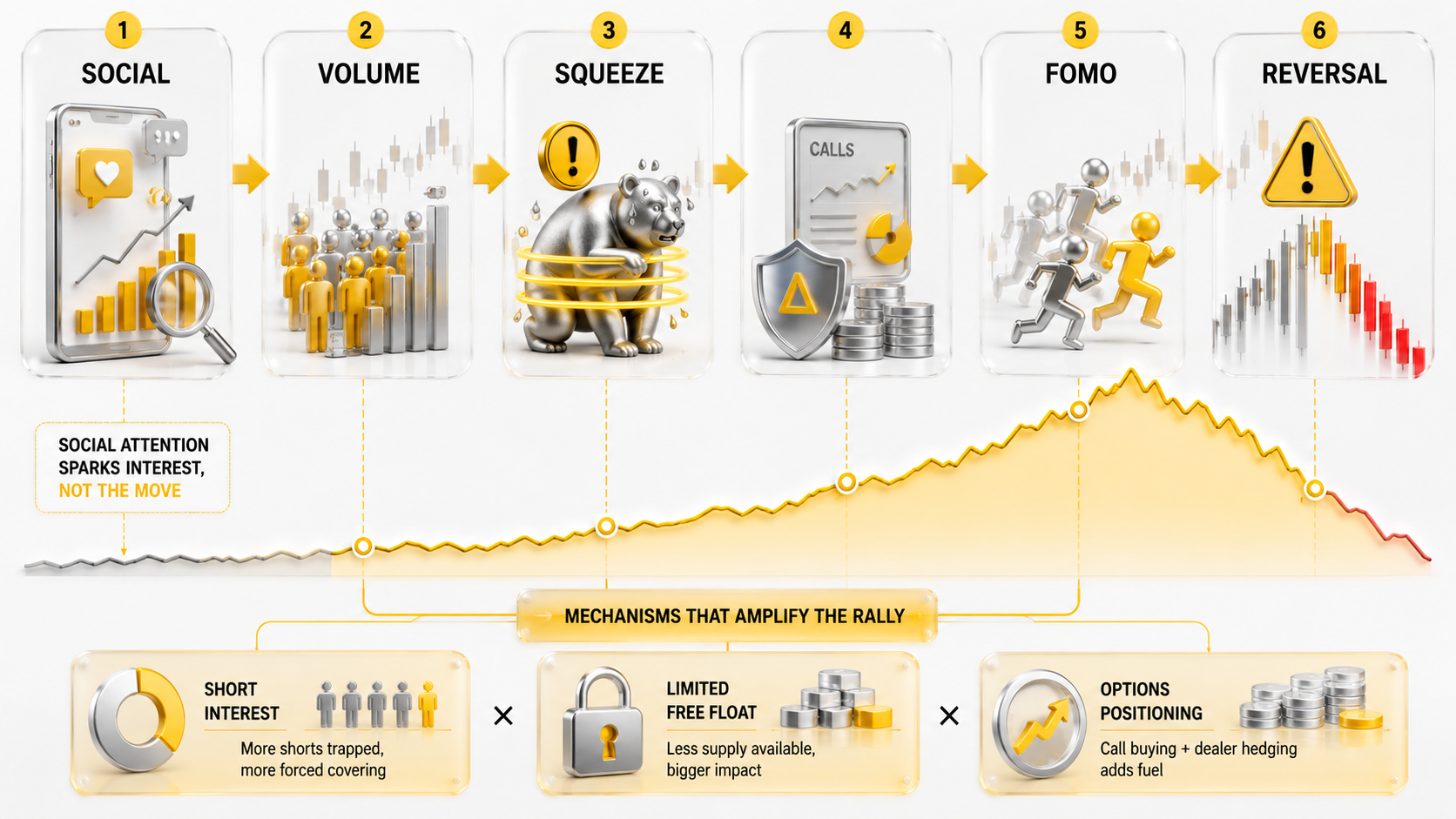
The typical feedback loop begins with discussion. Search interest and social posts increase, bringing more people to the ticker. Buying pushes the price higher, and the price move becomes new content for social media. That creates even more attention.
The loop can appear self-reinforcing, but it is unstable. Social posts are often reactive rather than predictive. A community may become most enthusiastic after a large rally has already occurred. Late buyers then face a poor risk-reward profile because the narrative is strongest when the price is most extended.
Academic studies of meme-stock episodes have found measurable links among online activity, volume and market regimes. They also show that social signals are not consistently accurate enough to replace fundamental or market-structure analysis.
Short Squeeze, Gamma Squeeze and FOMO
Short Squeeze
A short seller borrows shares and sells them, expecting to buy them back later at a lower price. If the stock rises instead, losses increase. The short seller may be forced to repurchase shares to limit risk or meet margin requirements. Those purchases add more demand and can accelerate the rally.
Gamma Squeeze
A gamma squeeze can occur when traders buy large amounts of call options. Dealers who sold those calls may buy shares to hedge their exposure. As the stock rises, the hedge requirement can increase, producing additional buying. This process depends on option strikes, expiry dates and dealer positioning; not every call-heavy rally becomes a gamma squeeze.
FOMO
Fear of missing out attracts traders after visible gains. FOMO can extend momentum, but it also increases the number of buyers with weak conviction and poor entry prices. When momentum stops, those traders may sell at the same time.
Meme Stock vs Ordinary Growth Stock
| Factor | Meme Stock | Ordinary Growth Stock |
|---|---|---|
| Short-term driver | Attention, positioning and momentum | Earnings and business expectations |
| Volatility | Often extreme | Usually more connected to fundamentals |
| Options activity | Frequently central | Varies by company |
| Valuation discipline | Can weaken temporarily | More consistently monitored |
| Reversal risk | Very high | Depends on fundamentals and valuation |
How to Evaluate a Meme Stock
Short interest is the first structural metric. A very high short-interest ratio can create squeeze potential, but it can also indicate serious business problems. Free float matters because a smaller tradable supply can make each new wave of demand more powerful.
Volume should be compared with normal activity. One high-volume session may be event-driven; repeated elevated volume suggests broader participation. Options open interest, especially near popular call strikes, can reveal whether dealer hedging may influence the move.
Fundamental checks remain essential. Revenue, cash flow, debt, share issuance and insider sales help determine whether the company can support a higher valuation after the attention fades.
Main Meme-Stock Risks
Overnight gaps: the stock may open far below the prior close, limiting the usefulness of stop orders.
Liquidity reversal: volume can disappear quickly when social attention shifts.
Dilution: companies may issue new shares into a rally, increasing supply.
Options expiry: hedging demand can change abruptly near expiry.
Narrative reversal: the same online community that promoted the stock may move to another ticker.
Readers can compare these dynamics with Tapbit Learn’s analysis of leveraged stock-market exposure and the guide to treasury-driven stock risk.
How Tapbit Fits Into Meme-Stock Risk Education
Tapbit should not be presented as a venue for every meme stock. When an exact stock is unsupported, the useful lesson is the product structure rather than a forced trading recommendation.
Tapbit offers confirmed stock-linked futures for selected companies. These contracts are derivatives, not direct shares. They do not provide voting rights, shareholder ownership or dividends. Their prices may track an underlying stock, but leverage, funding and liquidation create an additional risk layer.
The same momentum behavior seen in meme stocks can become more dangerous in a leveraged derivative. A sharp reversal that causes a manageable loss in an unleveraged share position may liquidate a futures position. Users should therefore review the underlying asset, contract specifications, margin and invalidation levels before trading.
After understanding those differences, users can create an account to review confirmed stock-linked contracts. The purpose is to understand derivative mechanics, not to treat any supported ticker as a meme-stock recommendation.
Final Assessment
A meme stock is driven by a combination of narrative, community attention and market structure. Social media can start the feedback loop, but short interest, float, options and liquidity determine how far it travels. The largest risk appears when popularity is mistaken for durable company value.
Frequently Asked Questions
Is every popular stock a meme stock?
No. A meme stock usually combines unusual online attention with abnormal trading activity and momentum.
What causes a meme-stock squeeze?
Short covering, call-option hedging and FOMO can reinforce one another.
Are meme stocks illegal?
No. However, fraud, market manipulation and misleading statements can violate securities laws.
Can a meme stock fall to zero?
Yes. Social popularity does not remove bankruptcy, dilution or business risk.


