

Seagate Technology Holdings plc (STX) has become one of the more closely watched storage stocks as investors try to connect artificial intelligence demand with hard-drive and data-center infrastructure spending. The question many traders are asking is direct: is Seagate stock a buy or sell after the latest volatility?
The short answer is that STX does not look like a clean buy at any price setup. Based on the charts provided, Seagate has strong momentum drivers but also meaningful downside risk. The better way to frame the stock is as a conditional buy for investors who believe AI storage demand can keep improving earnings, and a hold or avoid for traders who dislike sharp post-earnings swings.
For traders who prefer to follow derivatives-style price movement, the STXSTOCKUSDT contract on Tapbit gives a direct way to track Seagate-linked price action, order-book pressure, and short-term volatility.
Is Seagate Stock a Buy or Sell Right Now?
Seagate stock looks more like a high-volatility AI infrastructure trade than a traditional defensive technology holding. The company sits inside a market narrative that investors understand: AI workloads need more data, more servers, more storage capacity, and better enterprise infrastructure. That narrative can support a premium valuation when earnings are improving.
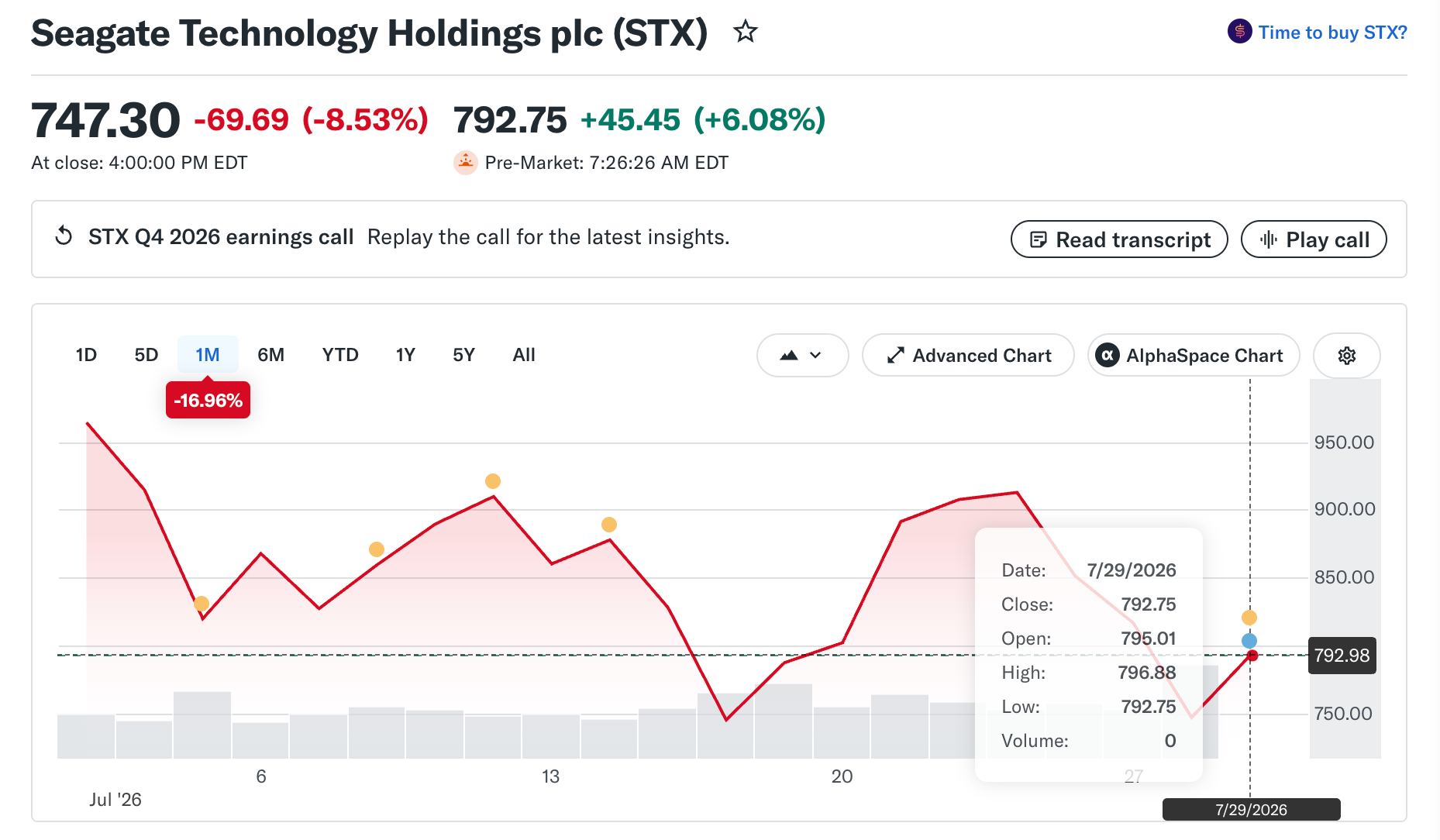
However, the stock's recent action also shows why chasing after a sharp rally can be dangerous. In the supplied stock chart, Seagate closed at 747.30, down 8.53%, before rebounding pre-market to 792.75. That kind of move suggests buyers are still interested, but it also confirms that the market is aggressively repricing the stock around earnings expectations.
For long-term investors, STX may be attractive if earnings growth and AI-related storage demand continue to strengthen. For short-term traders, the setup requires caution because the stock can move quickly in both directions.
STX Price Today: What the Latest Charts Show
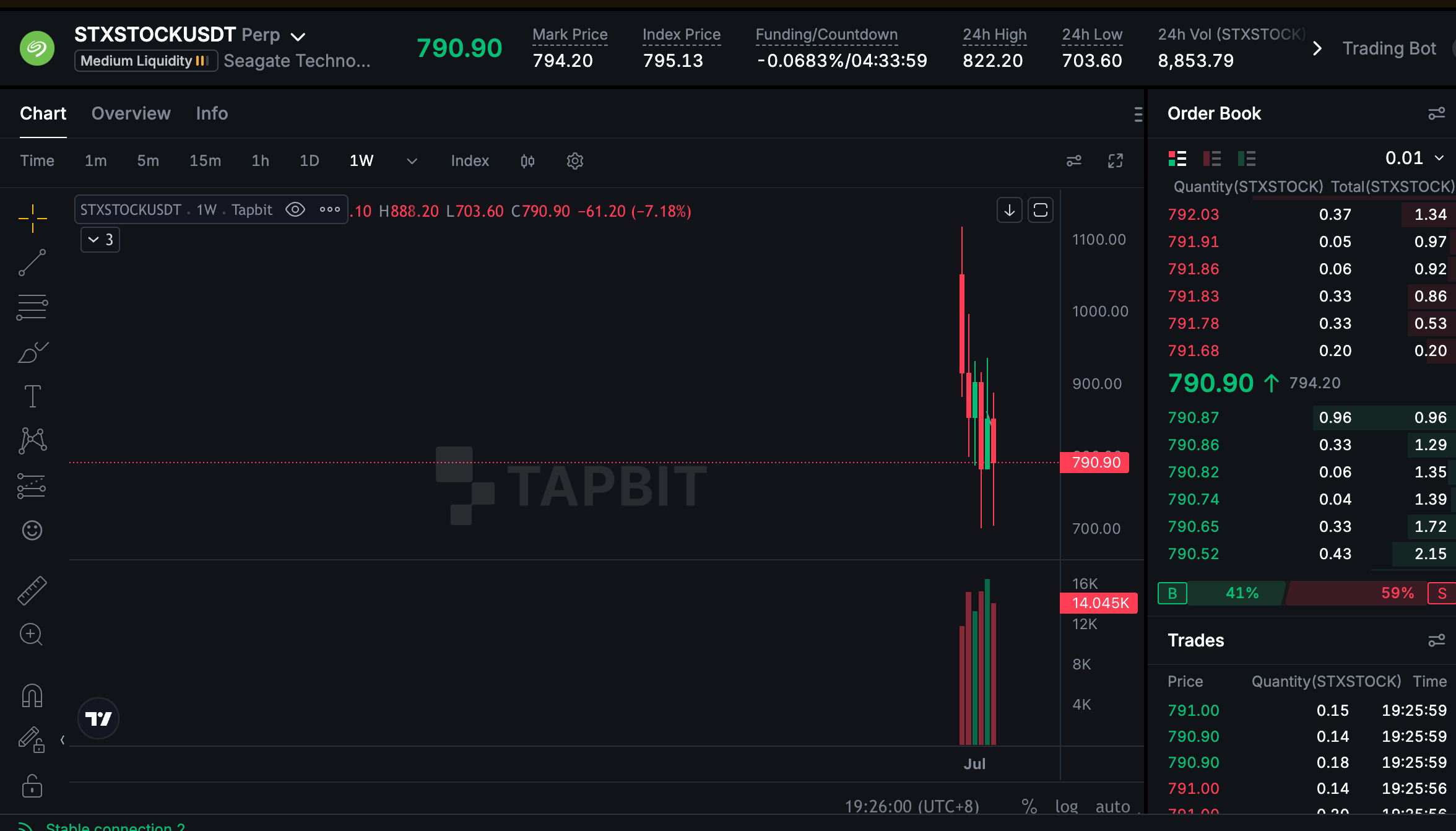
The supplied Tapbit screenshot shows STXSTOCKUSDT trading near 790.90, with a mark price around 794.20 and an index price near 795.13. The 24-hour range shown in the image runs from 703.60 to 822.20, which is a very wide band for a stock-linked derivatives market. That tells traders the move is not quiet consolidation; it is active repricing.
The same screenshot also shows a weekly candle down about 7.18%, while the order book snapshot leans slightly more toward sell-side pressure than buy-side pressure. This does not automatically mean the next move must be lower, but it does suggest that traders are still debating whether the rebound is sustainable.
The separate Seagate stock chart gives a broader equity-market view. It shows a regular-session close of 747.30 after an 8.53% drop, followed by a pre-market move to 792.75. The one-month performance shown in the screenshot is down 16.96%, which means the stock has not fully recovered from recent pressure even after the pre-market bounce.
Why Seagate Stock Is Moving
The main reason Seagate remains in focus is the overlap between storage demand and the AI infrastructure cycle. AI models, cloud workloads, enterprise data retention, and high-capacity storage systems all require larger and more efficient storage solutions. While Nvidia and major cloud names often capture most of the attention, storage companies can also benefit when data-center investment expands.
Seagate's stock has also been sensitive to earnings expectations. When investors believe the company is entering a stronger margin and demand cycle, the stock can re-rate quickly. But when the market senses that the move has gone too far, profit-taking can be just as aggressive.
That is why STX currently trades like a momentum stock tied to the AI buildout, not merely like a mature hardware company. The opportunity is real, but so is the volatility.
The Buy Case for Seagate Stock
The bullish argument starts with demand. If AI infrastructure spending remains strong, storage capacity becomes increasingly important. Training data, inference workloads, enterprise archives, cloud backups, video datasets, and compliance storage all create pressure for more high-capacity systems.
Seagate also benefits if enterprise customers move from inventory digestion back into active purchasing. A hardware company can see meaningful earnings leverage when revenue improves after a weak cycle because fixed costs and manufacturing utilization matter. If margins recover faster than expected, investors may be willing to assign STX a higher multiple.
Another point in favor of the bull case is that the supplied chart shows buyers stepping back in after a heavy selloff. A pre-market rebound does not prove a new uptrend, but it does suggest the market is not abandoning the stock entirely.
The Sell Case: Why STX Still Looks Risky
The bear case is just as important. Seagate is still a cyclical hardware stock. Demand can improve quickly, but it can also weaken if cloud budgets slow, enterprise spending pauses, or customers delay upgrades. That makes the stock more vulnerable than software or platform companies with recurring revenue profiles.
The recent price action also raises valuation risk. When a stock rallies strongly on an AI-related narrative, expectations can become difficult to beat. Even a good earnings report may not be enough if traders already priced in a perfect scenario.
The Tapbit screenshot also shows a wide 24-hour range and notable sell-side pressure in the displayed order book. That does not mean STX must fall, but it does reinforce that traders should avoid oversized positions and should not treat the rebound as risk-free.
Seagate Stock Price Levels to Watch
| Price Area | Why It Matters |
|---|---|
| 703-750 | This is the lower volatility zone shown in the provided charts. A break back toward this area would signal renewed selling pressure. |
| 790-800 | This is the current rebound zone based on the supplied screenshots. Holding this area would support the bull case. |
| 822 | The 24-hour high shown on Tapbit. A move above this area could suggest momentum buyers are returning. |
| 880-900 | A higher resistance zone visible in the broader stock chart. Failure near this region could attract profit-taking. |
These are not guaranteed support or resistance levels. They are practical zones based on the price action visible in the screenshots and should be used alongside broader market conditions, earnings guidance, and risk management.
STXSTOCKUSDT on Tapbit: How Traders Can Follow the Move
One reason traders monitor STXSTOCKUSDT is that stock-linked perpetual markets can show how short-term participants are positioning around major equity moves. The contract screen provides real-time price movement, market depth, 24-hour high and low, volume, and funding information.
This can be useful for traders who want to compare the spot stock reaction with derivatives-market sentiment. If the underlying stock rebounds but the contract remains under pressure, that may suggest caution. If both markets stabilize together, the rebound case becomes more credible.
Still, stock-linked perpetual contracts carry additional risks, including leverage, funding changes, liquidity gaps, and non-trading-hour volatility. Traders should understand the product before using it.
Buy, Sell, or Hold: Practical View
For conservative investors, Seagate may be a hold rather than a fresh buy after such large swings. Waiting for price stability, clearer earnings guidance, or a retest of support may reduce the risk of buying into a temporary bounce.
For growth-oriented investors, STX may still be interesting if they believe AI storage demand is underappreciated. In that case, position sizing matters. A staged entry may make more sense than buying all at once after a volatile earnings reaction.
For short-term traders, the answer depends on whether STX can stay above the 790-800 area and challenge the recent 822 high. If it fails to hold that zone, the risk of another drop toward the lower range increases.
Conclusion
Seagate stock is not an obvious sell simply because it dropped, but it is also not an automatic buy just because AI storage demand is a strong theme. The stock sits at the intersection of a powerful long-term narrative and a highly volatile short-term chart.
The better answer is conditional: STX may be a buy for investors who believe AI infrastructure demand will keep supporting storage growth and who can tolerate sharp pullbacks. It may be a hold or avoid for investors who prefer lower volatility, clearer valuation support, or steadier earnings visibility.
This article is for informational purposes only and does not constitute financial advice. Stock and derivatives trading involve risk, and users should evaluate their own financial situation before making any trading decision.
FAQ
Is Seagate stock a buy now?
Seagate may be a conditional buy for investors who believe AI storage demand will keep improving earnings, but the recent volatility means it is not a low-risk entry.
Why did Seagate stock fall?
The supplied chart shows a sharp regular-session decline, likely reflecting profit-taking, earnings-related volatility, and concern that the recent rally had priced in strong expectations.
Why did STX rebound pre-market?
The pre-market rebound shown in the screenshot suggests buyers were willing to step back in after the selloff, possibly because the long-term AI storage narrative remains intact.
What is STXSTOCKUSDT?
STXSTOCKUSDT is a Tapbit stock-linked perpetual contract that tracks Seagate-related price action for traders who want derivatives-style exposure.
Is Seagate stock risky?
Yes. Seagate remains exposed to hardware cycles, data-center spending, earnings expectations, valuation pressure, and sharp price swings.


