

QBTS stock closed at $19.51 on July 27, 2026, up 20.36% in D-Wave Quantum’s first session on Nasdaq. The shares traded between $17.75 and $19.54, with volume near 48.5 million shares. The rally followed an expanded commercial agreement with AT&T for quantum optimization across telecom network operations.
The move combined three powerful signals: a recognizable enterprise customer, a measurable early performance result and a technology-company listing on Nasdaq. It did not resolve the main investment question. D-Wave still needs to show that successful optimization projects can become repeatable revenue at a scale that supports its valuation.
QBTS Stock Today: Why Shares Jumped 20.36%
D-Wave entered the session with a previous close near $16.21. The AT&T announcement pushed the stock above the prior trading range, and the shares finished only three cents below the daily high. Closing near the high suggests that buyers maintained control into the end of the session rather than treating the announcement only as a premarket spike.
The $19.54–$20 area is now the first resistance and confirmation zone. A sustained move above $20 would indicate that the market is willing to hold the higher valuation after the initial news reaction. The $17.75 intraday low is the first support reference, while the pre-rally close near $16.21 is a more important downside level if momentum reverses.
Why the D-Wave and AT&T Agreement Matters
The agreement matters because quantum-computing companies are often valued on technical roadmaps that may take years to produce commercial results. AT&T provides a current operational use case rather than a laboratory benchmark.
A Real Network-Optimization Use Case
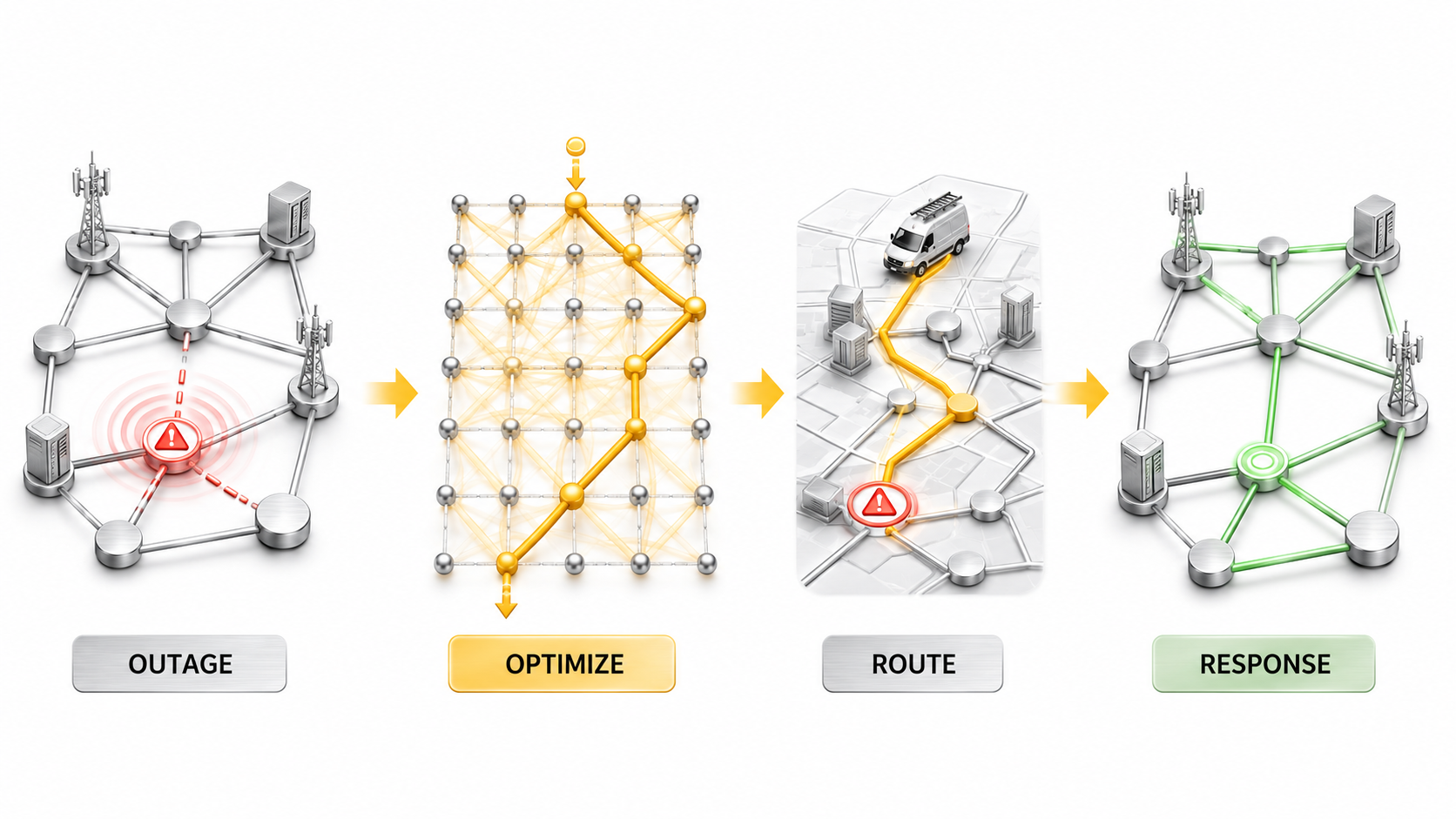
AT&T plans to expand the use of D-Wave’s annealing technology in tools supporting agentic AI across its network. The companies identified outage detection and response, technician routing, network-build planning and traffic management as potential applications.
In early work, AT&T reduced the processing time for a network-optimization task from approximately one hour to less than 15 seconds using D-Wave technology. That result is important because scheduling and routing are the types of combinatorial optimization problems for which quantum annealing is designed.
AT&T also said its wider agentic tools reduced customer downtime by 12 million hours in 2025. The expanded agreement aims to layer D-Wave’s optimization capabilities into that existing operational framework rather than building a disconnected proof of concept.
Commercial Validation Is Not the Same as Revenue Scale
The announcement did not disclose a contract value. A successful technical result can strengthen credibility, but investors still need to know how usage is priced, how broadly the system will be deployed and whether the agreement produces recurring revenue.
The strongest confirmation would be evidence that AT&T moves from selected applications to wider production use, followed by similar contracts with other enterprises. Without that conversion, the agreement may remain strategically valuable but financially small.
Does the Nasdaq Transfer Change the QBTS Investment Case?
D-Wave transferred its listing from the New York Stock Exchange to Nasdaq after the close on July 24, and trading began on Nasdaq on July 27 under the same QBTS ticker. The transfer does not change the company’s shares, underlying business or financial statements.
Nasdaq can improve D-Wave’s visibility among technology-focused investors and index or screening systems. The timing also gave the AT&T news an additional narrative: the company’s Nasdaq debut became associated with a major commercial customer and a 20% rally.
Listing venue alone is not a fundamental catalyst. Revenue, bookings, cash use, technology delivery and customer adoption remain more important than the exchange name.
What Makes D-Wave Different From Other Quantum Companies?
D-Wave now describes itself as a dual-platform quantum company. Its established commercial positioning is built around annealing, while its longer-term roadmap also includes gate-model systems.
Quantum Annealing and Near-Term Optimization
Quantum annealing is designed to search for low-cost solutions to complex optimization problems. It is relevant to routing, scheduling, resource allocation, manufacturing and other tasks where the number of possible combinations becomes very large.
The AT&T agreement fits this model. The objective is not to replace every classical system. It is to use quantum and hybrid tools for a narrow optimization layer inside a larger operational workflow.
Gate-Model Expansion and Execution Risk
D-Wave completed its acquisition of Quantum Circuits in January 2026, adding error-corrected superconducting gate-model technology. The company’s published roadmap targets a 17-physical-qubit system in 2026 and, ultimately, 100 logical qubits capable of more than one million operations by 2032.
Those milestones are company targets, not guaranteed outcomes. Gate-model development expands D-Wave’s potential market, but it also adds integration costs, capital requirements and technical execution risk. The stock can benefit from a larger vision while remaining vulnerable if timelines slip.
Tapbit Learn’s 2026 quantum-computing reality check explains why commercial usefulness, error correction and security implications need to be separated from speculative headlines.

Is QBTS Stock a Buy After the 20% Rally?
The rally strengthens the short-term chart, but a one-day move does not determine whether the stock offers a favorable risk-reward profile. The answer depends on whether the AT&T agreement improves D-Wave’s financial outlook and whether the price can hold above the breakout area.
QBTS Bull Case
The bull case requires AT&T to expand production usage, additional enterprises to adopt annealing solutions and bookings to translate into visible revenue. Progress in the gate-model program would broaden the story, while strong cash resources could reduce near-term financing pressure.
Technically, the case improves if QBTS closes and holds above $20 rather than briefly trading through it. Continued high volume without an immediate return below $17.75 would show that the market is accepting the new range.
QBTS Bear Case
The bear case is that the announcement provides strong publicity but limited financial contribution. Quantum projects can remain in evaluation for long periods, and D-Wave must fund research, hardware, sales and the integration of Quantum Circuits.
A break below $17.75 would weaken the immediate post-news structure. A move below $16.21 would erase the rally and suggest that investors are again prioritizing revenue scale, dilution and cash burn over partnership momentum.
QBTS Stock Forecast: Bull, Base and Bear Scenarios
| Scenario | Main Catalyst | Initial Confirmation or Invalidation |
|---|---|---|
| Bull | AT&T deployment expands, bookings improve and Q2 guidance supports commercialization | Sustained close above $20 with continued volume |
| Base | Commercial progress continues, but revenue remains small relative to valuation | QBTS builds a range between roughly $17.75 and $20 |
| Bear | Earnings disappoint, cash use rises or the partnership lacks financial detail | Break below $17.75, followed by the $16.21 pre-rally reference |
The levels are market reference points rather than guaranteed targets. Earnings data can quickly invalidate a chart-based scenario, especially in a high-volatility emerging-technology stock.
What Investors Should Watch in D-Wave’s August 6 Earnings
D-Wave is scheduled to report second-quarter 2026 results on August 6. The most important numbers are revenue, bookings, remaining performance obligations, gross margin, operating cash use and the company’s cash balance.
Investors should also look for any financial detail on the AT&T agreement, customer concentration, production deployment and the cost of integrating Quantum Circuits. Share issuance and dilution matter because a company can grow its business while reducing the value attributable to each existing share.
Management commentary on the 2026 gate-model milestone will also be important. A roadmap becomes more credible when the company shows completed engineering steps rather than only distant targets.


