
Tectonic is a decentralized lending protocol on the Cronos blockchain. Users can supply supported crypto assets to earn variable interest or borrow assets after depositing collateral. The protocol became a major news topic on August 31 after Cronos halted its network while investigating an exploit involving Tectonic.
Independent researchers estimated the impact at approximately $75 million after identifying more than one address. CoinDesk reported that thin TONIC liquidity may have allowed the token price to be pushed roughly 100 times higher within about 20 minutes, inflating the value recognized by the lending market. These findings remain preliminary. In the latest public reporting reviewed on September 1, Tectonic and Cronos still had not published a final postmortem confirming the precise root cause, total loss, restart timetable or depositor compensation.
What Is Tectonic Crypto?
Tectonic is a decentralized money market. Instead of a bank matching depositors and borrowers, smart contracts manage asset pools, interest rates, collateral requirements and liquidations. Suppliers deposit assets into a pool and receive a claim on their funds plus accrued interest. Borrowers post eligible collateral and take another asset from the available liquidity.
Interest rates change with utilization. When borrowing demand uses more of a pool, rates can rise to encourage new supply and discourage additional borrowing. When liquidity is abundant, rates may fall.
Tectonic operates on Cronos and is distinct from the Crypto.com app and exchange. The organizations exist within the broader Cronos ecosystem, but a protocol deposit is not the same as an exchange balance. This distinction became especially important during the incident.
What Is the TONIC Token?
TONIC is Tectonic's native token. It has been used for protocol incentives, governance-related participation and staking mechanisms connected to protocol revenue. Token utility and current parameters can change, so users should verify them in official documentation.
Liquidity matters when any token is accepted as collateral. A token can have a quoted price while still being difficult to trade in meaningful size. CoinDesk reported TONIC liquidity around $1.34 million and daily volume around $11,000 before the incident. In such a thin market, a relatively modest amount of buying can move the observable price much more than it would in a deep market.
How Does Borrowing Work on Tectonic?
Collateral Factor
A collateral factor determines how much borrowing power a deposited asset creates. If a token has a 20% factor, a protocol-recognized value of $100 could support about $20 of borrowing. This conservative percentage is intended to provide a buffer against price changes.
The protection only works if the recognized price is reliable. If an oracle reports an inflated market price, the protocol may believe the collateral is worth much more than it could actually be sold for.
Oracle Price
An oracle supplies external price information to a smart contract. Some systems aggregate several venues, use time-weighted averages or apply liquidity checks. The design goal is to prevent one small or manipulated market from becoming the protocol's authoritative valuation.
Oracle risk is not limited to faulty code. A formally correct oracle can still produce a dangerous result if its source market is too thin, updates too quickly after a price spike or lacks adequate deviation controls.
Liquidation
If collateral value falls and a loan becomes undercollateralized, liquidators can repay part of the debt and receive collateral at an incentive. This mechanism is supposed to keep the protocol solvent. It can fail when collateral cannot be sold near the oracle price or when the market moves faster than liquidations can execute.
What Happened in the Reported Tectonic Exploit?
According to current onchain analysis and reporting, the apparent sequence was as follows. It should remain labeled “reported” until the projects publish a final technical account.
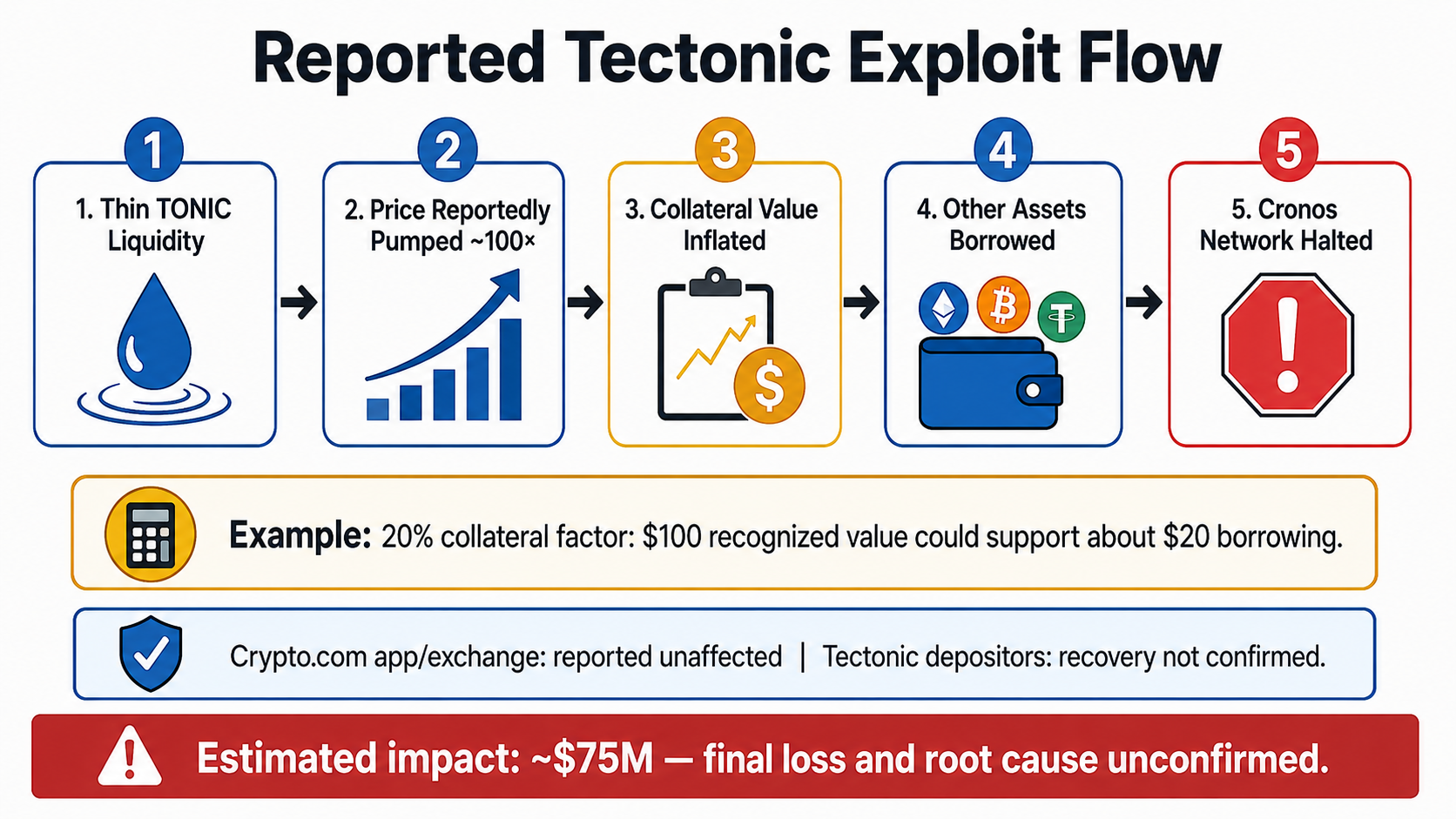
Step 1: Thin TONIC Liquidity
The TONIC market had limited liquidity and volume relative to the size of the lending protocol. Thin books made the market price easier to move.
Step 2: Price Reportedly Increased About 100 Times
Researchers observed an extreme TONIC price increase within roughly 20 minutes. The key issue was not only the market pump but whether the protocol's price input accepted that move as valid collateral value.
Step 3: Collateral Value Was Inflated
With TONIC reportedly carrying a 20% collateral factor, an exaggerated price could create substantial borrowing power even after the haircut. A token that cannot be liquidated near the quoted price is poor security for a loan.
Step 4: Other Assets Were Borrowed
The attacker could then borrow more liquid assets against the inflated TONIC valuation. When the TONIC price returned toward realizable market value, the collateral was insufficient to cover those loans.
Step 5: Cronos Validators Halted the Network
Cronos validators stopped the chain while the incident was investigated. Onchain estimates suggested about $6 million had been bridged to Ethereum before the halt, while much of the remaining value stayed on Cronos. CoinDesk also reported that Tectonic's TVL fell from roughly $121.7 million on August 26 to about $3 million by Monday. These figures are researcher and dashboard estimates, not final protocol accounting.
Why Did Cronos Halt the Blockchain?
A network halt can contain an emergency by preventing further transactions, bridges and asset movement. It gives developers and validators time to understand the attack and coordinate safeguards. In this case, it may have limited the amount moved beyond Cronos.
The cost is that all users lose access while the chain is stopped, including people unrelated to the affected application. The ability to halt also raises governance questions: who can coordinate a stop, what threshold is required, and how is the restart decided? Emergency control can reduce immediate losses while weakening the promise of uninterrupted, permissionless availability.
What Does the Incident Mean for CRO and DeFi Users?
Three types of risk should be separated. Protocol risk concerns Tectonic's contracts, collateral settings and oracle design. Base-layer risk concerns Cronos availability and validator governance. Custody risk concerns assets held by a centralized service.
Crypto.com stated that its app and exchange were unaffected. That is useful for customers of those services, but it does not mean Tectonic depositors were unaffected or guaranteed to be repaid. A final postmortem must explain the recognized loss, remaining assets and recovery process.
Token prices can react to ecosystem uncertainty, but a CRO or TONIC price move does not reveal the amount recoverable by depositors. Market price, protocol solvency and reimbursement are separate questions.
DeFi Risk Checklist After an Exploit
- Use official incident channels: Verify status updates from the protocol and chain rather than screenshots or reposted links.
- Do not interact prematurely: Follow the project's safety instruction while contracts or the network remain under investigation.
- Review approvals: Revoke risky token approvals where technically appropriate and only through trusted tools.
- Assess collateral quality: Check liquidity, oracle sources, collateral factors and liquidation capacity.
- Understand validator powers: Know whether a chain can be paused and who controls the restart process.
- Expect recovery scams: Attackers often impersonate support teams and publish fake claim pages after an exploit.
Tapbit Learn's DeFi security lessons explain how execution risk, approvals and malicious transaction paths can differ from market risk.
Bottom Line
Tectonic is a Cronos-based lending protocol, and TONIC is its native token. Current evidence suggests that thin TONIC liquidity and an inflated oracle-recognized price may have created excessive borrowing power, leading to an estimated impact near $75 million.
The estimate, attack mechanism and recovery outlook remain provisional. The durable lesson is that a collateral factor cannot protect a lending protocol if the collateral price is not robust and the asset cannot be liquidated at scale.
FAQ
What is Tectonic crypto?
Tectonic is a decentralized lending and borrowing protocol on Cronos. Users can supply supported assets or borrow against eligible collateral.
What is TONIC used for?
TONIC is the protocol's native token and has been used for incentives, governance-related participation and staking mechanisms.
How much was lost in the Tectonic exploit?
Independent researchers estimated the impact at about $75 million. Tectonic and Cronos had not confirmed a final loss figure at publication time.
Why did Cronos halt its network?
The halt was an emergency containment measure intended to stop further transactions and asset movement while the exploit was investigated.
Was the Crypto.com exchange affected?
Crypto.com said its app and exchange were unaffected. That statement is separate from the status of Tectonic protocol deposits.
Are Tectonic user funds guaranteed to be recovered?
As of the September 1 update, no recovery guarantee had been confirmed. Users should wait for official accounting and a documented recovery or compensation plan.


