
The KOSPI closed at 6,835.80 on September 1, up 15.78 points or 0.23%, extending its rebound to a second session. The recovery came despite renewed U.S.-Iran military tensions and a bond sell-off that pushed the U.S. 10-year Treasury yield to about 4.78%.
Tuesday's final close is more informative than yesterday's early snapshot, but it does not confirm a new trend. At 11:20 a.m. KST, the index was still down 0.16% at 6,809.04 before chip buying helped it finish higher. For traders following Korea through KORU, it is important to understand that KORU does not track the KOSPI directly and that its leverage resets every day.
KOSPI Index Today: Market Snapshot
| Market | Latest Verified Snapshot | Why It Matters |
|---|---|---|
| KOSPI | 6,835.80, up 0.23% at the September 1 close | Second daily gain after the August 31 sell-off |
| KOSPI intraday | 6,809.04, down 0.16% at 11:20 a.m. KST | Shows the late semiconductor-led recovery |
| Brent crude | About $91.15, up 0.7% | Keeps Korea's imported-energy risk elevated |
| U.S. 10-year Treasury yield | About 4.78% | Raises valuation and rate sensitivity |
| KORU | Latest available U.S. close about $20.96 on August 31 | Leveraged Korea exposure traded in U.S. hours |
The opening tone remained cautious. At 11:20 a.m., the won was around 1,369.85 per dollar and the KOSPI was slightly lower, while Samsung Electronics was down 0.1%. SK hynix, however, rose 1.19%, helping the index recover by the close. The contrast shows how chip-specific demand can temporarily outweigh macro pressure.
The KORU value above is the latest available U.S. session close, not a real-time quote synchronized with the Korean market. Yahoo Finance history showed an August 31 close near $20.96 after a $20.39-$21.45 range. The different trading windows can create temporary gaps between Korea's cash market, U.S. ETF pricing and perpetual futures.
Why Did the KOSPI Rebound Today?
Fed Rate-Hike Expectations Returned
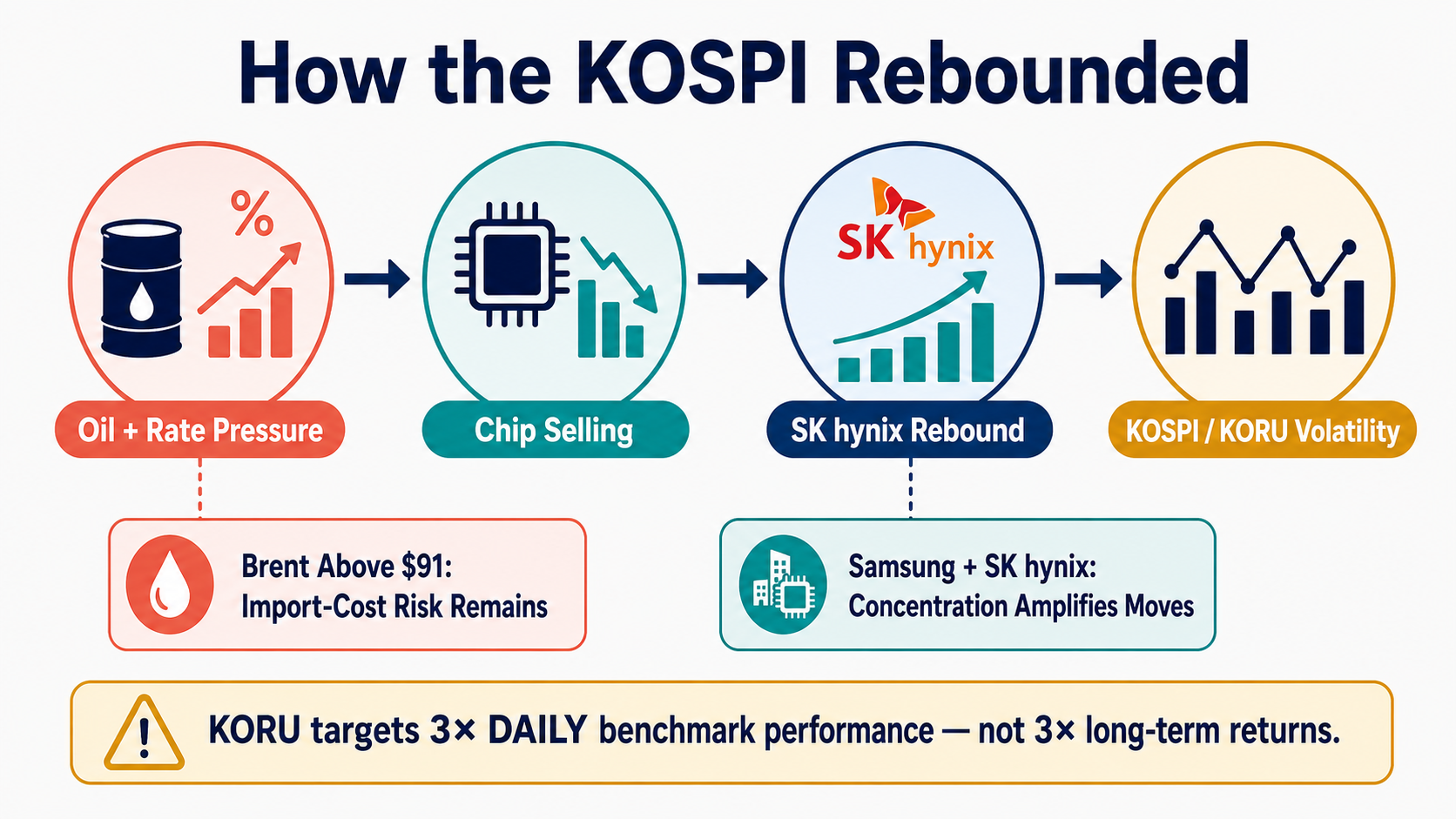
Higher U.S. rates remained a headwind rather than disappearing. Investors still apply a higher discount rate to future corporate earnings, and the U.S. 10-year yield near 4.78% keeps Korean growth and technology shares sensitive to bond moves. The rebound therefore reflects a change in the balance of forces, not a clean removal of rate risk.
Higher Treasury yields can also make U.S. assets more attractive relative to overseas equities. Foreign investors may reduce Korean positions, increasing selling pressure in the KOSPI and demand for dollars. A weaker won can eventually support exporters' translated revenue, but during a sudden risk-off session it often signals tighter financial conditions and capital outflow concerns.
Oil Above $91 Keeps Korea's Import-Cost Risk Elevated
Brent rose above $91 as renewed U.S.-Iran military escalation kept the risk premium around Gulf supply and shipping elevated. South Korea is highly dependent on imported energy, so a sustained oil shock can raise transport, power and manufacturing costs. That can squeeze corporate margins, worsen the trade balance and complicate the Bank of Korea's inflation outlook.
One session above $91 does not determine the path of Korean inflation. The duration of the shock matters more than the headline alone. If shipping routes stabilize and oil retreats, the macro damage may remain limited. If crude stays elevated, expectations for easier Korean monetary policy may be pushed back.
Chip Concentration Amplified the Index Move
Samsung Electronics and SK hynix carry substantial influence in Korean equity benchmarks. When global technology shares fall, weakness in these two names can pull the whole index lower even if some domestic sectors remain stable. The same concentration can work in the opposite direction when memory prices, HBM demand or AI capital spending surprise positively.
This is why traders should not interpret a KOSPI move as a uniform verdict on every Korean company. It can be a concentrated response to semiconductors, foreign flows and currency conditions.
What the KOSPI Move Means for KORU
KORU Tracks a Different Korea Benchmark
KORU is the Direxion Daily MSCI South Korea Bull 3X ETF. It seeks 300% of the daily performance of the MSCI Korea 25/50 Index before fees and expenses. The KOSPI and MSCI Korea 25/50 both provide exposure to major Korean companies, so their direction is often similar, but their construction and weights are not identical.
Direxion data as of June 30 showed information technology at 56.65% of the fund's reference exposure, with SK hynix at 27.41% and Samsung Electronics at 23.38%. Those weights change, so they should be treated as a dated concentration snapshot rather than a permanent allocation.
For the structure, split history and daily leverage mechanics, see Tapbit Learn's guide to what KORU stock is.
KORU's 3X Target Resets Daily
The word “daily” is the most important part of KORU's objective. If its benchmark rises 1% in one session, KORU seeks about 3% before costs and tracking differences. It then rebalances for the next day. Over several sessions, gains and losses compound from a changing base.
In a smooth trend, compounding can help. In a volatile sideways market, repeated up-and-down moves can create volatility drag. Traders therefore should not take a five-day KOSPI return, multiply it by three and assume that equals KORU's result.
Korea-U.S. Trading-Hour Gap
Korean cash equities trade while U.S.-listed KORU is closed. By the time the U.S. session begins, KORU may need to reflect the Korean close, movements in U.S. technology futures, changes in USD/KRW and new geopolitical headlines. A gap is therefore not automatically a pricing error; it may reflect information arriving in different sessions.
KOSPI and KORU Scenarios for the Next Several Sessions
- Bull case: Oil retreats, U.S. employment data weakens the rate-hike case and foreign selling stabilizes. Korean chip shares recover and KORU can amplify the rebound.
- Base case: The KOSPI remains volatile while investors wait for U.S. labor data and clearer oil-supply information. KORU's daily reset makes position sizing more important than directional conviction alone.
- Bear case: Brent rises further, Treasury yields climb and the won weakens as foreign outflows accelerate. Heavy semiconductor weights could deepen the index move, while KORU magnifies daily downside.
The second-day gain is constructive, but it is not confirmation that the sell-off has ended. The most useful signals are Brent crude, the U.S. 10-year yield, USD/KRW, foreign net flows and whether SK hynix's outperformance spreads to Samsung Electronics.
How to Trade KORU-USDT Futures on Tapbit
Tapbit offers KORU-USDT perpetual futures for traders who want price exposure without owning the U.S.-listed ETF. A perpetual contract is a derivative: it does not provide ETF shares, distributions or voting rights.
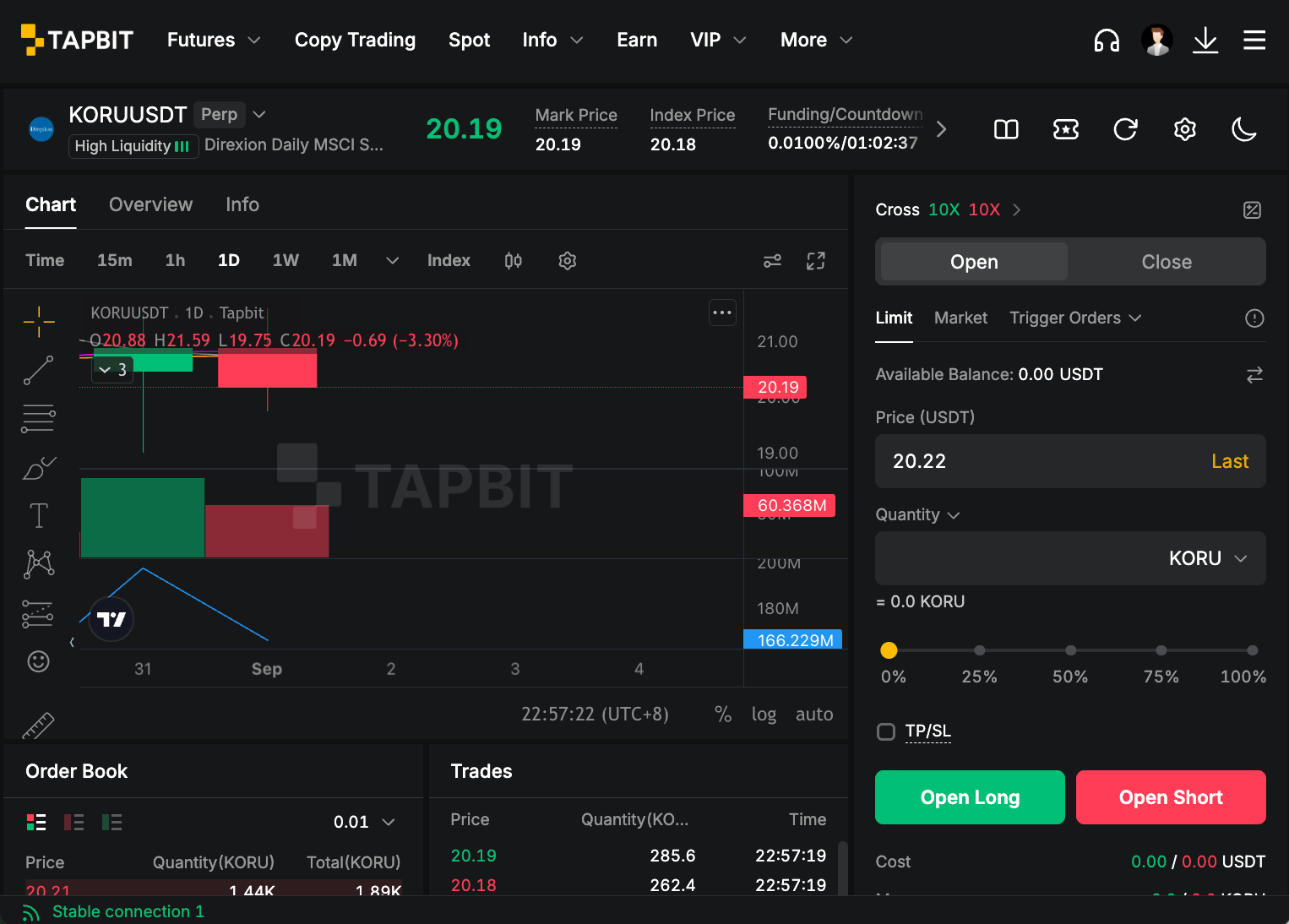
Risk can be amplified twice. KORU itself targets 3x daily benchmark exposure, and margin on the perpetual contract can add another layer of leverage. Check the mark price, funding rate, margin mode and liquidation price before entering. Traders should also account for the Korea-U.S. session gap and avoid assuming that the previous KORU close represents the current Korean market. New users can create a Tapbit account and review the contract specifications before placing an order.
Bottom Line
The KOSPI's sharp August 31 decline reflected three connected pressures: tighter U.S. rate expectations, an oil shock that matters for an energy importer and concentrated weakness in globally sensitive chip stocks. The late-morning recovery reduced the loss but did not remove those drivers.
KORU can express a tactical Korea view, but it tracks a different benchmark, targets 3x performance for one day and trades in a different time zone. Those structural facts are as important as the direction of the KOSPI itself.
FAQ
Why did the KOSPI rebound on September 1?
Semiconductor buying, especially gains in SK hynix, helped the index recover despite renewed Middle East tensions and higher U.S. Treasury yields.
Does KORU track the KOSPI directly?
No. KORU seeks 300% of the daily performance of the MSCI Korea 25/50 Index. Its direction may resemble the KOSPI, but weights and daily returns can differ.
Is KORU always three times the Korean stock market?
No. It has a daily 3x objective before fees and expenses. Compounding and volatility can make multi-day results very different from three times the benchmark's cumulative move.
What could change the KOSPI outlook next?
U.S. jobs data, Fed expectations, Brent crude, the U.S. 10-year yield, USD/KRW, foreign flows and the performance of Samsung Electronics and SK hynix are the main near-term variables.
Can traders access KORU exposure on Tapbit?
Yes. Tapbit offers KORU-USDT perpetual futures. The contract provides leveraged price exposure and does not represent ownership of KORU ETF shares.


