
ARK Invest has built positions in both Block (NYSE: XYZ) and Circle Internet Group (NYSE: CRCL), giving Cathie Wood’s funds two very different ways to invest in the crypto economy. Recent trade disclosures estimated that ARK bought roughly $37.4 million of Block and $3.4 million of Circle on August 31, 2026. That one-day difference is notable, but it is not enough by itself to declare a permanent favorite.
The cleaner answer is this: Block is the more diversified crypto-fintech bet, while Circle is the purer and potentially more volatile stablecoin infrastructure bet. Investors deciding between them should first decide whether they want broader payments exposure or a more concentrated wager on onchain dollars.
Crypto traders who want to compare liquid market opportunities alongside listed-company exposure can create a Tapbit account and explore the platform’s supported markets and risk-management tools.
Why ARK Invest Owns Both Block and Circle
ARK’s thesis is broader than the price of Bitcoin. Its research focuses on digital wallets, blockchain settlement, stablecoins and new financial networks. Block addresses the consumer and merchant side through Cash App, Square and Afterpay. Circle supplies infrastructure for digital dollars through USDC, EURC and its planned Arc blockchain.
ARK’s public holdings also change daily. Circle represented 3.82% of ARKK in the fund’s July 31, 2026 holdings, while an ARKF disclosure dated January 27 showed both Block and Circle among its positions. Those dated snapshots confirm that ARK sees value in both models, but they should not be read as live portfolio weights.
Block vs Circle at a Glance
| Factor | Block (XYZ) | Circle (CRCL) |
|---|---|---|
| Core business | Consumer and merchant fintech | Stablecoin and blockchain infrastructure |
| Main crypto link | Bitcoin trading, custody, wallets and mining tools | USDC and EURC issuance, reserves and payments |
| Revenue diversification | High | Lower |
| Rate sensitivity | Indirect | High through reserve income |
| Key risk | Consumer credit and execution | Rates, regulation and USDC concentration |
| Best fit | Diversified fintech investors | Higher-beta stablecoin believers |
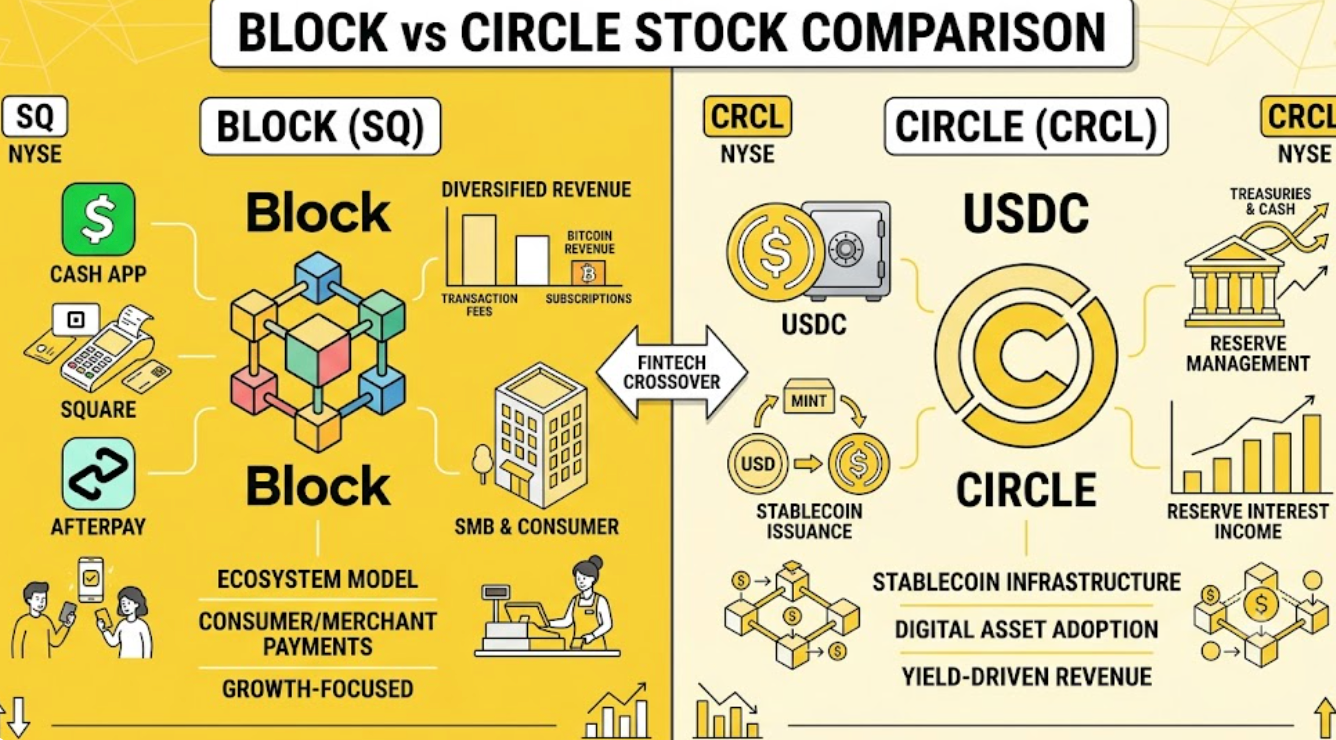
The Case for Block: Diversified Fintech With Bitcoin Optionality
Block’s attraction is that Bitcoin is meaningful without being the whole company. Cash App lets users buy and sell Bitcoin, while Bitkey provides self-custody hardware and Proto develops Bitcoin mining products. Square, Afterpay and lending products create additional growth engines that do not require a crypto bull market.
This diversification can reduce dependence on one regulatory decision or one source of yield. Block also reported in January 2026 that it had provided more than $200 billion in credit across Cash App Borrow, Afterpay and Square Loans. That scale demonstrates the strength of its financial ecosystem, but it introduces consumer-credit, underwriting and economic-cycle risks that Circle does not face in the same form.
The Case for Circle: A Pure Stablecoin Infrastructure Bet
Circle is more directly tied to crypto adoption. It issues USDC and EURC, and its economics benefit when stablecoin balances and payment activity expand. In July 2026, Circle received final U.S. approval to establish a national trust bank, strengthening its institutional custody and reserve-management story. It also plans to launch the Arc mainnet on September 16, 2026.
Those catalysts give Circle more upside if regulated stablecoins become a major settlement layer. The trade-off is concentration. Reserve income is affected by interest rates, USDC supply and distribution arrangements. Falling short-term rates can reduce yield on reserve assets even when stablecoin adoption continues to grow.
Which Business Has the Stronger Crypto Link?
Circle has the stronger direct link. Growth in USDC circulation, onchain payments and Arc activity can flow more visibly into its investment narrative. Block’s crypto exposure is broader but diluted by merchant services, lending and consumer payments.
That distinction changes how the stocks may react. Circle can respond sharply to stablecoin legislation, rate expectations and USDC market-share changes. Block may react more to Cash App engagement, Square seller trends, credit performance and operating margins, with Bitcoin acting as an additional catalyst.
Valuation, Rates and Regulatory Risk
Neither stock should be judged by crypto enthusiasm alone. Circle’s valuation must be tested against sustainable reserve income and fee economics under lower-rate scenarios. Investors should also watch whether Arc generates genuine developer and payment activity rather than only headlines.
For Block, the central questions are whether Cash App and Square can grow efficiently and whether expanding lending creates acceptable losses. Its Bitcoin products can improve engagement, but they do not remove the company’s exposure to consumer spending and competitive pressure.
Which Is ARK Invest’s Better Crypto Bet?
Block looks stronger on a risk-adjusted basis for investors who want crypto participation without relying on a single token or regulatory framework. Circle may be the better choice for investors with high conviction that stablecoins will become core global payment infrastructure and who can accept greater sensitivity to rates and policy.
ARK’s recent buying supports interest in both companies, not a definitive winner. The much larger Block purchase on August 31 may reflect valuation, portfolio rebalancing or a tactical opportunity. It should not be treated as proof that ARK has abandoned Circle’s stablecoin thesis.
Conclusion
Block and Circle represent different layers of the same financial transition. Block connects digital assets with wallets, consumers, merchants and credit. Circle focuses on tokenized money and blockchain settlement. Block is the more balanced crypto-fintech exposure; Circle is the more concentrated, higher-beta stablecoin bet. The better stock depends on whether diversification or direct crypto infrastructure exposure matters more to the investor.
FAQ
Does ARK Invest own both Block and Circle?
Yes. Public ARK disclosures have shown positions in both XYZ and CRCL, although fund weights and daily trades change frequently.
Is Block a Bitcoin stock?
Block has substantial Bitcoin products through Cash App, Bitkey and Proto, but it is also a diversified payments, merchant-services and lending company.
Is Circle more sensitive to interest rates?
Yes. A meaningful part of Circle’s economics comes from income earned on reserves backing USDC, so changes in short-term rates can affect profitability.
Which stock has more direct crypto exposure?
Circle has the more direct exposure because its core products are stablecoins and blockchain infrastructure. Block offers broader fintech exposure with Bitcoin optionality.
Did ARK’s larger Block purchase make XYZ the clear winner?
No. A single day’s trades can reflect valuation and portfolio management. Investors should compare business quality, valuation and risk rather than copy one transaction.


