

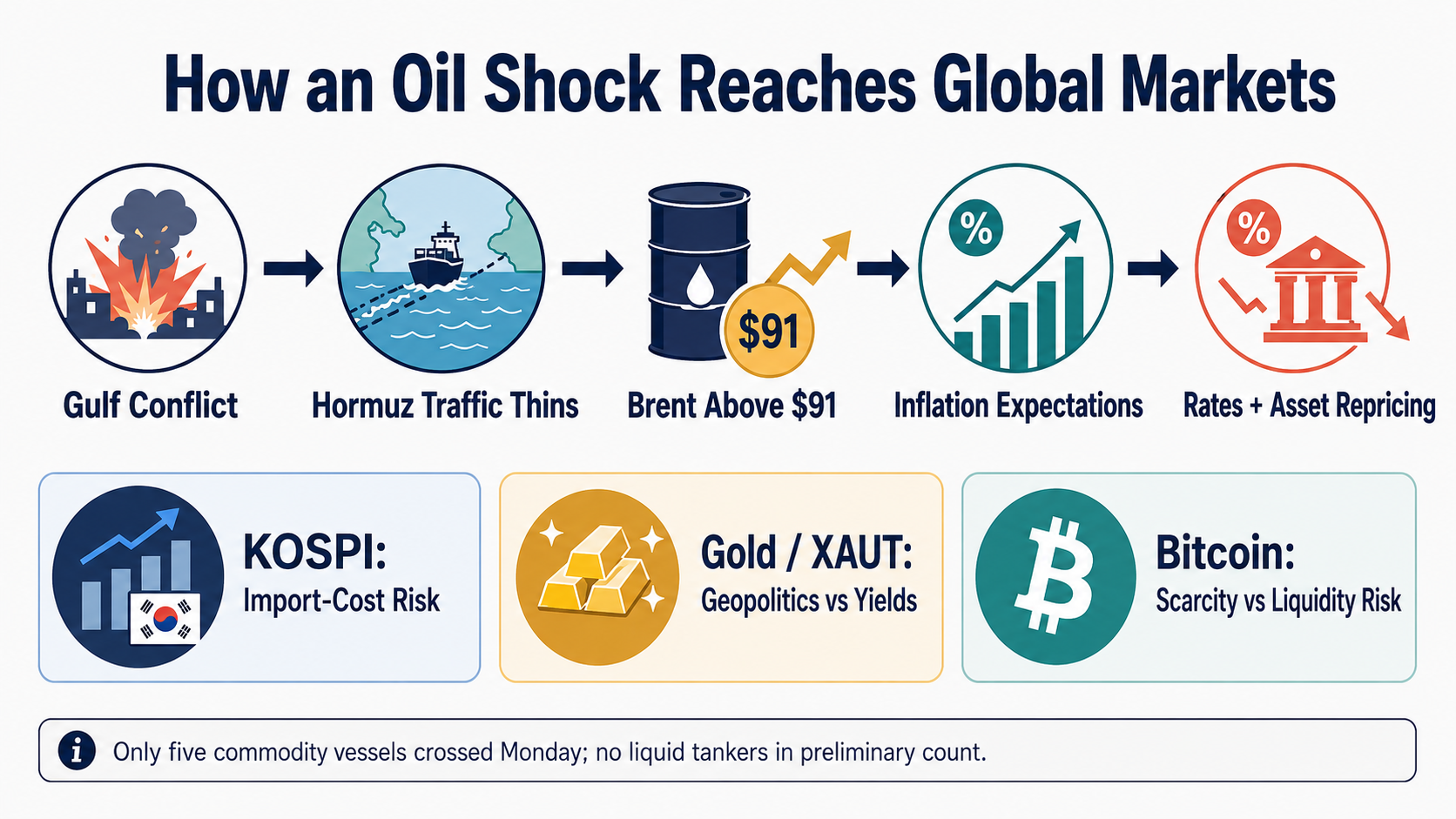
Brent crude held above $91 per barrel on September 1 after renewed military escalation between the United States and Iran kept concern about Gulf supply and shipping elevated. Reuters observed Brent up about 0.7% at $91.15, while U.S. West Texas Intermediate crude was around $86.46 after the previous session's jump of nearly 3%.
The market is pricing a persistent risk premium before it has complete evidence of a new, sustained loss of barrels. Reuters reported that only five commodity vessels crossed the Strait of Hormuz on Monday versus a recent average of about 14, with no liquid tankers in the preliminary count. Tanker availability, insurance costs and expected shipping delays can move futures before physical export data is complete.
Oil Price Today: Brent and WTI Snapshot
| Benchmark | September 1 Snapshot | Change |
|---|---|---|
| Brent crude | About $91.15 per barrel | Up about 0.7% |
| WTI crude | About $86.46 per barrel | Up about 0.8% |
| Hormuz commodity vessels | 5 on Monday vs about 14 average | No liquid tankers in preliminary count |
| Gold | About $4,435 per ounce | After a roughly 10% August gain |
These are time-specific futures-market readings, not fixed daily closes. Brent and WTI also represent different crude grades, delivery locations and contract structures. Prices displayed on other platforms can differ because of contract month, data delay or rollover timing.
The move above $91 matters psychologically, but the durability of the premium matters more. A brief geopolitical spike can fade if exports continue and tanker traffic normalizes. Persistently thin traffic, depleted inventories or damaged capacity could turn the premium into a physical shortage.
Why Is Oil Rising Today?
Renewed U.S.-Iran Military Escalation
The move followed U.S. strikes on Iranian launchers on Larak Island and Iranian retaliation. Public claims about damage to Kharg Island, an important export area, had not been independently confirmed in the reporting window. Traders should separate verified military events from claims that may later be corrected.
Oil markets react rapidly because the potential downside of waiting can be large. If export infrastructure or shipping lanes are damaged, refiners may compete for alternative grades, freight rates can rise and inventories can be drawn down. That possibility is incorporated into prices before a complete assessment is available.
The Strait of Hormuz Risk Premium
The Strait of Hormuz is the narrow maritime passage connecting the Persian Gulf with global shipping routes. The U.S. Energy Information Administration estimates that petroleum liquids moving through the strait averaged 4.9 million barrels per day in the second quarter of 2026. That was already far below the 21.6 million b/d average in the fourth quarter of 2025 before the conflict.
The lower flow estimate is important because old pre-conflict figures can overstate the amount currently at risk. Even so, several million barrels per day are material. Tanker delays, higher war-risk insurance and uncertain access can affect delivered prices even when some crude continues to move.
Supply Risk Matters Before Actual Barrels Are Lost
Futures prices reflect expected supply and demand, not only the barrels missing today. A useful framework is expected loss: the probability of disruption multiplied by its possible scale and duration. If any of those inputs rises, traders may bid up prompt crude, refiners may secure inventory and shipping companies may demand more compensation.
The mechanism can reverse just as quickly. A credible ceasefire, verified restoration of export capacity or improving tanker flows can remove the risk premium even before global inventories rebuild.
How Oil Above $91 Could Affect Inflation and Interest Rates
Energy costs enter inflation through fuel, transport, petrochemicals, electricity and the cost of moving goods. The first effect is visible in headline inflation. A longer shock can also affect business pricing and consumer expectations, making central banks less confident that inflation will fall.
That does not mean one day above $91 forces a rate increase. Policymakers consider duration, core inflation, wages and growth. But oil can shift the balance at the margin. On September 1, markets were assigning roughly 64%-65% odds to a September Federal Reserve hike, so the oil shock reinforced an existing tightening narrative.
The EIA's baseline forecasts Brent averaging about $85 in the third quarter of 2026, $78 in the fourth quarter and $69 in 2027. Those numbers are forecasts, not promises. A larger disruption or prolonged tanker shortage would make them too low; de-escalation and restored flows could make them too high.
What Higher Oil Means for Korea, Stocks and the Won
South Korea imports most of its energy. Sustained expensive crude can weaken the trade balance, raise costs for airlines, chemicals and manufacturers, and complicate the Bank of Korea's policy outlook. A weaker won makes dollar-priced oil more expensive in local currency, creating an additional feedback loop.
Exporters may receive some translation benefit from a softer won, but that does not automatically offset higher input costs or weaker global demand. Korean equity benchmarks are also heavily influenced by semiconductor companies, which remain sensitive to U.S. yields and global technology sentiment. Oil and rates can therefore pressure the KOSPI through several channels at once.
What Oil Means for Gold, XAUT and Bitcoin
Gold and XAUT
Geopolitical demand can support gold, but higher real yields and a stronger dollar can work in the opposite direction. Gold was down about 0.6% near $4,425 in the observed window despite the military escalation, illustrating that the safe-haven response is not automatic. XAUT is designed to track gold exposure, so the same macro tension can influence it.
Bitcoin
Bitcoin may attract scarcity-based demand during geopolitical stress, but it remains sensitive to liquidity, leverage and the dollar. In this session BTC held near $78,000 while stocks weakened, a sign of relative resilience. If oil keeps rates higher and reduces market liquidity, that resilience could be tested.
Oil Price Scenarios for the Coming Week
- Bullish oil scenario: New evidence shows damaged export capacity, tanker disruptions intensify or fighting expands. Brent could retain or extend the risk premium.
- Base scenario: Political risk remains elevated but physical exports stabilize. Brent may stay volatile around the new risk-adjusted range without a clean trend.
- Bearish oil scenario: A credible de-escalation emerges and verified tanker flows improve. Part of the geopolitical premium could unwind quickly.
Inventory reports, freight and insurance rates, verified export flows and the Brent time spread can help distinguish a physical tightening from a headline-driven move.
How to Trade BZ-USDT Futures on Tapbit
Tapbit offers BZ-USDT perpetual futures for Brent-linked price exposure. A perpetual contract is a derivative and does not deliver barrels of crude oil. It can also differ from a dated Brent futures contract because it uses its own mark-price and funding mechanism.
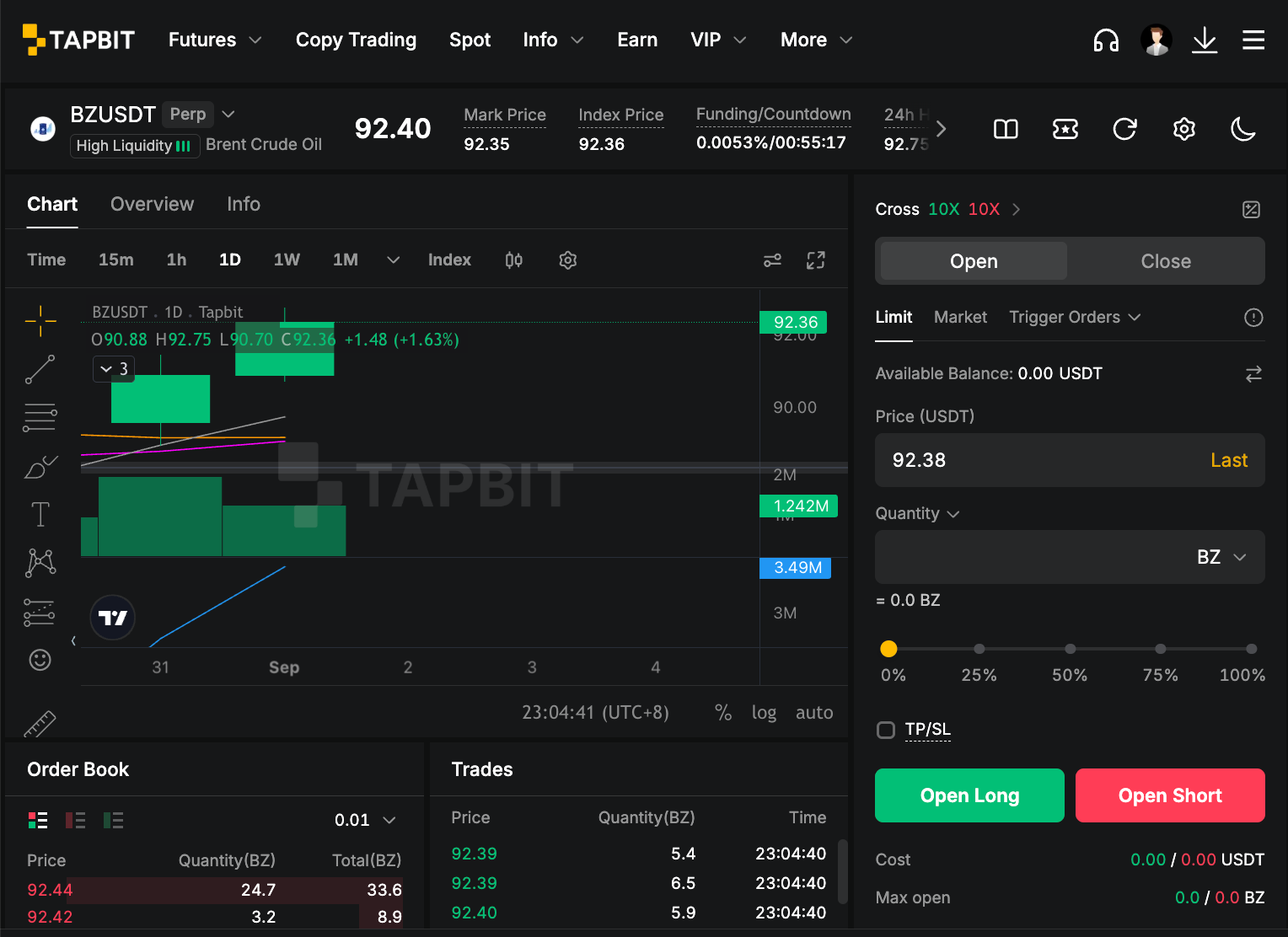
Before trading, review the contract specifications, funding rate, liquidity, mark price and liquidation level. Geopolitical headlines can create gaps and rapid reversals, so leverage should be sized conservatively. Tapbit Learn's BZ-USDT and Brent derivatives guide explains the product structure. New users can create a Tapbit account before reviewing the market.
Bottom Line
Brent's move above $91 reflects the market's estimate of disruption risk, reinforced by unusually thin Hormuz traffic. Sustained upside requires continued shipping problems, damaged capacity or tightening inventories. De-escalation and restored tanker flows could remove the premium quickly.
The wider impact runs from oil to inflation, rates, currencies and risk assets. For Korea, the import-cost channel is especially important. For gold and Bitcoin, geopolitical demand must be weighed against higher yields and tighter liquidity.
FAQ
Why is the oil price rising today?
Renewed U.S.-Iran fighting increased concern about Gulf exports and tanker traffic. Brent rose to about $91.15 as the market added a geopolitical risk premium to crude.
Why is the Strait of Hormuz important?
It is a critical route for Gulf energy exports. Even reduced 2026 flows remain large enough that delays or restrictions can affect global crude prices.
Does higher oil always make gold rise?
No. Geopolitical demand can help gold, but higher real yields and a stronger dollar can offset or overpower that support.
How can higher oil prices affect Bitcoin?
Higher oil can lift inflation and interest-rate expectations, tightening liquidity and pressuring leveraged positions even if Bitcoin also attracts scarcity-based demand.
Can users trade Brent-linked exposure on Tapbit?
Yes. Tapbit offers BZ-USDT perpetual futures. The contract provides price exposure and is not ownership or physical delivery of crude oil.


