

Bitcoin's recent rally has brought an unfamiliar term into crypto commentary: Treasury liquidity It might sound like the US government is printing money or buying Bitcoin — neither is accurate.
The real driver is more technical. The Treasury announced increased buybacks of older, longer‑dated government bonds, which traders interpreted as an effort to ease pressure in a strained bond market. Long‑term yields fell, the dollar softened, and Bitcoin began to rally.
BTC climbed from the mid‑$60,000s to over $80,000, supported by short covering and renewed spot ETF demand.
The timing is hard to dismiss, but it doesn't prove causation — and the larger buyback operations haven't even begun.
September will show whether this marks the beginning of a more favorable liquidity environment or simply a sharp trade built around a policy headline.
What the Treasury Actually Announced

On August 19, the U.S. Treasury said it would at least double the maximum size of liquidity-support buybacks for nominal bonds in the 10-to-20-year and 20-to-30-year sectors.
The current maximum is $2 billion per operation. Beginning September 9, that amount will increase to at least $4 billion. The new schedule will remain in place through November 4, when the Treasury conducts its next quarterly refunding review.
The program allows the government to purchase older Treasury securities that may be less liquid than newly issued benchmark bonds. Improving liquidity in these securities can make large trades easier to execute and reduce disruptions across the yield curve.
It does not reduce the government’s financing needs.
The Treasury generally replaces the debt it buys back with new issuance. Its own borrowing announcement says buybacks are not expected to have a significant effect on privately held net marketable borrowing.
That makes the program closer to a debt exchange than a conventional stimulus package.
The Rally Began Before the Larger Buybacks
The expanded operations do not begin until September 9, yet Bitcoin reacted immediately to the August announcement. This tells us that the market was trading expectations.
Long-term Treasury yields had been creating problems for risk assets. On August 18, the 10-year yield stood at 4.71%, while the 30-year yield was 5.28%. Those levels offered investors a relatively attractive return from government debt and raised borrowing costs across the economy.
After the Treasury announcement, the 10-year yield fell to 4.65% and the 30-year yield declined to 5.19%. Bitcoin moved out of its previous range as traders responded to the possibility that Washington would provide greater support to the long end of the bond market.
The improvement was not smooth. Yields climbed again on August 20 and 21 before falling to 4.64% for the 10-year and 5.17% for the 30-year on August 25.
The Treasury’s daily yield data therefore supports a cautious interpretation. Long-term yields are below their pre-announcement levels, but the bond market has not entered a stable downward trend.
Bitcoin responded to a change in direction, not the arrival of permanently cheap money.
Why Falling Yields Can Help Bitcoin
Bitcoin does not pay interest simply because someone holds it. Its return depends on price appreciation or income generated through separate lending and trading arrangements.
When long-term government bonds yield more than 5%, investors can earn a substantial return from an asset generally considered less volatile than Bitcoin. High yields also increase funding costs for companies, households and leveraged market participants.
Falling yields reverse some of that pressure. They can make non-yielding assets more competitive, reduce discount rates and improve broader risk appetite.
The dollar also matters. Bitcoin is quoted globally against the U.S. currency. A weaker dollar can support BTC by improving financial conditions outside the United States and increasing demand for scarce assets.
These relationships are not mechanical. Bitcoin will not rise every time a Treasury yield falls. ETF flows, regulation, leverage and crypto-specific events still influence the market. The August move matters because several of those factors aligned at once.
Short Sellers Turned a Macro Signal Into a Fast Rally
Bitcoin entered the Treasury announcement with a large amount of bearish positioning.
Once BTC broke above its previous range, short sellers began closing losing trades. Closing a short requires buying back the underlying asset or contract, which adds demand to a market that is already rising.
The resulting liquidation wave pushed Bitcoin through several price levels in rapid succession. Estimates vary by exchange coverage, but reports placed short liquidations during the most active period between approximately $2.7 billion and $4 billion across the crypto market.
A short squeeze explains the speed of the move. It does not fully explain why Bitcoin remained near $80,000 after those forced purchases ended. For that, the spot ETF market is more useful.
ETF Demand Took Over From the Short Squeeze
U.S. spot Bitcoin ETFs recorded six consecutive sessions of net inflows from August 17 through August 24.
Farside Investors reported $297.5 million of inflows on August 17, followed by $189.3 million on August 18. Demand accelerated to $517.2 million on August 19 and $606.3 million on August 20.
The funds added another $307.5 million on August 21 and $337.6 million on August 24. Across those six sessions, net inflows reached approximately $2.26 billion.
Preliminary figures for August 25 showed another $29.9 million, although BlackRock’s IBIT data had not yet been included. That number should therefore be treated as incomplete.
The direction remains positive, but the pace may be cooling. A decline from hundreds of millions of dollars per session to a much smaller inflow would not amount to institutional abandonment. It would, however, leave Bitcoin more dependent on ordinary spot buyers and derivatives activity.
Treasury policy opened the trade. ETF demand helped validate it.
Could the Treasury Use Its Cash Balance to Support Bonds?
Recent reporting has suggested that the Treasury could use part of its TGA balance to finance additional purchases of longer-term bonds.
That possibility has attracted attention because spending down the TGA while buying long-duration debt could support bond prices without requiring immediate coordination from the Federal Reserve.
It is not yet an announced policy. The official Treasury statement confirms the increase to at least $4 billion per operation. It does not commit the government to deploying hundreds of billions from the TGA or establish a permanent bond-support facility.
The Treasury is also operating against an enormous financing requirement. It expects to borrow $739 billion in privately held net marketable debt during the July-to-September quarter and another $628 billion during the final quarter of 2026.
Those borrowing totals are far larger than the scheduled buyback operations. Even if the Treasury temporarily spends cash, it eventually needs to consider how that balance will be rebuilt.
For Bitcoin, the question is not whether money leaves the TGA on one day. It is whether government spending, tax receipts, debt issuance and buybacks produce a sustained increase in liquidity after they are combined.
Bank Reserves Are Ample but Lower Than a Year Ago
The Federal Reserve reported approximately $2.93 trillion in reserve balances on August 19. That was about $367 billion lower than one year earlier.
The level does not automatically signal a funding shortage. Nearly $3 trillion remains a substantial amount, and the Federal Reserve has been making reserve-management purchases of Treasury bills.
The direction is worth monitoring, particularly with the TGA near $1 trillion and the Treasury preparing to borrow more than $1.3 trillion across the second half of 2026.
If reserves remain stable while the Treasury completes its financing, the market may absorb the debt without serious disruption. If reserves fall rapidly and money-market rates begin showing stress, the liquidity environment would become less favorable for risk assets.
This is the part of the story that a Bitcoin price chart cannot reveal by itself.
Bitcoin Has Already Started Testing the Thesis
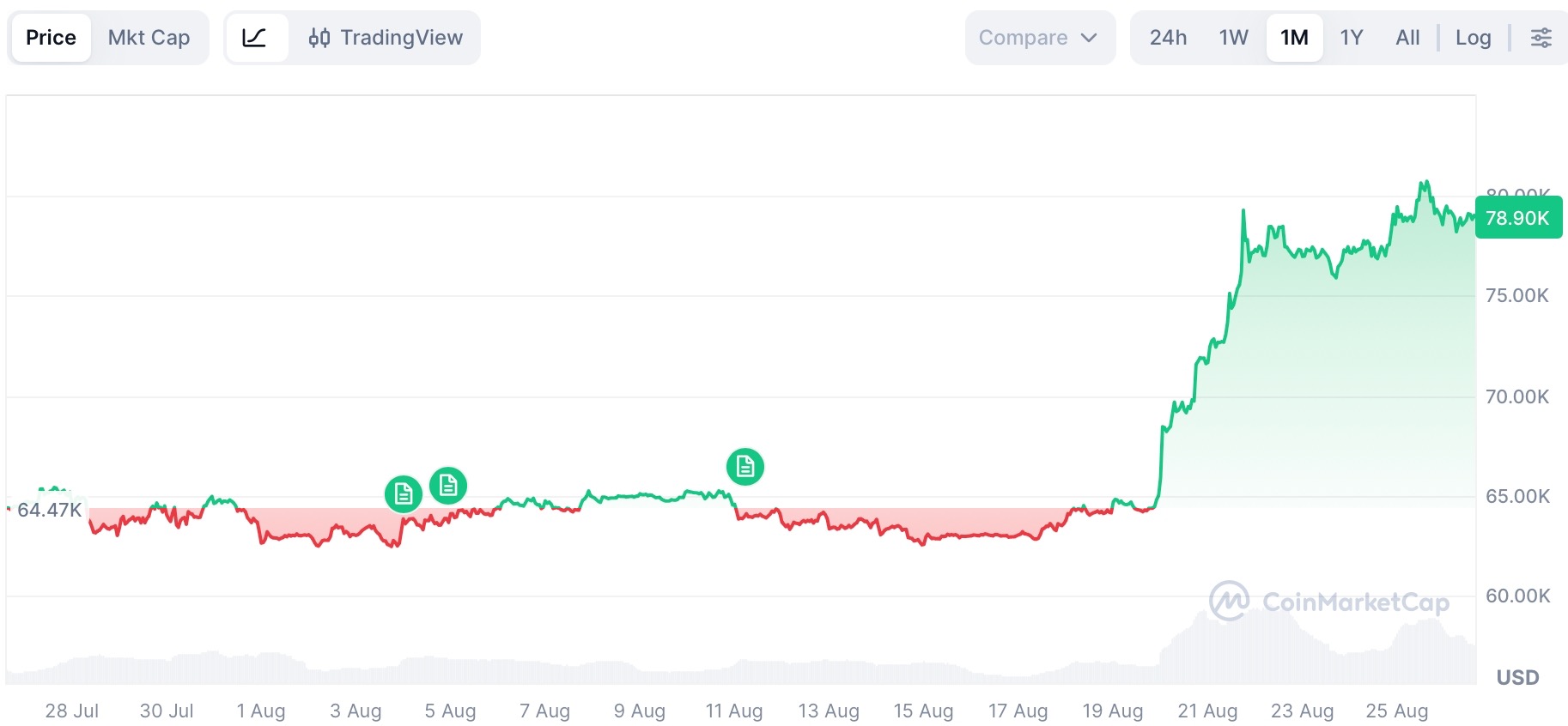
Bitcoin briefly traded above $80,000 but moved back toward $79,059 on August 26. It remained up approximately 22.9% over seven days, with a 24-hour range between roughly $77,955 and $80,850.
That pullback is not surprising after such a fast advance. It does show that $80,000 has not yet become established support.
The next phase should help separate the Treasury thesis from the short-squeeze narrative.
If BTC holds near the breakout while ETF demand continues, the market will have evidence that investors are willing to own Bitcoin at higher prices. If ETF inflows fade and BTC falls as yields rise, the rally will look more dependent on the original liquidation event.
The Bond Market Is a Driver, Not the Whole Explanation
Treasury liquidity contributed to Bitcoin’s rally, but the phrase can conceal more than it explains.
The government announced larger buybacks for selected long-term bonds. Markets read that as support for a stressed yield curve. Bitcoin responded, short sellers were forced out and ETF investors followed.
At the same time, the TGA remains close to $1 trillion, federal borrowing needs remain large and the previous reverse repo liquidity buffer is mostly exhausted. The buybacks are offset by new issuance and do not constitute QE.
The bullish interpretation is possible: lower yields, TGA spending and steady ETF demand could give Bitcoin a more durable macro tailwind.
The skeptical interpretation is equally coherent: traders may have priced a modest debt-management change as a broad easing cycle before the expanded program has even begun.
As Bitcoin becomes more closely tied to bond yields and institutional fund flows, crypto traders increasingly need to understand decisions made far beyond the blockchain. Tapbit will continue examining those connections through its global market coverage. Visit Tapbit for more research, log in to access your account, or register to explore the platform.
Frequently Asked Questions
What is Treasury liquidity?
Treasury liquidity can describe how easily government bonds trade or the broader availability of dollars affected by Treasury borrowing, government spending, the TGA and Federal Reserve operations. These are related but separate concepts.
Why can Treasury liquidity affect Bitcoin?
Treasury operations can influence bond yields, the dollar and financial conditions. Lower yields and easier dollar liquidity may support Bitcoin, while higher yields and tighter funding conditions can reduce demand for risk assets.
What did the U.S. Treasury announce in August 2026?
The Treasury announced that it would increase the maximum size of selected long-term bond buybacks from $2 billion to at least $4 billion per operation.


