

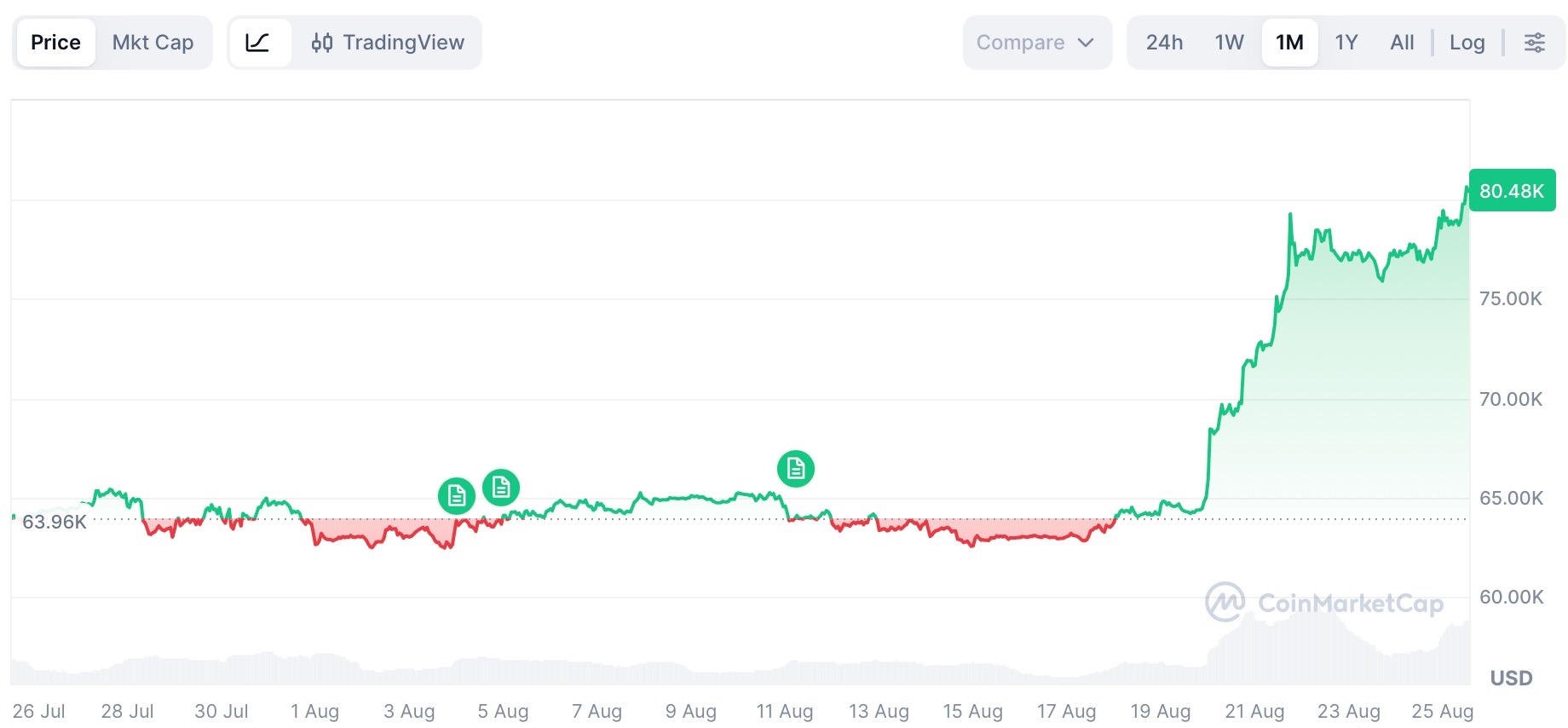
After trading below $64,000 earlier in August, BTC moved through $70,000, $75,000 and $80,000 in less than a week. CoinGecko showed the asset near $80,346 on August 25, up roughly 25.5% over seven days. During the latest session, it traded as high as $81,160.
A move that fast naturally brings back the $100,000 forecasts. Yet the more useful question is not whether Bitcoin can add another 25%. It is whether the buying behind this recovery can continue after the forced liquidations have ended.
The rally began with a change in the U.S. bond market, accelerated through a historic short squeeze and then found support from six consecutive sessions of spot ETF inflows. That is a stronger foundation than a purely leverage-driven spike.
The Spark Came From Outside Crypto
The first major catalyst arrived on August 19, when the U.S. Treasury announced plans to expand its buybacks of longer-dated government debt. Under the revised program, the Treasury will increase the maximum size of certain operations from $2 billion to at least $4 billion. The expanded purchases are scheduled to begin on September 9.
The purpose is to improve liquidity in older Treasury securities and ease some of the pressure building in the long end of the bond market. Before the announcement, the 30-year Treasury yield had reached approximately 5.34%, its highest level in years.
Lower bond yields can help Bitcoin in two ways. They reduce the return available from relatively safe government debt, and they can improve investors’ appetite for assets whose value depends on price appreciation rather than interest payments.
Markets reacted quickly. Long-term yields initially fell, the dollar weakened and Bitcoin broke out of its previous range.
The distinction between a Treasury buyback and quantitative easing is important. The Federal Reserve is not creating new reserves to purchase assets, and the program is not a direct investment in Bitcoin. It is a debt-management tool operating on a much smaller scale.
The announcement changed market expectations, but it did not permanently solve the pressure in U.S. government bonds. The 10-year yield soon returned to around 4.69%. If long-term yields continue rising, the same macro force that helped lift Bitcoin could begin working against it again.
A Crowded Short Trade Supplied the Fuel
When BTC broke above its previous resistance, short sellers had to buy back the asset to close losing positions. Those purchases pushed the price higher, forcing another group of shorts to exit. The process repeated as Bitcoin crossed one level after another.
Estimates vary because data providers track different exchanges and contract types. Bloomberg reported approximately $2.7 billion in short liquidations during the initial surge, while broader estimates covering several days and more crypto contracts reached closer to $4 billion.
Whatever the exact total, the mechanism is clear. The move from the mid-$60,000s toward $70,000 was not created entirely by investors calmly building long-term positions. A meaningful part came from traders being forced out of bearish bets.
That does not make the rally artificial. Liquidations are part of market structure. But they are temporary buyers. Once the short positions have been closed, Bitcoin needs another source of demand to keep climbing.
This time, that demand appeared in the ETF market.
Six Days of ETF Inflows Changed the Picture
U.S. spot Bitcoin ETFs recorded net inflows on every trading day from August 17 through August 24. According to Farside Investors, the funds attracted $297.5 million on August 17 and $189.3 million the following day. Inflows then accelerated to $517.2 million on August 19 and $606.3 million on August 20.
Another $307.5 million entered on August 21, followed by $337.6 million on August 24.
Across those six sessions, net inflows reached approximately $2.26 billion.
The five-day period ending August 21 was the strongest week for U.S. spot Bitcoin ETFs in 2026. Trading volume across the funds also rose sharply, suggesting that investors were doing more than passively watching the rally.
BlackRock’s IBIT remained the largest contributor. It received about $503 million on August 20 alone and another $239.3 million the following session.
That concentration cuts both ways. IBIT provides a large and efficient source of demand, but the aggregate ETF figure can become dependent on one fund. A slowdown in IBIT creations would make the broader flow data less impressive even if smaller products remained positive.
For now, the ETF tape gives the rally something the first wave of liquidations could not: evidence of sustained spot buying.
$100,000 Is a Recovery Level, Not a New Frontier
At approximately $80,346, Bitcoin needs to gain about 24.5% to reach $100,000. That would be a substantial move for most assets. For Bitcoin, it is within the range of historical multi-month rallies. BTC has already gained a similar amount in roughly one week.
Still, $100,000 carries more psychological weight than mathematical significance. It is a round number, an obvious options strike and a natural area for profit-taking.
It is also not a new all-time high. Bitcoin reached approximately $126,080 in October 2025. A return to $100,000 would recover a large part of the previous decline but would still leave BTC well below its record.
This changes how the market should interpret the target. Bitcoin is not entering untouched price discovery. It is moving back into an area where investors who bought during the previous cycle may be waiting to reduce positions.
The path could therefore become more difficult as price rises. ETF buyers will be meeting not only short sellers, but also holders looking for an exit after months underwater.
Derivatives Are Catching Up With the Price
The futures market is rebuilding quickly after the short squeeze. Public CoinGlass data reported by market outlets showed Bitcoin futures open interest approaching $58 billion on August 24, up from roughly $49 billion only days earlier. Bitcoin options open interest had climbed toward $39 billion after sitting near $25 billion earlier in August.
Part of that increase reflects Bitcoin’s higher dollar price. It also indicates that traders are putting new positions back on after the previous bearish exposure was cleared.
Leverage is not inherently negative. Futures allow institutions to hedge holdings, market makers to manage risk and traders to express views without moving coins between venues.
The danger appears when leveraged positioning grows faster than spot demand. If ETF inflows remain strong, rising open interest can develop alongside a healthy market. If spot buying slows while futures exposure continues expanding, the rally becomes more sensitive to liquidations.
The previous move punished shorts. The next sharp reversal could punish late longs.
Funding rates, open interest and the relationship between futures and spot volume may therefore tell traders more than a simple $85,000 or $90,000 price target.
The Regulatory Headline Is Ahead of the Legislation

The White House added another narrative to the rally when President Donald Trump called on Congress to pass the Digital Asset Market CLARITY Act.
The bill is intended to establish clearer boundaries between the Securities and Exchange Commission and the Commodity Futures Trading Commission. For crypto businesses, a defined market structure could reduce years of uncertainty over token classification and exchange oversight.
But the legislation has not passed. The Senate left for its August recess without holding a final vote. Lawmakers are expected to return on September 14, with a possible procedural vote beginning around September 15.
Several disputes remain unresolved. Senators are still negotiating ethics restrictions connected to political officials’ crypto interests, stablecoin reward provisions, law-enforcement concerns and objections from parts of the banking industry.
The market can price in the possibility of clearer rules. It should not price the bill as settled law.
September will provide a better test. A successful procedural vote could strengthen the policy narrative. Another delay would show that supportive speeches do not necessarily translate into legislation.
What Would Make the Breakout More Convincing?
Bitcoin does not need to move straight to $100,000 to keep the recovery intact. A period of consolidation near $80,000 could be constructive if ETF inflows remain positive and leverage cools. Holding the former breakout area during a pullback would show that buyers are willing to defend higher prices rather than chase only green candles.
The market should also watch whether trading remains active during U.S. ETF hours. Price gains supported by regulated spot products carry a different structure from overnight moves dominated by perpetual futures.
A weaker setup would look different: ETF inflows fading, futures open interest continuing to climb and BTC repeatedly failing above $80,000. Add a renewed rise in Treasury yields, and the conditions behind the breakout would begin to reverse.
The $69,000 area also remains relevant because it sits near Bitcoin’s 200-day moving average. A return below that region would undo much of the recent technical improvement.
The Rally Has Earned Attention, Not Certainty
Bitcoin’s move above $80,000 has more substance than an ordinary short squeeze. Treasury buyback plans changed the macro backdrop. Forced liquidations accelerated the breakout. More than $2.2 billion of net ETF inflows then provided evidence that spot investors were joining the move.
That sequence explains why BTC held its gains after the initial shock.
It does not guarantee $100,000. The bond-market catalyst remains untested, the CLARITY Act remains unfinished and derivatives exposure is rising again. Bitcoin has also moved 25% in a week, leaving little time for the market to establish support between the mid-$60,000s and $80,000.
The next useful signal may be less dramatic than another vertical candle. It will be whether Bitcoin can absorb profit-taking while ETF buyers continue showing up.
Tapbit will continue following the ETF flows, macro decisions and market positioning behind Bitcoin’s recovery. Explore more global market analysis on Tapbit, access your account, or register to get started.
Frequently Asked Questions
Why did Bitcoin rise above $80,000?
The rally began after the U.S. Treasury announced plans to expand buybacks of longer-dated government bonds. Falling yields and a weaker dollar supported risk assets, while a large short squeeze accelerated Bitcoin’s initial move. Continued spot ETF inflows later added more durable demand.
What is the current Bitcoin price?
CoinGecko showed Bitcoin near $80,346 on August 25, 2026. BTC traded between approximately $76,718 and $81,160 over the previous 24 hours. Crypto prices change continuously.
How much did Bitcoin ETFs receive during the rally?
U.S. spot Bitcoin ETFs recorded approximately $2.26 billion in net inflows across the six trading sessions from August 17 through August 24.


