

Stellar is becoming one of the largest blockchain venues for tokenized real-world assets, but its native token has not reflected that growth. Onchain RWA value has climbed from about $868.8 million at the end of 2025 to nearly $4 billion in 2026—an increase of roughly 360%—while XLM has remained close to $0.18.
The divergence raises a useful question: if institutions are bringing billions of dollars in funds, government debt, credit and gold onto Stellar, why has XLM price failed to follow? The answer is that network adoption and token value are related, but the connection is neither immediate nor automatic.
Traders monitoring whether that gap begins to close can follow the market and trade XLM/USDT on Tapbit.
Stellar’s RWA Market Is Approaching $4 Billion
Stellar’s 2026 growth has been unusually fast. Stellar Development Foundation reported that RWA value crossed $1 billion in January, $2 billion in April and $3 billion in June. More recent market data places the network near the $4 billion mark.
| Period | Approximate Stellar RWA Value | Milestone |
|---|---|---|
| End of 2025 | $868.8 million | Institutional base established |
| January 2026 | Above $1 billion | First billion-dollar threshold |
| April 2026 | Above $2 billion | Rapid expansion in tokenized funds |
| June 2026 | Above $3 billion | Threefold milestone within six months |
| Recent 2026 level | Near $4 billion | Approximately 360% growth from year-end |
The assets are not limited to one category. Stellar now hosts tokenized U.S. Treasury exposure, money market funds, non-U.S. sovereign debt, private credit and gold-backed products. This mix is important because it shows that growth is coming from multiple financial use cases rather than a single short-term issuance.
Spiko and BENJI Are Driving Institutional Scale
Spiko has become one of the largest individual RWA issuers on Stellar. Its tokenized money market products provide exposure to short-term government debt, including euro-denominated instruments. Stellar has also highlighted rapid growth in Spiko’s European T-bill fund, with much of that expansion occurring on its network.
Franklin Templeton’s BENJI is another central component. BENJI represents shares in the Franklin OnChain U.S. Government Money Fund, which launched on Stellar in 2021. Franklin Templeton said the Stellar-based fund accounted for more than $650 million in value in April 2026 and remains one of the network’s largest tokenized assets.
These products give Stellar institutional credibility. They also demonstrate why the network appeals to regulated issuers: low transaction costs, rapid settlement and asset controls that can support identity checks, transfer restrictions and compliance requirements.
Why Has XLM Price Failed to Follow RWA Growth?
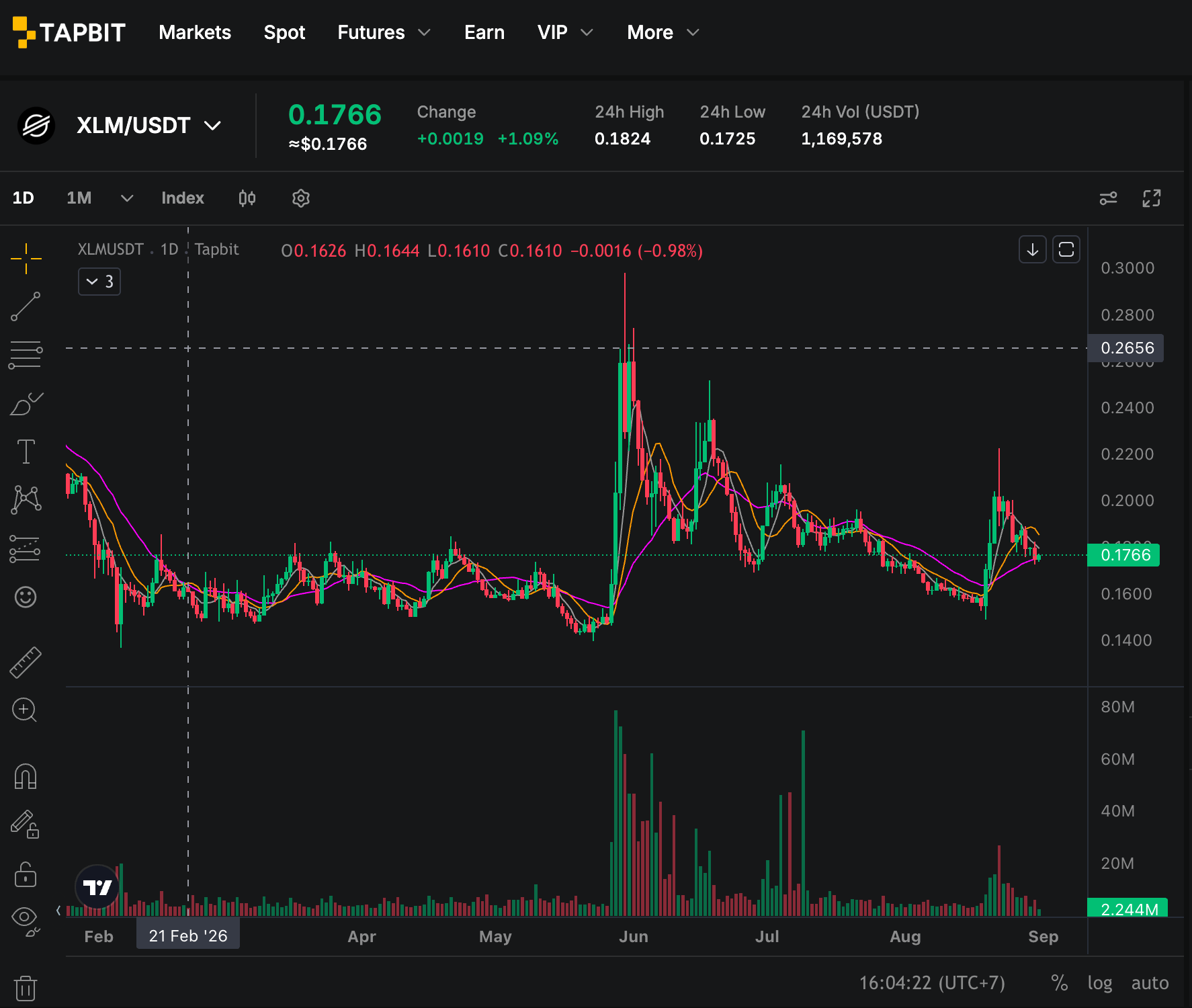
The simplest explanation is that RWA value locked on Stellar is not the same as direct buying pressure for XLM. Investors purchasing a tokenized Treasury fund generally want the fund token and its yield, not a speculative position in XLM.
XLM is still needed for transaction fees and account reserves, but Stellar fees are deliberately low. A large increase in transaction value can therefore occur without requiring institutions to buy or hold an equally large amount of XLM. The network can settle billions of dollars efficiently while generating relatively modest native-token demand.
Price is also determined in the broader crypto market. Liquidity conditions, Bitcoin’s direction, altcoin risk appetite, exchange flows and derivatives positioning may outweigh a strong adoption story over short periods. If traders do not expect RWA growth to improve XLM’s monetary demand, they may treat the expansion as positive for Stellar infrastructure but neutral for the token.
RWA Adoption and Token Value Are Different Metrics
| Metric | What It Measures | Direct Effect on XLM |
|---|---|---|
| RWA value | Value of tokenized financial assets issued on Stellar | Indirect |
| Transaction count | Network activity and settlement usage | Creates fee demand, but fees are small |
| Active accounts | Users and institutions interacting with Stellar | Can raise reserve and liquidity demand |
| DEX liquidity | Capital available for onchain trading | Potentially stronger token impact |
| XLM holding demand | Desire to own XLM beyond operational needs | Most direct price influence |
This distinction explains why blockchain fundamentals sometimes improve before token prices respond. RWA expansion strengthens Stellar’s relevance and may create long-term optionality, but the value-accrual mechanism must become visible to investors.
What Could Help XLM Catch Up?
A stronger link between Stellar’s institutional activity and XLM would require more than a rising headline RWA total. Growth in active accounts, onchain exchange liquidity, payments, smart-contract applications and XLM-denominated collateral could increase recurring demand for the native asset.
Market structure matters as well. A sustained move above recent resistance with stronger volume would suggest investors are beginning to reprice the RWA narrative. By contrast, continued trading near $0.18 while network assets rise would confirm that adoption is still being valued separately from the token.
What Could Keep XLM Under Pressure?
Tokenized finance is competitive. Ethereum, Solana, BNB Chain and other networks are also attracting issuers, and institutions can deploy the same or similar products across several chains. Multi-chain issuance reduces the chance that one network captures all associated value.
There is also concentration risk. A meaningful share of Stellar’s RWA total comes from a small number of issuers and fund products. Redemptions, a shift in interest rates or a decision to distribute assets on other networks could slow growth. Finally, low fees are excellent for users but limit the amount of economic activity that flows directly to XLM holders.
Conclusion
Stellar’s rise toward $4 billion in RWAs is a major infrastructure achievement, led by products such as Spiko’s tokenized funds and Franklin Templeton’s BENJI. Yet XLM’s muted performance shows that tokenized asset growth does not automatically become native-token demand. For XLM to catch up, investors will likely need evidence that institutional adoption is producing deeper liquidity, more active users and durable reasons to hold the token—not merely use the network.
FAQ
How large is the Stellar RWA market?
Recent 2026 data places Stellar’s onchain RWA value near $4 billion, up from roughly $868.8 million at the end of 2025.
What are the largest RWAs on Stellar?
Major components include Spiko’s tokenized money market products and Franklin Templeton’s BENJI, alongside government debt, credit and gold-backed assets.
Why does RWA growth not automatically raise XLM price?
RWA investors primarily buy the tokenized financial product. Stellar’s low fees mean institutions can use the network without purchasing large amounts of XLM.
Can Stellar RWA adoption help XLM over time?
It can, especially if adoption leads to more active accounts, onchain liquidity, collateral demand and sustained XLM ownership. The effect is not guaranteed or immediate.
Where can traders follow XLM price?
Traders can monitor the XLM/USDT market on Tapbit and compare price, volume and order-book conditions.


