

Ethereum has delivered one of its strongest moves against Bitcoin in months. On August 19, the ETH/BTC ratio jumped from roughly 0.0296 to 0.0325 and briefly traded above 0.033.
The move was large enough to revive talk of an Ethereum bull run. It also arrived with something that many earlier ETH rebounds lacked: sustained demand through US spot exchange-traded funds.
Still, ETH has not totally completed the breakout. The ratio has since returned to around 0.0317. Ethereum is outperforming Bitcoin, but the market has not yet decided whether this is a lasting rotation or just a sharp recovery from an oversold position.
ETH/BTC Has Improved, but 0.033 Remains Unresolved
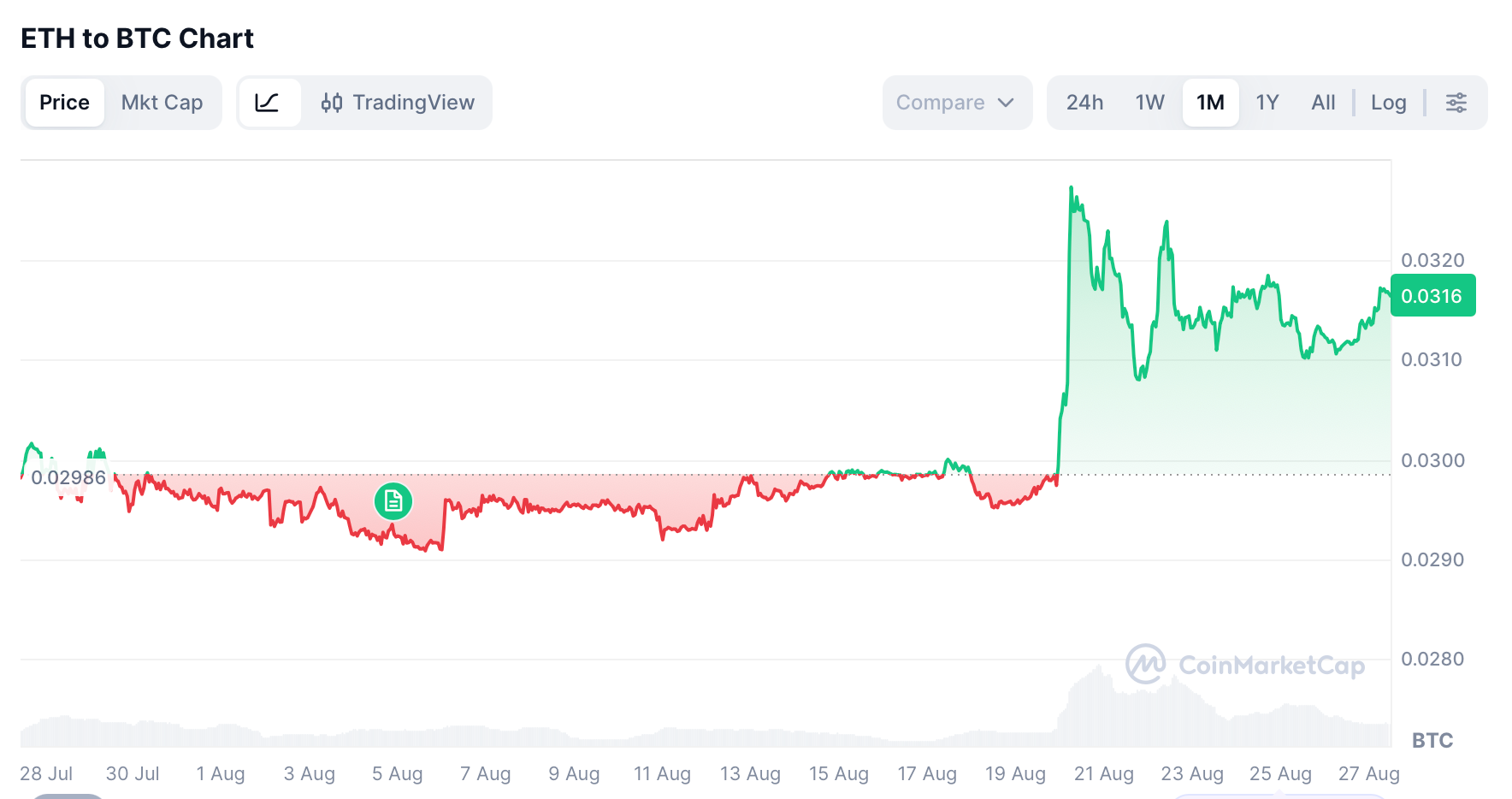
ETH/BTC measures the value of Ether in Bitcoin rather than US dollars. When the ratio rises, ETH is outperforming BTC. When it falls, Bitcoin remains the stronger asset.
Ethereum gained approximately 32% against Bitcoin over the 30 days ending August 26. Much of that improvement came during the August 19 breakout.
The rally reached an important area around 0.033 BTC but failed to remain there. This does not invalidate the recovery. It does mean that describing the move as a confirmed long-term reversal would be premature.
A sustained move above 0.033 would show that buyers are prepared to hold ETH even after its initial rebound. Continued trading below that level would leave the ratio inside a broader recovery range.
Support between approximately 0.030 and 0.031 now matters. If ETH holds that area during a market pullback, the recent move could become the base for another attempt at 0.033. A decisive fall below it would suggest that the August rally moved faster than underlying demand could support.
ETF Buyers Have Given the Rally Real Weight
The clearest evidence behind Ethereum’s recent strength comes from US spot Ether ETFs. Between August 18 and August 25, these products recorded six consecutive sessions of net inflows. Data shows approximately $957 million entering the funds during that period.
Daily net inflows reached about $187 million on August 19, $220 million on August 20 and $180 million on August 25. BlackRock’s iShares Ethereum Trust ETF, ETHA, accounted for much of the buying.
That changes how the rally should be read. A move driven entirely by leveraged futures can disappear when short liquidations end. ETF inflows represent demand for products backed by spot Ether, giving the advance a stronger foundation.
The concentration of those flows is also a risk. BlackRock’s fund has carried a large share of the recent demand. If ETHA inflows slow or turn negative, Ethereum could lose an important source of marginal buying.
Institutional Demand Is Expanding Beyond Price Exposure
SharpLink reported that it held approximately 888,938 ETH as of August 3, 2026. Other public companies have built Ether treasuries and placed part of their holdings into staking, attempting to earn network rewards instead of holding ETH as an inactive balance-sheet asset.
Staking is becoming relevant to regulated investment products as well. An August filing with the US Securities and Exchange Commission identifies the Grayscale Ethereum Staking ETF and details its operating agreements. This gives investors a different proposition from a conventional spot fund: exposure to ETH alongside participation in its proof-of-stake economics.
Institutional adoption does not guarantee a higher ETH price. Treasury companies can issue shares or debt to fund purchases, and ETF demand can reverse. What has changed is the number of regulated channels through which larger investors can gain Ethereum exposure.
Ethereum Still Controls Important On-Chain Markets
Ethereum remains the leading settlement layer for large parts of DeFi, stablecoins and tokenized real-world assets.
The Ethereum Institutional Data Hub tracks tens of billions of dollars in DeFi assets and a much larger stablecoin economy across Ethereum mainnet and its Layer 2 networks. DefiLlama reports approximately $16.6 billion in on-chain real-world assets on Ethereum.
These figures support the argument that ETH is tied to active financial infrastructure rather than only market speculation. Stablecoin transfers, lending markets, decentralized exchanges and tokenized assets all depend on Ethereum’s settlement and security model.
The harder question is how much of that activity translates into direct demand for ETH.
Layer 2 networks allow users to transact more cheaply, but they also reduce congestion and fees on Ethereum mainnet. Lower fees mean less ETH is burned under EIP-1559. When validator issuance exceeds fee burning, the ETH supply can become mildly inflationary.
Ecosystem growth and ETH value capture are related, but they are not identical.
Glamsterdam Is Progress, Not a Rally Explanation

Ethereum development is moving toward the Glamsterdam upgrade, which introduces changes across the consensus and execution layers.
The Ethereum Foundation launched the Platåberget testnet in August to test post-Glamsterdam features. Work includes changes to validator and builder workflows as well as gas repricing intended to reflect the real cost of state creation and access more accurately.
The upgrade could support higher network capacity over time. It also requires some wallet providers, indexers and smart contract developers to update their assumptions. The Ethereum Foundation has warned that a small number of contracts could experience problems without preventive changes, although most applications are expected to remain unaffected.
Glamsterdam is therefore a meaningful technical development, but it is not yet a mainnet catalyst. The current ETH rally is more directly connected to market rotation and ETF demand.
The Breakout Still Needs Confirmation
Ethereum has a stronger case than it did at the beginning of August. ETH/BTC has recovered sharply, spot ETFs have attracted close to $1 billion across six sessions, and institutional access continues to expand.
The missing piece is confirmation.
A stable move above 0.033 BTC would show that Ethereum can preserve its relative gains rather than surrender them after one powerful rally. Holding the 0.030 to 0.031 region during a pullback would also strengthen the structure.
Beyond price, traders should watch ETF flows, mainnet fee revenue, ETH issuance, staking participation and demand for Ethereum settlement across Layer 2 networks.
Ethereum is outperforming Bitcoin for now. Whether that becomes a wider ETH bull run depends on what happens after the first breakout attempt.
Market participants can follow ETH and other digital asset markets through Tapbit. Existing users can access their accounts from the Tapbit login page, while new users can register here.
Frequently Asked Questions
Is Ethereum currently outperforming Bitcoin?
Yes. ETH gained approximately 32% against BTC over the 30 days ending August 26, 2026. The ETH/BTC ratio nevertheless remains below its recent resistance around 0.033.
Why is 0.033 important for ETH/BTC?
ETH/BTC briefly traded above 0.033 during the August rally but did not hold the level. A sustained breakout would provide stronger evidence that Ethereum’s relative recovery is continuing.
Are spot Ethereum ETFs receiving inflows?
US spot Ether ETFs recorded approximately $957 million in combined net inflows between August 18 and August 25. BlackRock’s ETHA contributed a large share of the total.


