
The Sandisk stock price closed at $1,786.85 on August 17, 2026, after surging 8.9% in a single session. The move extended a strong multi-day rebound and pushed SNDK back above its 50-day moving average, reinforcing investor confidence that the AI-driven storage cycle may have more room to run.
The rally follows Sandisk’s August 13 Investor Day, where management outlined ambitious long-term growth expectations and highlighted the role of flash storage in data-intensive workloads. The stock has been one of the most volatile AI-hardware names of 2026, so the current Sandisk stock price is testing whether the rebound can evolve into a sustained trend rather than another short-lived recovery.
Sandisk Stock Price Today: What Changed?
SNDK gained 8.9% to $1,786.85 on August 17, according to the latest completed U.S. trading session. The move came after a roughly 35% advance over the prior week as investors digested Sandisk’s Investor Day and improving sentiment toward memory stocks.
The rebound is significant because Sandisk suffered a sharp correction in July. That selloff showed how quickly high-valuation AI hardware trades can reverse when investors question capital spending or future margins. The current recovery has repaired some of the technical damage but has not removed the stock’s volatility risk.
Why Is Sandisk Stock Rising?
Investor Day Reset Long-Term Expectations
Sandisk’s Investor Day gave investors a clearer view of the company’s long-term model. Management discussed mid- to high-teens revenue-growth ambitions for fiscal 2028 through 2030 and emphasized stronger visibility from new business-model agreements with customers.
Longer-term agreements matter because the NAND industry has historically been highly cyclical. Better demand visibility could reduce some of the boom-and-bust behavior that has made memory companies difficult to value.
AI Data Centers Need More Storage
The AI investment cycle is not only about GPUs. Training and inference workloads generate enormous amounts of data that must be stored, moved and accessed efficiently. That increases demand for advanced flash products alongside compute and networking hardware.
Sandisk is positioning high-bandwidth flash as part of that opportunity. If AI infrastructure spending remains elevated, storage can capture a larger share of the data-center budget.
NAND Supply and Pricing Remain Supportive
The Sandisk stock price also benefits when NAND supply remains disciplined and pricing stays firm. Memory profitability can change rapidly when supply exceeds demand, so investors are watching whether producer discipline and long-term agreements can support margins through the cycle.
What Sandisk’s Investor Day Means for the Stock
The most important message was that Sandisk wants investors to view the business as more structurally profitable than in previous NAND cycles. The company has emphasized long-term customer relationships, advanced flash technologies and returning excess cash to shareholders.
The bull case assumes these changes create more predictable earnings and reduce the discount investors typically apply to cyclical memory companies. The risk is that very strong current pricing leads analysts to extrapolate peak conditions too far into the future.
Sandisk Support and Resistance
| Reference Zone | Why It Matters |
|---|---|
| $1,700-$1,750 | Near-term breakout and support area after the latest rally. |
| $1,800-$1,850 | Immediate resistance zone as SNDK tests whether momentum can extend. |
| $2,000+ | Psychological and momentum zone if the rally broadens. |
| Prior summer peak area | Major longer-term resistance and bull-case reference. |
These zones should be refreshed against the live chart before trading. The Sandisk stock price can move quickly around memory-sector news, AI-capex expectations and changes in U.S.-China technology policy.
Sandisk Bull, Base and Bear Scenarios
Bull case: NAND pricing stays firm, AI storage demand accelerates and Sandisk’s long-term agreements improve earnings visibility. A sustained move above the recent breakout zone could reopen the path toward previous highs.
Base case: SNDK consolidates after its sharp rebound. Revenue expectations remain strong, but investors wait for evidence that long-term margins can support the current valuation.
Bear case: AI spending slows, NAND supply tightness eases or margins normalize faster than expected. In that scenario, the Sandisk stock price could give back part of the post-Investor-Day rally.
Sandisk vs Micron: Different Memory Exposure
Sandisk and Micron are both benefiting from AI infrastructure, but their exposures differ. Sandisk is primarily associated with NAND flash and storage, while Micron has major DRAM and HBM exposure in addition to NAND.
That means AI demand can affect the two companies differently. HBM is tightly linked to accelerator systems, while NAND and flash are tied more directly to data storage and access. Investors should avoid treating every memory stock as the same AI trade.
What Would Confirm the SNDK Rally?
The first confirmation would be sustained trading above the recent breakout zone rather than a one-day spike. The second would be continued strength in NAND pricing and customer agreements. Third, analysts would need to maintain or raise earnings estimates as the company executes on its Investor Day targets.
Failure to hold the 50-day moving average, weakening memory prices or a broad AI-hardware selloff would increase the risk that the current rally is overextended.
How to Trade SNDK-USDT on Tapbit
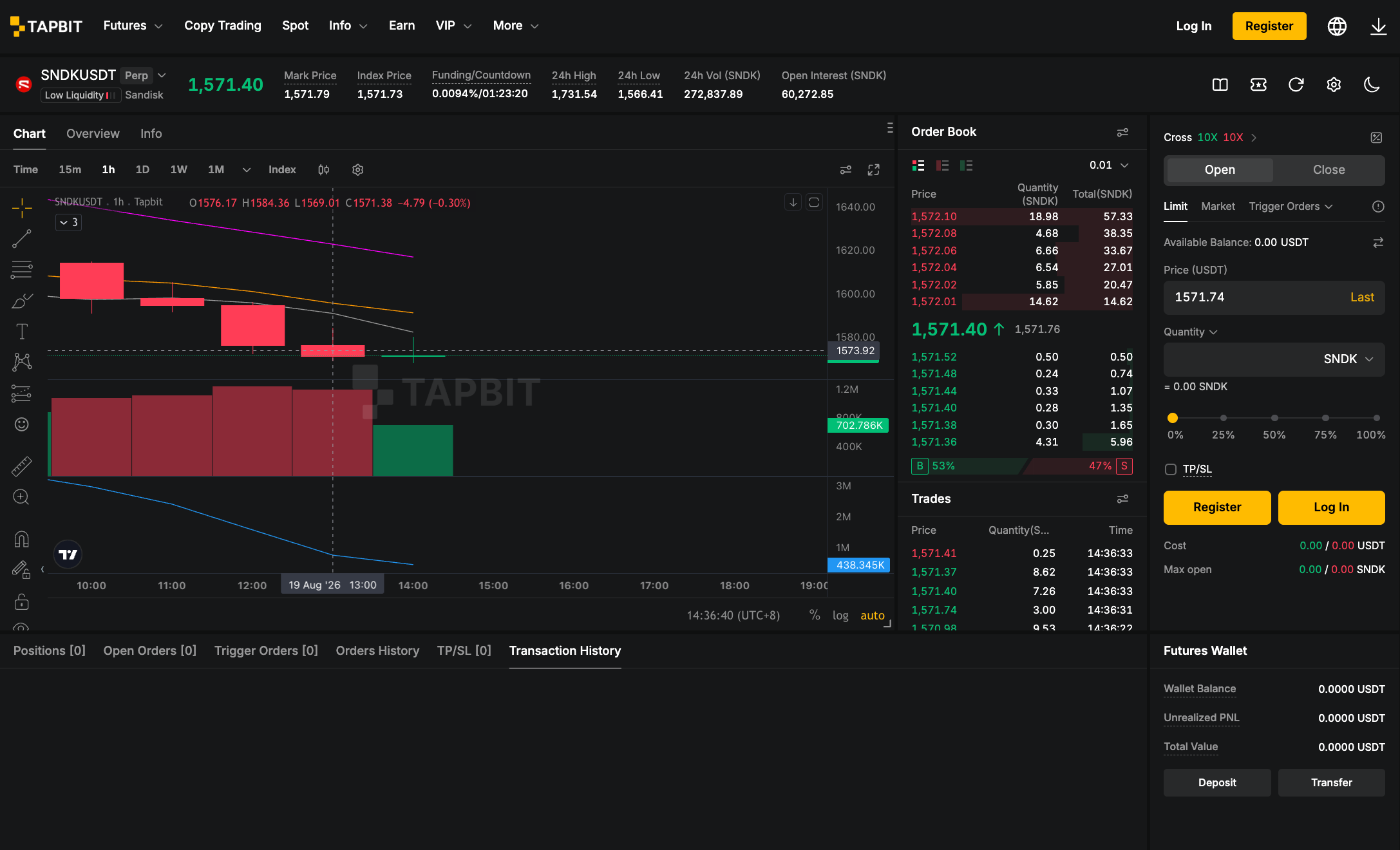
Tapbit offers SNDK-USDT perpetual futures. The contract provides Sandisk-linked derivative price exposure. It is not direct ownership of Sandisk shares and does not provide shareholder voting rights or dividends.
-
Create an account or log in.
-
Open SNDK-USDT and review the contract name, mark price, index price and funding countdown.
-
Select Limit, Market or Trigger, choose quantity, leverage and margin mode, then Open Long or Open Short.
-
Add TP/SL and monitor margin, Positions, Open Orders, Trigger Orders and liquidation risk.
Near term, the Sandisk stock price will likely remain sensitive to both NAND fundamentals and broader AI-hardware sentiment. If SNDK holds its breakout while memory pricing and estimates stay firm, the Sandisk stock price would have stronger confirmation that the recovery is more than a short squeeze.
Bottom Line
The Sandisk stock price at $1,786.85 reflects renewed confidence in AI storage, NAND pricing and Sandisk’s long-term growth plan. Investor Day strengthened the fundamental case, but the stock’s July collapse is a reminder that valuation and memory-cycle risk remain substantial. Holding the recent breakout area would support the bull case, while a reversal below key moving averages would weaken it. Tapbit’s SNDK-USDT provides derivative exposure for traders who want to take a directional view without owning Sandisk shares directly.
FAQ
Why is Sandisk stock rising?
The latest rally has been driven by strong Investor Day guidance, AI storage demand, supportive NAND conditions and renewed investor confidence in memory stocks.
What was the latest Sandisk stock price?
SNDK closed at $1,786.85 on August 17, 2026, after rising 8.9% that day.
Is Sandisk an AI stock?
Sandisk is primarily a flash-memory and storage company, but AI data centers increase demand for high-performance storage, making it an indirect AI infrastructure play.
Can I trade Sandisk on Tapbit?
Tapbit offers SNDK-USDT perpetual futures for derivative Sandisk-linked price exposure.


