

Nike is one of the world's most recognizable consumer brands, but that hasn't protected its stock.
NKE closed at $39.09 on August 17 — its lowest since 2014. That's roughly 78% below the November 2021 record close of $177.51. Market cap has fallen to about $58 billion.
A drop that steep naturally raises the question: is Nike finally cheap?
The answer isn't as clear as the chart might suggest.
CEO Elliott Hill is working to rebuild the product pipeline, repair wholesale relationships, and refocus the brand around sport. Some signs are positive — North America is growing again, wholesale sales have improved, and performance products are gaining traction.
But China remains weak. Direct-to-consumer is still shrinking. Digital sales continue to decline. And one of the standout numbers from the latest quarter — gross margin — got a significant boost from a tariff-related recovery that isn't likely to repeat.
So NKE is probably better understood as a turnaround play than a simple value pick.
Why Is Nike Stock Down So Much?

Nike’s problems did not begin with one bad quarter. For several years, the company leaned heavily into its direct-to-consumer strategy, reduced its dependence on traditional retail partners and pushed large volumes of successful lifestyle franchises such as Dunk and Air Force 1.
That strategy eventually created problems.
Wholesale partners had more shelf space to give emerging competitors. Brands such as Hoka and On gained visibility. At the same time, Nike’s own digital business lost momentum, some established footwear franchises became overexposed, and competition intensified in important markets including China.
Elliott Hill, who returned to lead Nike as CEO, has been trying to reverse parts of that strategy. His approach is built around sport, performance innovation, stronger wholesale relationships and a healthier marketplace.
The turnaround is underway. What investors do not yet know is how long it will take. That uncertainty is a major reason the market continues to discount NKE even after such a large decline.
Nike’s Latest Earnings Show Progress, but Not a Full Recovery
Nike reported $46.4 billion in fiscal 2026 revenue, essentially flat on a reported basis and down 2% on a currency-neutral basis. Net income came in at approximately $3.1 billion, down 3%, while diluted earnings per share declined 3% to $2.10.
The fourth quarter offered a similar picture.
Revenue was about $11.0 billion, down 1% reported and 4% currency-neutral. Nike is no longer experiencing the kind of severe deterioration that defined earlier stages of the turnaround, but it has not returned to consistent growth either.
CEO Elliott Hill said Nike had made structural improvements during fiscal 2026 and was seeing encouraging progress in performance products, while also acknowledging continued top-line pressure.
That is a fair description of the business today: some parts are improving faster than others.
Wholesale Is Recovering
One of the strongest pieces of evidence supporting Nike’s turnaround is wholesale. Fourth-quarter wholesale revenue rose 4% to $6.6 billion, while full-year wholesale sales increased 6% to $27.5 billion.
This matters because rebuilding wholesale relationships has been one of Hill’s major priorities.
Nike previously pulled back from some retail partners as it tried to shift more consumers toward its own stores and websites. That created room for competitors and reduced Nike’s visibility in places where consumers were still buying athletic footwear.
The company is now reversing that imbalance. If wholesale growth continues without requiring excessive discounting, it could provide a much more stable foundation for the next stage of Nike’s recovery.
The problem is that wholesale strength is currently being offset by weakness elsewhere.
Nike Direct and Digital Are Still Falling
Nike Direct revenue fell 7% in the fourth quarter to $4.1 billion, including a 12% decline in Nike Brand Digital and a 7% decline in Nike-owned stores. For the full year, Nike Direct fell 6%, while digital sales were again down 12%.
That is one of the most important numbers in the entire NKE investment story.
Nike spent years presenting direct-to-consumer sales as an important driver of higher margins, better consumer data and stronger brand control. Now, the company is rebuilding wholesale while its own direct channels remain under pressure.
A genuine turnaround probably requires both sides of the business to become healthier. If wholesale grows simply because Nike moves sales away from its own digital channels, the overall growth story remains limited.
China Is the Biggest Problem Nike Still Needs to Solve
Greater China remains Nike’s weakest major geography. Fiscal 2026 Greater China revenue fell 11% to $5.85 billion, or 13% on a currency-neutral basis. In the fourth quarter alone, revenue dropped 12% reported and 17% currency-neutral. Greater China footwear revenue declined 17% currency-neutral during the quarter.
That weakness matters beyond the lost revenue.
China was once one of Nike’s most dependable growth markets. Today, domestic competitors such as Anta and Li-Ning have become stronger, while Nike has also had to adapt to changing local shopping behavior and a more fragmented digital marketplace.
Nike is responding with a significant overhaul. Beginning January 1, 2027, the company plans to eliminate online sales through more than 1,000 third-party vendors in China and concentrate digital distribution around roughly a dozen official flagship channels, including major platforms and Nike’s own website and app.
The idea is to regain control over pricing, inventory, counterfeit risk and brand presentation. It is also a risky move.
North America Is Showing a Different Picture
The situation is considerably healthier in Nike’s largest market. North American Nike Brand revenue reached about $20.5 billion in fiscal 2026, up 5%. Fourth-quarter North American revenue increased 3% to approximately $4.83 billion.
Footwear was particularly encouraging, increasing 5% for the full year.
This supports management’s argument that parts of the Sport Offense strategy are gaining traction.
A successful Nike recovery probably begins in North America, where the company has strong brand awareness, extensive distribution and a deeper connection with major sports.
But North American growth alone cannot completely offset persistent weakness in China, EMEA and digital channels.
Nike Still Has Financial Flexibility
Despite the operational challenges, Nike is not facing a balance-sheet crisis. The company ended fiscal 2026 with about $9.0 billion of cash, equivalents and short-term investments. Inventories were roughly flat at $7.5 billion.
Nike also returned approximately $2.5 billion to shareholders during the fiscal year, including $2.4 billion in dividends. On August 6, the board declared another $0.41-per-share quarterly dividend, payable October 1 to shareholders of record on September 1.
That financial position gives Hill something many struggling turnaround companies do not have: time.
Nike does not need to repair the business while simultaneously fighting an immediate liquidity crisis. But shareholders still need earnings to recover eventually. Cash and dividends can support the investment case; they cannot replace growth indefinitely.
Is NKE Stock Cheap at $39?
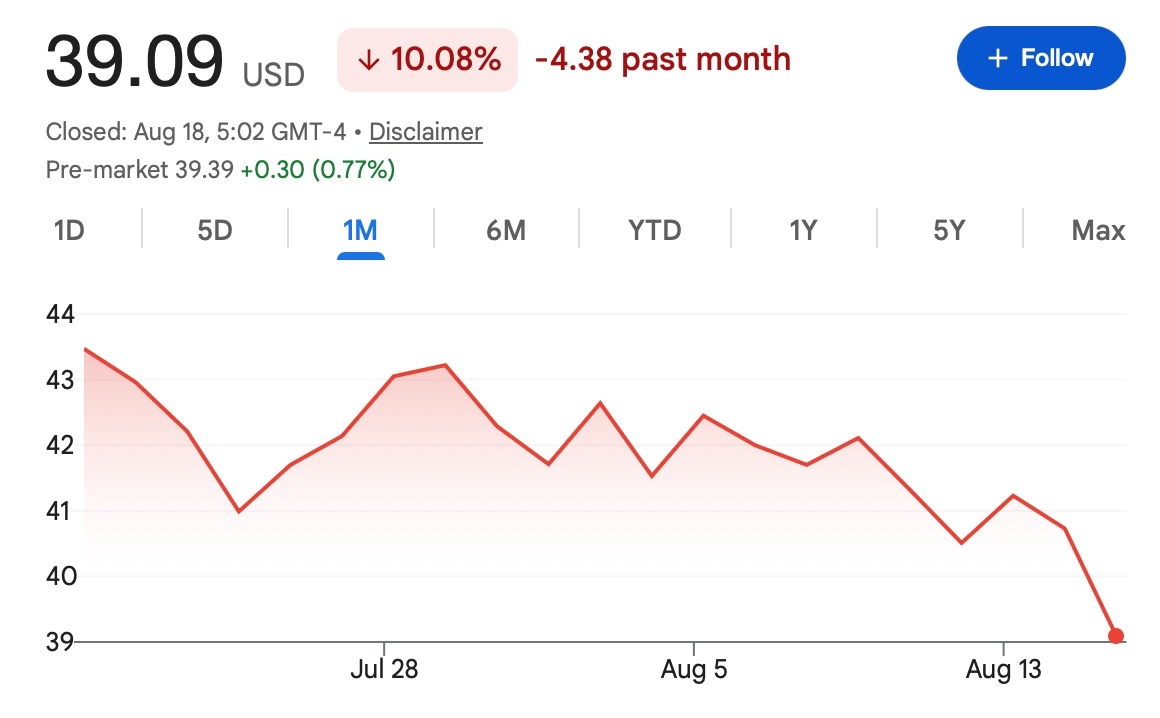
This is where the debate becomes interesting. A stock trading 78% below its all-time high looks inexpensive visually. But share-price declines and valuation are not the same thing.
NKE currently trades around $39.09, while trailing market data puts its price-to-earnings ratio in the mid-20s.
That is not an obviously distressed valuation for a company whose earnings are still under pressure. Nike could eventually prove very cheap if earnings recover strongly over the next several years.
But if earnings continue falling, today's apparently low share price may not be low on an earnings basis at all.
That is why calling NKE either “cheap” or “expensive” without a view on the turnaround misses the point. The valuation depends heavily on what Nike earns in the future, not what the stock used to cost.
What Could Send Nike Stock Higher?
Nike does not need every part of its business to improve simultaneously. A few changes could materially alter sentiment.
If North American momentum continues, performance footwear gains share and wholesale stays healthy, investors could begin treating those improvements as evidence that Hill's strategy works.
China would be an even larger catalyst.
A slowdown from double-digit declines toward stabilization could change the narrative considerably because expectations for the region are now so depressed.
Finally, improvement in Nike Digital would be particularly important. The market already understands that wholesale is recovering. A return to growth in Nike's own channels would suggest the company is no longer shifting weakness from one channel to another.
Final Thoughts
Nike stock has fallen far enough that the market is clearly pricing in serious problems. At roughly $39, NKE is at its lowest closing level since 2014 and about 78% below its 2021 record.
The business, however, is not collapsing. Fiscal 2026 revenue was essentially flat. North America grew. Wholesale is recovering. Nike still has substantial liquidity and continues paying dividends.
The concerns are just as real. China remains deeply challenged, digital revenue continues falling, Converse is shrinking and Nike's latest quarterly margin improvement was heavily influenced by a tariff recovery rather than purely operational progress.
That leaves investors with a turnaround rather than an easy bargain.The bullish thesis is that Elliott Hill is fixing problems that are temporary and execution-related. The bearish thesis is that Nike's competitive position has changed more permanently than the market once believed.
At this point, $39 alone does not answer which side is right. The answer will come from whether Nike can turn early wholesale and North American progress into sustained revenue and earnings growth.
Users can explore available crypto markets through the Tapbit homepage. Existing users can access their accounts through the Tapbit login page, while new users can register with Tapbit.
Frequently Asked Questions
What is Nike stock trading at now?
NKE was trading around $39.09 as of August 18, 2026 market data.
Why is Nike stock falling?
Investors remain concerned about declining Nike Direct and digital sales, double-digit weakness in Greater China, intense competition and uncertainty about how quickly CEO Elliott Hill's turnaround can restore sustainable earnings growth.
How far is NKE below its all-time high?
Nike shares are approximately 78% below the company's November 2021 record closing price of $177.51.


