
The best crypto wallet in 2026 depends on what the user needs to do. A trader moving funds frequently has different priorities from a DeFi user signing smart-contract transactions or a long-term holder protecting a large balance. No wallet can maximize convenience, privacy, chain support and offline security at the same time.
This guide compares five widely used options—MetaMask, Rabby, Trust Wallet, Ledger and Trezor—using practical criteria rather than declaring one universal winner. Features can change, so users should verify current chain support and download only from official sources.
What Makes a Crypto Wallet “Best”?
- Custody: who controls the private keys?
- Security: where are keys stored and how are transactions verified?
- Chain support: which networks and tokens can the wallet manage?
- Web3 access: can it connect safely to dApps and display transaction details?
- Recovery: what happens if the device is lost?
- Usability: is the interface appropriate for the user’s experience level?
Five Crypto Wallets to Consider in 2026
1. MetaMask — Best for Broad EVM DeFi Access
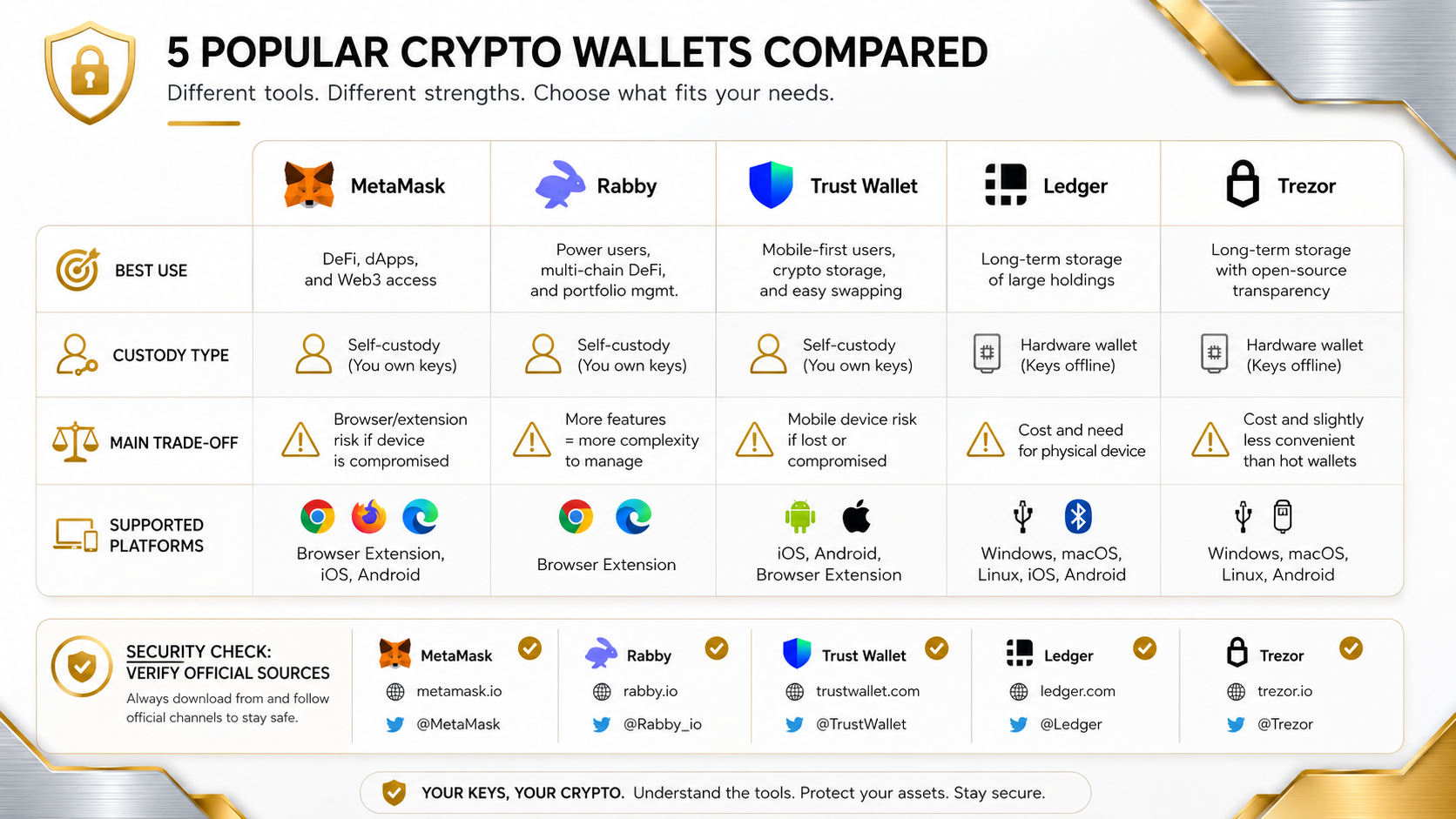
MetaMask remains one of the most widely supported interfaces for Ethereum and EVM-compatible applications. It suits users who interact with DeFi protocols, tokenized assets, NFT platforms and browser-based dApps. It can also connect to Ledger and Trezor hardware wallets.
Main strength: broad EVM application compatibility.
Main limitation: a software-only account remains exposed to browser, device and phishing risks.
2. Rabby — Best for EVM Transaction Transparency
Rabby is designed for EVM users who want clearer transaction previews and network switching. Its simulation and risk-warning features can help users understand what a smart-contract approval may do before signing.
Main strength: transaction simulation and clearer approval context.
Main limitation: a narrower focus outside EVM ecosystems.
3. Trust Wallet — Best for Mobile Multichain Use
Trust Wallet supports many networks and is designed around mobile access. It can be convenient for users who hold assets across several ecosystems and want swaps, staking or dApp access from one application.
Main strength: broad mobile multichain experience.
Main limitation: convenience does not remove hot-wallet risk.
4. Ledger — Best for Hardware Security With Broad App Support
Ledger devices keep signing keys in dedicated hardware and can connect to software interfaces such as MetaMask. This can reduce direct exposure of private keys to an internet-connected computer.
Main strength: hardware signing with broad ecosystem support.
Main limitation: users still need to verify transaction details and protect the recovery phrase.
5. Trezor — Best for Open Hardware-Wallet Integration
Trezor emphasizes hardware-based key control and works with a range of wallet applications. It is a strong option for long-term holders who prefer a hardware signer and compatibility with interfaces such as MetaMask or Rabby.
Main strength: hardware security and third-party wallet integration.
Main limitation: setup and recovery require more responsibility than a custodial account.
Wallet Comparison
| Wallet | Best For | Custody Type | Main Trade-Off |
|---|---|---|---|
| MetaMask | EVM DeFi and dApps | Self-custody hot wallet | Online attack exposure |
| Rabby | EVM transaction clarity | Self-custody hot wallet | Narrower non-EVM support |
| Trust Wallet | Mobile multichain use | Self-custody hot wallet | Mobile-device and dApp risk |
| Ledger | Hardware-backed Web3 access | Self-custody hardware wallet | Cost and backup responsibility |
| Trezor | Long-term hardware storage | Self-custody hardware wallet | More setup complexity |
Best Wallet by Use Case
Beginners: prioritize a simple interface, official download source, clear recovery flow and a small initial balance.
DeFi users: MetaMask and Rabby offer strong EVM connectivity. Rabby may appeal to users who value transaction simulation, while MetaMask offers exceptionally broad dApp support.
Long-term holders: Ledger or Trezor can reduce online key exposure. Users should test recovery procedures and never photograph or cloud-store the seed phrase.
Active traders: keeping a limited trading balance on an exchange can be more efficient than transferring assets for every order. Long-term holdings can remain separated in self-custody.
Seven Security Checks Before Choosing a Wallet
- Download only from the official website or verified app-store listing.
- Confirm which chains are supported natively.
- Understand whether the wallet is custodial or self-custodial.
- Review how transaction approvals are displayed.
- Check hardware-wallet compatibility.
- Research the wallet’s audit and incident history.
- Test with a small transaction before moving a large balance.
Common Wallet Mistakes
The most damaging error is entering a seed phrase into a website, form or unsolicited recovery tool. Legitimate support teams do not need a user’s recovery phrase.
Other mistakes include buying counterfeit devices, approving unlimited token allowances, using one wallet for every dApp, downloading fake browser extensions and storing recovery phrases in cloud notes.
Tapbit Learn’s guide to Phantom Wallet and Web3 use provides another ecosystem example. Users comparing specialized DOGE storage can also review the Dogecoin wallet security guide.
How Tapbit Can Fit Into a Broader Wallet Strategy
A crypto wallet strategy does not need to rely on one platform or one storage method. Many users separate their assets by purpose: an exchange account for active trading and market access, a hot wallet for limited Web3 activity, and a hardware wallet for long-term self-custody. Tapbit can serve as the exchange layer in that structure, but it should not be described as a replacement for a self-custody wallet.
For active traders, a Tapbit account can provide access to supported spot and futures markets without requiring every position to be moved through an external wallet before each trade. Users can also follow market prices, place orders and manage short-term trading capital from one account. Long-term holdings or assets used in DeFi can remain separated in a self-custody wallet according to the user’s own risk plan.
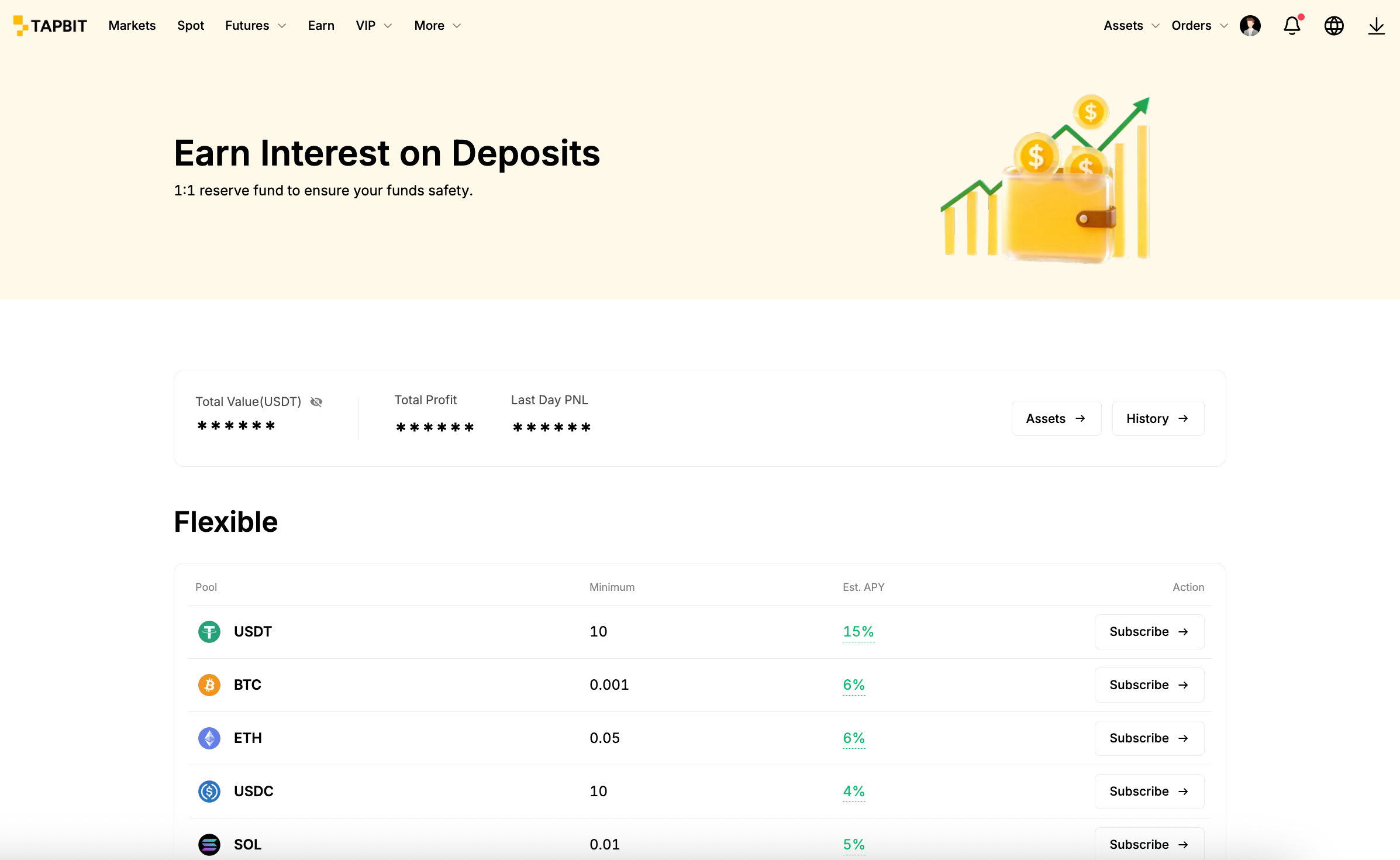
Users who do not want to trade a specific asset immediately can still use Tapbit’s market pages to monitor price movements and compare market conditions before deciding whether to transfer or trade. Eligible assets may also be available through Tapbit Earn, allowing users to review variable-yield products for assets they already intend to hold. Earn availability, rates and redemption terms should always be checked on the live product page.
A practical hybrid setup may look like this:
- Tapbit account: active trading, supported market access, price monitoring and eligible Earn products.
- Hot wallet: small balances for DeFi, dApps and frequent on-chain transactions.
- Hardware wallet: larger or longer-term holdings that do not need regular access.
Users can create an account to review supported markets and Earn products, then decide which assets belong on the exchange and which should remain in self-custody. The goal is not to choose between Tapbit and a wallet, but to assign each tool a clear role.
Final Assessment
MetaMask is strong for broad EVM access, Rabby for transaction transparency, Trust Wallet for mobile multichain use, and Ledger or Trezor for hardware-backed key protection. The strongest setup is often a combination rather than one winner.
Frequently Asked Questions
What is the safest crypto wallet?
No wallet is risk-free. Hardware wallets reduce online key exposure, but users can still approve malicious transactions.
Can a wallet provider recover a seed phrase?
In true self-custody, the provider generally cannot recover a lost seed phrase.
Should all crypto be kept in one wallet?
Separating trading, DeFi and long-term storage can reduce the impact of one compromised account.


