
clan.tech is a SocialFi platform that turns access to private trader communities into tradeable on-chain “Clan Keys.” The resemblance to friend.tech is clear: users buy a key, gain access to a gated chat, and can later sell the key as demand changes. The important difference is emphasis. friend.tech centered on keys linked to individual creators, while clan.tech presents the community—or clan—as the primary social and economic unit.
That makes clan.tech one of the clearest attempts to revive the token-gated chat model in 2026. Yet calling it “the next friend.tech” is premature. The platform still has to prove that its communities can remain useful after launch speculation cools, that key liquidity works under stress, and that fee incentives do not overwhelm genuine conversation.
CLAN and individual Clan Keys are not currently presented as supported Tapbit markets. Readers who want broader market access can create a Tapbit account and explore the assets that are actually available on the platform.
What Is clan.tech?
clan.tech combines private group messaging with a market for access. A clan can represent a trader circle, research group, creator community or other gated network. Instead of asking an administrator for an invite, a user buys the clan’s key through an on-chain contract. Holding the key is intended to unlock the clan’s private chat; selling it removes the economic position and may end access.
The public site also displays clan rankings, member counts and reported profit-and-loss figures. Those dashboards can help users discover active groups, but they should not be confused with audited performance. A clan’s ranking or displayed PnL does not guarantee that a new key buyer will earn money.
How CLAN Keys Work
A Clan Key is an access asset tied to a specific group. It is not the same thing as the platform’s CLAN token. The key’s price is described in community materials as following a quadratic bonding curve: as more keys are purchased, the next key becomes increasingly expensive; as holders sell, the curve moves downward.
This design provides continuous contract-based buying and selling without requiring a conventional order book. The reserve held by the contract is meant to support exits along the curve. That does not eliminate loss risk. A user who buys after a rapid climb can receive much less on sale if several holders exit first, and fees widen the break-even point further.
What Do Private Chats Offer?
The key’s practical value depends on the clan behind it. A high-quality room might offer market discussion, research, deal flow, educational sessions or direct access to experienced members. A weak room may contain little more than promotional messages encouraging new key purchases.
Token gating can align access with financial commitment, but it also changes social incentives. Members may promote the room because higher demand raises key prices, while clan operators earn more when keys trade. Readers should judge the quality, consistency and transparency of the conversation separately from the chart attached to the key.
How clan.tech Trading Fees Work
Community explainers describe a 7% fee on each key purchase and sale, split equally between the platform team and the relevant clan. If that structure is active, each side receives 3.5% of the trade value. Because fees apply in both directions, a round trip can create a substantial hurdle before considering movement along the bonding curve or network transaction costs.
| Feature | clan.tech | friend.tech Model |
|---|---|---|
| Access asset | Clan Key linked to a group | Key linked mainly to an individual profile |
| Private space | Clan-based gated chat | Creator or profile chatroom |
| Reported trade fee | 7% per buy or sell | Historically 10% per buy or sell |
| Core incentive | Community access plus clan fee share | Creator access plus creator fee share |
Fee schedules can change, and third-party summaries may become stale. Users should confirm the percentage shown in the live transaction preview and inspect the current contract before signing. The total cost is the protocol fee, curve movement, network fee and any additional spread—not merely the headline percentage.
What Is the CLAN Token?
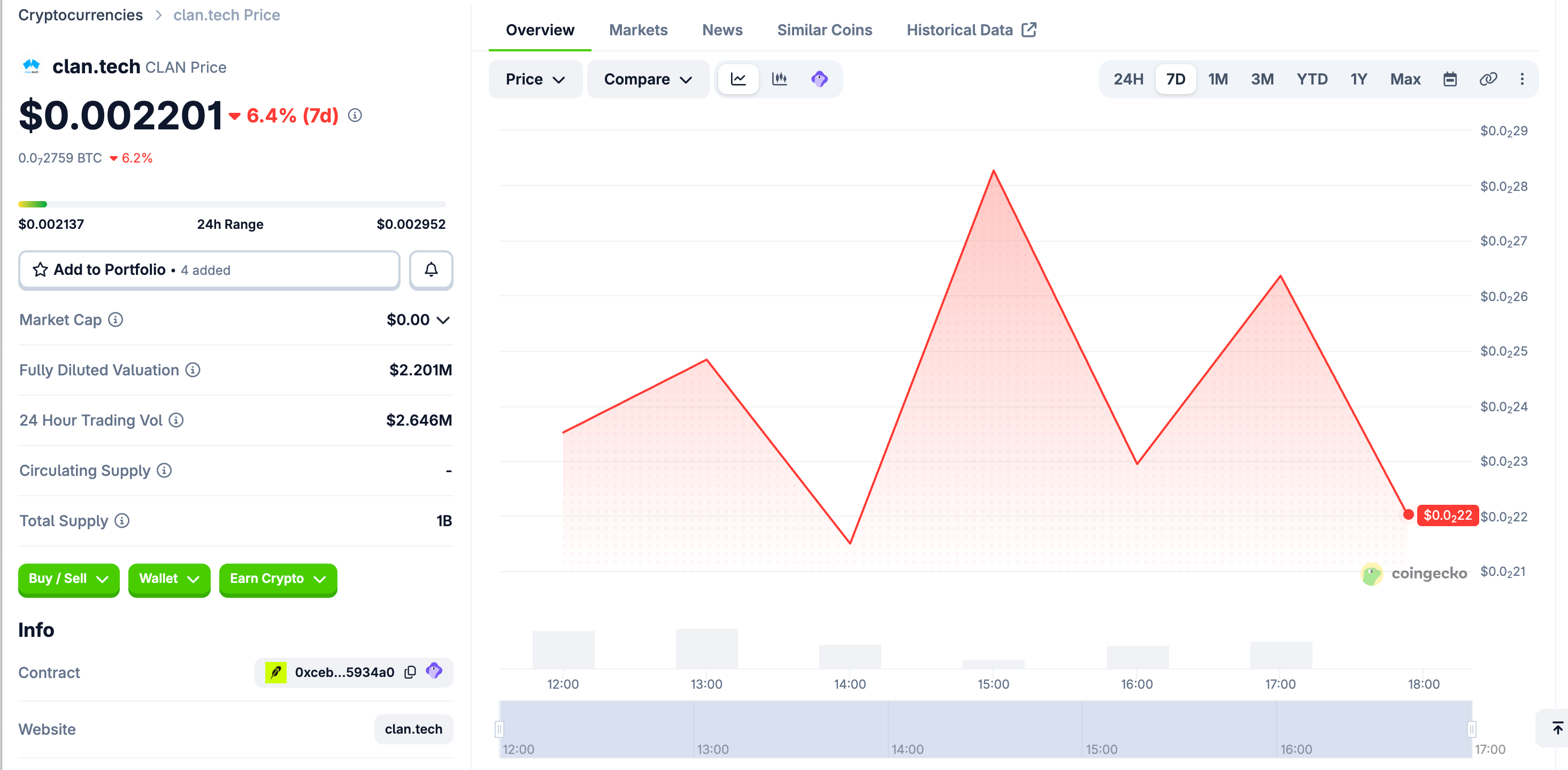
CLAN is a separate fungible token associated with the clan.tech ecosystem. Market trackers currently identify it within the Robinhood Chain ecosystem and show a total supply of one billion tokens, although circulating-supply and valuation fields are not consistently reported. That limited data history makes conventional market-cap comparisons unreliable.
Owning CLAN should not be assumed to unlock every private clan, represent ownership in the company, or entitle holders to a share of key-trading fees. Those rights would need to be stated explicitly in the token documentation or smart contracts. Users should also verify the exact CLAN contract because copying a ticker or token name is easy.
Is clan.tech Really the Next friend.tech?
The comparison is useful because both products combine bonding-curve assets, gated messaging and social fee incentives. friend.tech demonstrated that the format can attract rapid activity, but it also showed the difficulty of sustaining attention. Its early trading frenzy generated major fees, while user activity later declined sharply and the project eventually relinquished contract control.
clan.tech’s group-first design may be more durable than a market built around individual personalities. A functioning community can continue producing value even when one member becomes less active. On the other hand, groups are harder to moderate, performance claims can be difficult to verify, and members may disagree about who controls branding, chat access or fee distributions.
Key Risks Before Buying a Clan Key
Bonding curves create visible liquidity, but not price stability. A few large holders can move the curve quickly, and buyers entering near the top may face steep losses during a coordinated exit. High two-way fees also make short-term trading expensive.
Smart-contract risk is equally important. Users should verify the network, contract address, upgrade permissions, fee recipients and whether access remains available if the website fails. Private chats add another layer: “private” does not mean confidential, encrypted against every party, or safe from screenshots and leaks. Traders should never share seed phrases, passwords or sensitive identity information in a clan.
Finally, displayed clan PnL can create an impression of proven skill without showing methodology, time period, wallet attribution or realized returns. Treat rankings as discovery tools, not due diligence.
What Would Make clan.tech Sustainable?
Long-term success depends less on launch volume than on repeat utility. Healthy signs would include active chats after incentives fade, transparent moderation, stable contract uptime, a diverse holder base and fee revenue driven by useful communities rather than churn. Clear documentation for the CLAN token and Clan Keys would also reduce confusion.
Warning signs include rooms becoming inactive after prices peak, concentrated key ownership, unexplained contract changes, unverifiable trading claims and a growing dependence on recruiting new buyers. SocialFi works best when the access product remains valuable even if its resale price stops rising.
Conclusion
clan.tech is a credible new variation on the friend.tech formula, but it has not yet earned the title of successor. Clan Keys create a simple way to buy access to private communities, and the group-centered approach may support stronger networks than personality-based rooms. The same mechanism also exposes users to bonding-curve volatility, two-way fees, concentrated exits and uncertain chat quality.
The decisive question is whether people continue joining clans for information and relationships rather than only for key appreciation. Until that is demonstrated over time, clan.tech is best viewed as an experimental SocialFi platform—not a proven replacement for friend.tech.
FAQ
What is a Clan Key on clan.tech?
A Clan Key is an on-chain access asset associated with a private clan. Holding it is intended to unlock the clan’s gated chat, while selling it may remove access.
How much does clan.tech charge in trading fees?
Community explainers report a 7% fee on both key buys and sells, divided equally between the platform and the clan. Users should verify the current percentage in the live interface before signing.
Are CLAN tokens and Clan Keys the same?
No. CLAN is a fungible ecosystem token, while Clan Keys are group-specific access assets priced through their own markets.
Can Clan Key holders always sell?
The bonding-curve reserve is designed to provide an exit, but the received amount depends on the current curve, earlier sales, fees and contract operation. An available sell function does not guarantee recovery of the purchase price.
Is clan.tech safer than friend.tech?
There is not enough operating history to make that conclusion. The group model may improve community resilience, but smart-contract, privacy, liquidity and incentive risks remain.


