
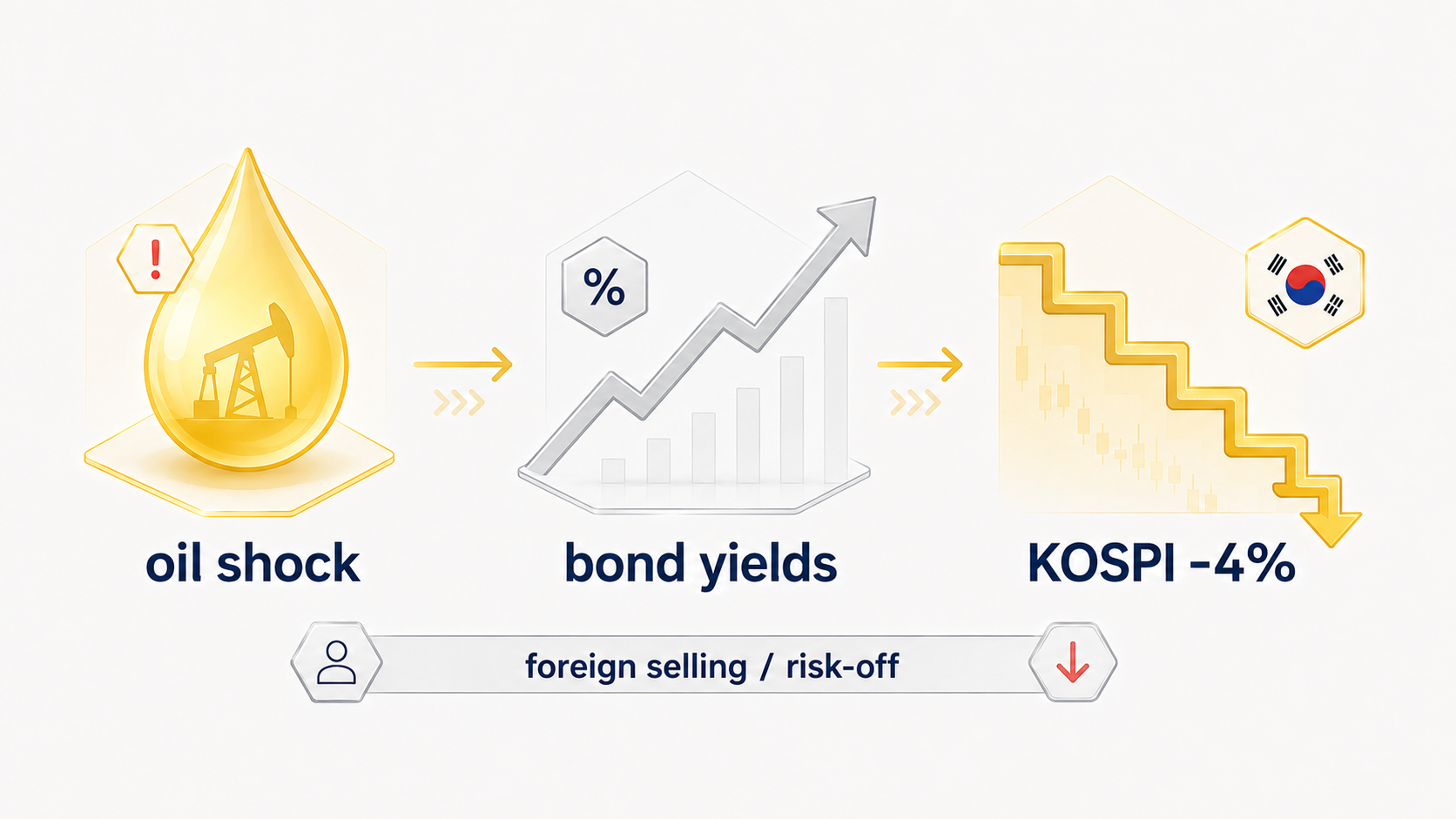
Korean stocks suffered a sharp risk-off session on September 2, with the KOSPI closing at 6,562.72, down 273.08 points or 3.99%. Yonhap linked the selloff to renewed U.S.-Iran tensions, higher oil prices and rising global bond yields. The decline spread across large-cap technology, automobiles, batteries and internet shares, showing that the move was broader than one company’s earnings.
The market reaction is best understood as a transmission chain. Geopolitical risk lifts the oil risk premium. Higher oil can push inflation expectations up. Bond yields then rise as investors price tighter monetary policy or greater fiscal risk. Higher discount rates reduce the present value of equities, while foreign investors often reduce exposure to markets with rising currency and funding uncertainty.
What Happened to Korean Stocks?
The KOSPI’s nearly 4% fall ended a short rebound and produced a wide loss ratio. Foreign and institutional investors sold heavily while individuals bought the dip. Samsung Electronics fell about 4.02% and SK hynix about 4.73%, while automakers and battery names also declined.
A broad selloff matters because the KOSPI is highly sensitive to a small number of large companies. When semiconductor leaders fall together, index-level pressure can be much larger than the move in an average constituent. Buybacks can provide support, but they may not offset global fund outflows during a rapid risk reduction.
How Oil and the Middle East Shock Reached Seoul
Oil prices respond quickly to the probability of supply disruption, shipping delays and insurance costs. Even before physical supply is lost, markets can price a higher risk premium. For Korea, a major energy importer, higher oil prices can worsen the trade balance and increase costs for households and manufacturers.
The key question is whether the oil move persists. A temporary spike may fade if tensions ease or exports continue. A sustained increase would be more damaging because it could keep inflation elevated and reduce the room for monetary easing.
Why Bond Yields Made the Selloff Worse
Korea’s three-year Treasury yield rose to about 3.93%, while longer-term yields also moved higher. When yields rise, future corporate cash flows are discounted at a higher rate. High-growth technology shares can be particularly sensitive because a larger share of their valuation depends on profits expected years ahead.
Higher yields also affect mortgage rates, corporate borrowing and household spending. That creates a second channel from bonds to equities: companies may face higher financing costs while consumers become more cautious. The Bank of Korea’s recent move to a 3.00% base rate adds to the market’s sensitivity to inflation and currency signals.
Foreign Flows, the Won and Semiconductor Leaders
Foreign selling can accelerate when investors reduce exposure to both equities and local currency. Semiconductor leaders then become a natural source of liquidity because they are large, widely held and closely linked to global technology demand. The result can look disproportionate: a relatively small number of large-cap sales pulls the entire index lower.
Investors should distinguish macro pressure from a permanent deterioration in Korea’s technology sector. Chip demand, memory pricing and AI-server orders remain separate company-level variables. The short-term index move reflects positioning and discount rates as much as earnings fundamentals.
That distinction is important for international readers. A stronger won can sometimes cushion imported energy costs, while a weaker won can support exporters but increase inflation pressure. The KOSPI’s next move will depend on the interaction of currency, rates and earnings—not on the index chart alone.
KOSPI Risk Scenarios for the Next Sessions
Relief scenario: Oil and bond yields stabilize, geopolitical headlines cool and foreign investors return to large-cap technology. The KOSPI could recover part of the loss, although volatility may remain high.
Base scenario: Markets remain choppy while investors wait for U.S. jobs data, inflation signals and central-bank comments. Index leadership rotates between exporters, defensives and rate-sensitive sectors.
Stress scenario: Renewed conflict pushes oil and yields higher, the won becomes more volatile and foreign selling continues. Semiconductor leaders could remain under pressure even if domestic investors buy the dip.
KORU-USDT as a Korean-Equity Proxy
Tapbit offers KORU-USDT perpetual futures as a related Korean-equity market reference. KORU is not the KOSPI index: it is a leveraged ETF-linked product with different holdings, daily reset mechanics and path dependency. It does not provide direct ownership of Korean shares, and leverage can magnify losses or trigger liquidation during volatile sessions.
Before trading, review the mark price, index price, funding rate, margin mode and liquidation price. A user who wants to follow the KOSPI story should not assume that KORU will match the index on every day or over longer periods. New users can create an account and read the contract specifications before placing an order.
What Korean Market Readers Should Watch Next
- Brent and WTI prices, shipping conditions and geopolitical headlines.
- U.S. 10-year Treasury yields and Korea’s 3-year/10-year yields.
- USD/KRW volatility and foreign equity flows.
- Samsung Electronics and SK hynix guidance, memory pricing and AI-server demand.
- Bank of Korea communication and upcoming inflation data.
Bottom Line
Korean stocks fell nearly 4% because several pressures arrived at once: geopolitical risk, higher oil, rising yields and foreign outflows. The next move depends on whether those shocks stabilize, not on one headline alone. KORU-USDT can provide leveraged Korean-equity price exposure, but it is not the KOSPI index and carries distinct daily-reset and liquidation risks.
FAQ
Why did Korean stocks fall 4%?
Renewed U.S.-Iran tensions lifted oil and global bond yields, while foreign and institutional investors sold Korean equities.
How do oil prices affect the KOSPI?
Higher oil raises import costs and inflation expectations, which can pressure the won, household spending, corporate margins and equity valuations.
Why do bond yields pressure stocks?
Higher yields increase discount rates and financing costs, reducing the present value of future corporate cash flows.
Is KORU-USDT the same as the KOSPI?
No. KORU-USDT is a leveraged ETF-linked perpetual contract with different mechanics and path dependency; it is not direct KOSPI exposure.


