

Broadcom stock is at the center of a familiar AI-market tension: the long-term opportunity is getting larger, but investors still judge the company against very high near-term expectations. Broadcom reported third-quarter revenue of about $29.59 billion, with AI-semiconductor sales near $16.7 billion. It also lifted its FY2027 AI-chip revenue outlook to approximately $115 billion. At the same time, its next-quarter revenue guide of $34.8 billion was slightly below the roughly $35.03 billion consensus cited in market coverage.
That combination explains why a strong report can produce a mixed stock reaction. Demand can be genuine while the share price pauses because the market wanted an even higher guide. The most useful analysis separates confirmed results, long-term forecasts and what is already priced into AVGO.
Why Is Broadcom Stock Moving After Earnings?
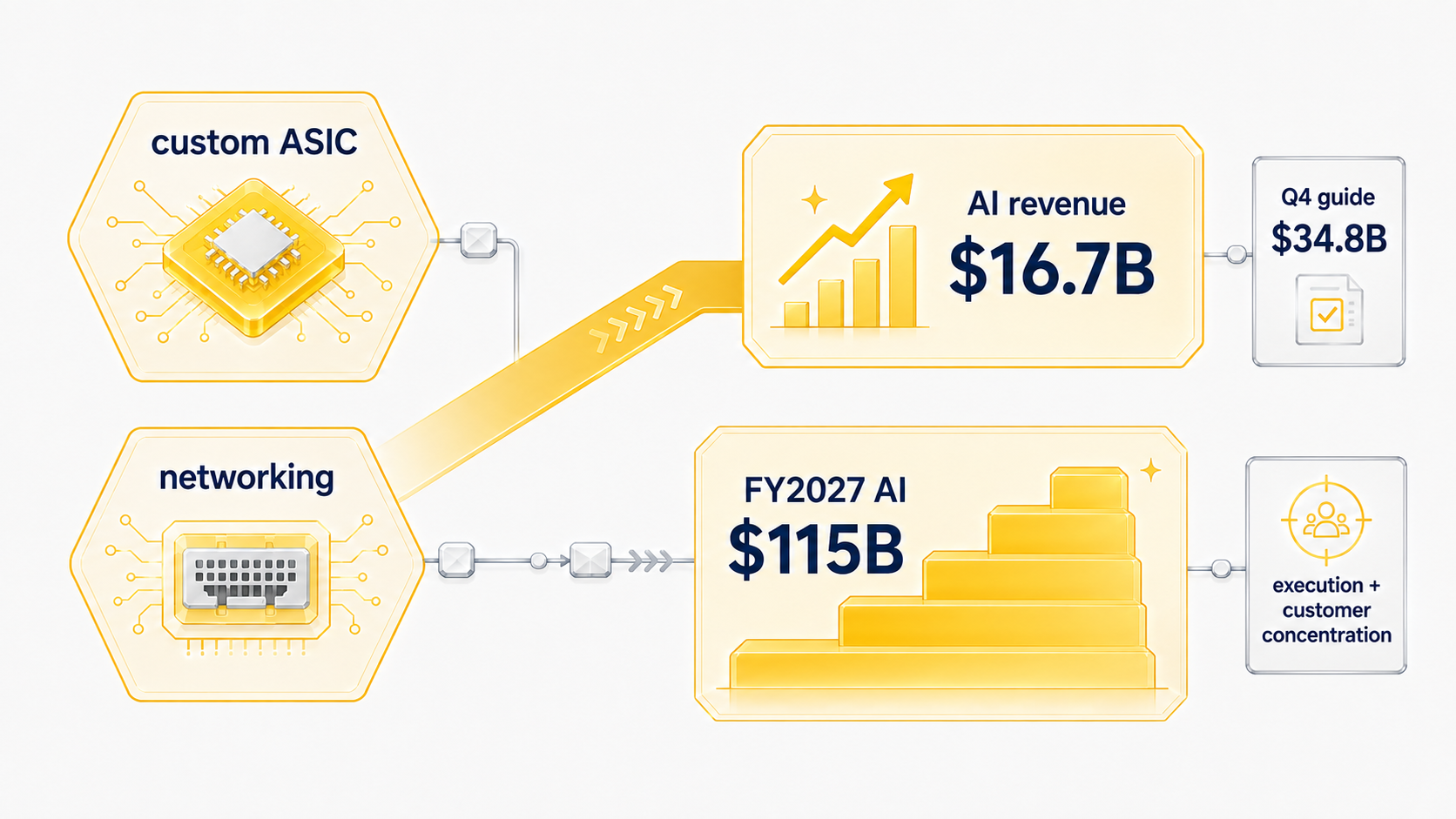
The headline beat supports the view that hyperscalers are still spending on AI infrastructure. Broadcom supplies custom accelerators and networking components that help large customers build specialized systems. Its long-term forecast therefore gives investors a way to participate in AI spending beyond Nvidia’s general-purpose GPU platform.
However, the near-term guide matters just as much. A forecast below consensus can create selling pressure even when revenue growth remains exceptional. Investors may also question whether long-term commitments arrive evenly, whether supply is sufficient and how much customer demand is already reflected in the valuation.
What Is Driving Broadcom’s AI-Chip Revenue?
Broadcom’s AI exposure includes custom silicon, networking and connectivity. A hyperscaler may use a custom accelerator for a specific workload while relying on high-speed networking to connect thousands of chips. This system-level role allows Broadcom to benefit when customers diversify their hardware architecture.
The model differs from Nvidia’s. Nvidia sells a broad accelerated-computing platform with GPUs, software and systems. Broadcom’s custom-chip relationships can be more concentrated, but a successful design may produce large and durable programs. The trade-off is that a delay or change by one major customer can have an outsized impact.
Can the $115B AI Forecast Become Revenue?
A long-term forecast is a scenario built from customer commitments, product roadmaps, supply and expected demand. It is not booked revenue. Analysts should monitor contract timing, production capacity, packaging, networking demand and customer concentration. The forecast becomes more credible when quarterly results repeatedly confirm the ramp.
Investors should also watch infrastructure software, including VMware-related contributions, because Broadcom is not a pure AI-chip company. A strong AI segment can coexist with integration costs, changing software growth and margin pressure. The mix determines how much of the headline revenue becomes free cash flow.
Expectations can be more important than absolute growth. A 90% revenue increase may still disappoint if the market was positioned for 100%. Conversely, a cautious guide can create an opportunity if management later proves that customer commitments were conservative. The article should therefore distinguish reported numbers, management forecasts and analyst consensus throughout the analysis.
Broadcom Stock Outlook: Bull, Base and Bear Scenarios
Bull scenario: Custom accelerators broaden across more customers, networking demand stays strong and the $115 billion forecast is supported by visible orders. Valuation can remain elevated if growth converts into cash flow.
Base scenario: AI revenue grows rapidly but quarterly guidance remains volatile. The stock trades in a wide range as investors balance strong demand with customer concentration and valuation.
Bear scenario: A major customer delays deployment, custom-chip competition intensifies or hyperscaler capex slows. A modest guide reduction could trigger a larger multiple compression because expectations are high.
Key AVGO Metrics to Watch
- AI-semiconductor revenue and sequential growth.
- Custom-chip customer concentration and production milestones.
- Networking demand, gross margin and free cash flow.
- VMware integration, recurring software revenue and costs.
- Forward valuation versus the rate outlook and semiconductor peers.
Similar Tapbit Products for AI-Hardware Exposure
No AVGO-USDT contract was verified in this review. If a trader wants an adjacent AI-hardware reference, Tapbit’s NVDA-USDT perpetual futures and SMCI-USDT perpetual futures represent different companies and different risk profiles. They do not provide Broadcom shares, dividends, voting rights or identical price exposure.
Perpetual futures involve leverage, funding, margin and liquidation risk. Broadcom’s earnings can influence the wider semiconductor sector, but it does not guarantee a move in NVDA or SMCI. New users can create an account only after reviewing the selected contract specifications.
Bottom Line
Broadcom’s AI-chip results and higher long-term forecast reinforce the structural demand story, while the below-consensus near-term guide explains the stock’s sensitivity. The next test is forecast conversion: customer commitments must become shipments, revenue and cash flow. Until AVGO support is verified, NVDA-USDT and SMCI-USDT are adjacent proxies, not Broadcom exposure.
FAQ
Why is Broadcom stock moving?
Investors are weighing strong AI-chip sales and a higher long-term forecast against a next-quarter guide that was slightly below consensus.
What is Broadcom’s AI-chip forecast?
Management raised its FY2027 AI-chip revenue outlook to approximately $115 billion, subject to customer demand and execution.
How does AVGO differ from NVDA?
Broadcom focuses heavily on custom accelerators and networking, while Nvidia offers a broader GPU and accelerated-computing platform.
Are NVDA-USDT and SMCI-USDT the same as AVGO stock?
No. They are separate perpetual futures markets tied to different companies and do not provide Broadcom ownership or identical price exposure.


