

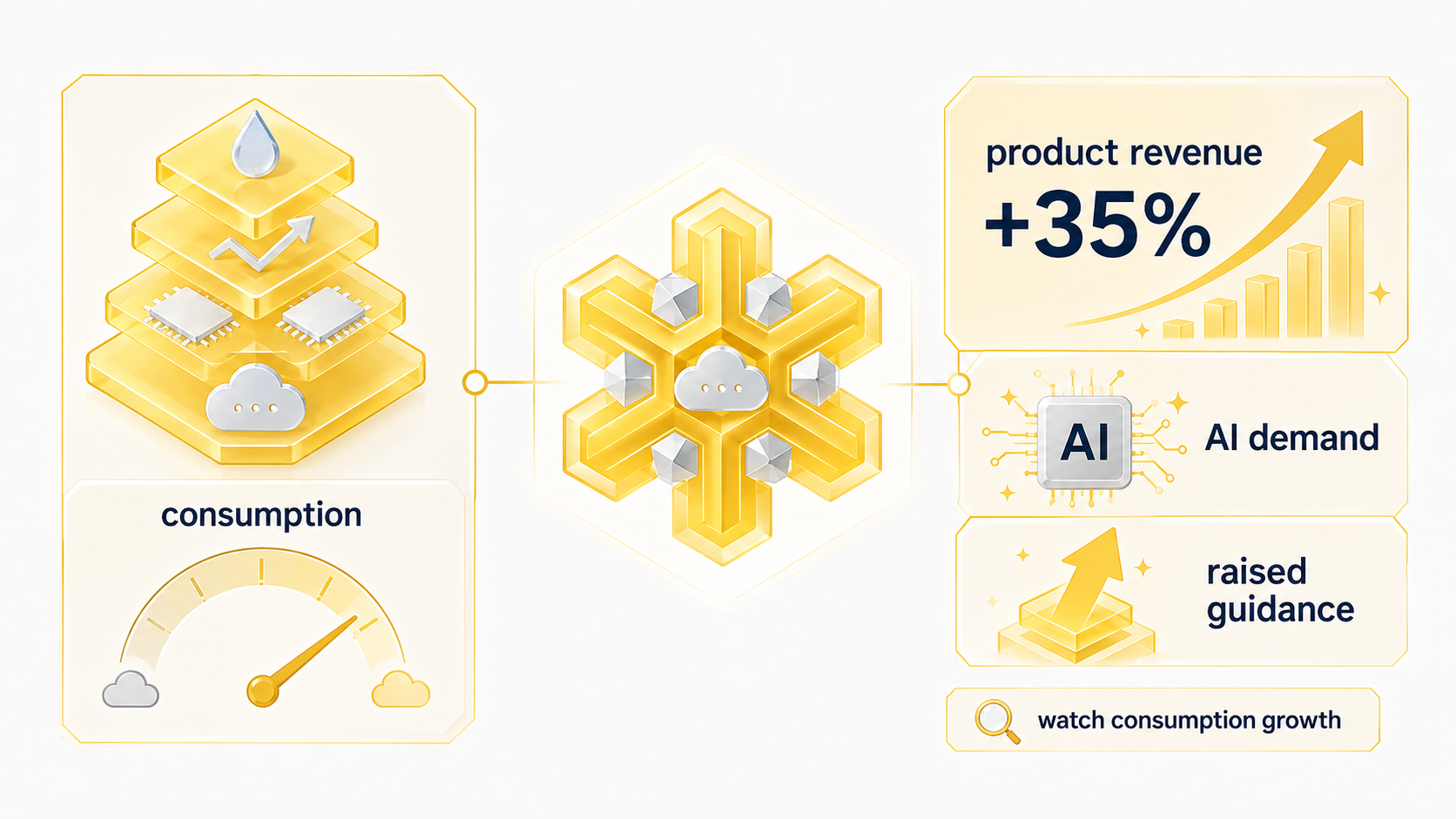
Snowflake stock moved into the spotlight after the company’s Q2 FY2027 results highlighted strong growth and increasing attention on artificial-intelligence workloads. The user-provided news snapshot described revenue beating expectations by roughly 35%, a visible jump in AI-related revenue and an upgraded full-year outlook. Snowflake’s investor-relations site has published the quarter’s results, but the exact reported figures and price reaction should be refreshed immediately before publication.
The market’s question is not simply whether Snowflake beat estimates. It is whether AI features such as Cortex and Snowflake Intelligence create incremental data consumption that can continue after the initial product launch. Because Snowflake uses a consumption-oriented model, revenue growth can accelerate when workloads expand and slow when customers optimize usage.
Why Is Snowflake Stock Moving After Q2 FY2027?
Three signals explain the reaction. The first is the revenue beat, which suggests customer demand remained resilient. The second is management’s commentary on AI workloads, which gives investors a new growth pathway beyond traditional data warehousing. The third is the higher full-year guidance, which indicates that management sees enough visibility to raise expectations.
Price action still needs context. A stock can rise on a strong report and later reverse if the market expected an even larger beat, if guidance is conservative or if valuation is already demanding. The cleanest way to read the move is to compare the reported quarter with the prior quarter, the guidance range and the company’s cash-generation trend.
What Does Snowflake’s AI Revenue Growth Actually Measure?
Snowflake’s AI opportunity includes tools that help enterprises build, query and govern models close to their proprietary data. When customers use these tools, they may consume more compute, storage and data-transfer capacity. That can increase product revenue if usage is sustained rather than concentrated in a short testing period.
AI adoption is therefore not a single line item that automatically equals profit. Investors should ask whether AI customers are expanding workloads, whether those workloads remain after pilots and whether Snowflake can serve them at attractive margins. A strong product launch matters most when it produces recurring consumption and higher customer retention.
Key Metrics Behind the SNOW Investment Case
- Product revenue: Shows the core platform’s scale and growth rate.
- Net revenue retention: Indicates whether existing customers are expanding or shrinking spend.
- Remaining performance obligations: Offers visibility into contracted future revenue, but not all obligations convert at the same pace.
- Gross margin and free cash flow: Test whether growth is becoming more efficient.
- Stock-based compensation: Matters when assessing dilution and the difference between adjusted and reported profitability.
The sequence of these metrics matters. If product revenue grows while retention falls, new customers may be replacing slower expansion from the installed base. If AI workloads rise but free cash flow does not improve, Snowflake may be spending heavily to support growth. A balanced earnings read therefore compares growth, efficiency and dilution rather than celebrating one percentage increase.
Snowflake Stock Outlook: Bull, Base and Bear Scenarios
Bull scenario: AI workloads move from experimentation into production, consumption expands across existing accounts and guidance is raised again. Snowflake could then defend a premium multiple as investors price a longer growth runway.
Base scenario: Growth remains strong but uneven. Large customers optimize usage, AI contributes steadily and the stock trades in a wide range as valuation responds to each quarterly update.
Bear scenario: AI pilots fail to become recurring workloads, cloud competition increases or macro uncertainty pressures enterprise budgets. Snowflake could miss consumption expectations even while its technology remains strategically important.
What Could Invalidate the Bullish Snowflake Thesis?
The main risk is a gap between product enthusiasm and paid usage. Customers may test AI tools without committing to large production workloads. Competition from hyperscaler platforms can also pressure pricing and make it harder to retain data workloads. Finally, high stock-based compensation and a premium valuation can amplify downside when growth slows.
Similar Tapbit Products for Cloud and AI Exposure
Snowflake has no corresponding Tapbit contract in this review. Traders seeking adjacent themes can review GOOGL-USDT perpetual futures for cloud and AI-platform exposure or NVDA-USDT perpetual futures for AI-infrastructure exposure. Neither contract represents SNOW shares, Snowflake governance or identical price behavior.
These are derivatives that can involve leverage, funding costs, margin requirements and liquidation. A strong Snowflake report does not guarantee that GOOGL or NVDA will move in the same direction. New users can create an account only after reviewing the selected contract’s specifications and risk controls.
Bottom Line
Snowflake’s Q2 FY2027 report strengthened the AI Data Cloud growth narrative, but the long-term case depends on recurring consumption, retention and cash generation. Investors should separate AI product launches from durable revenue and avoid relying on one price target. With no verified SNOW contract on Tapbit, GOOGL-USDT and NVDA-USDT are adjacent proxies only, not substitutes for Snowflake stock.
FAQ
Why is Snowflake stock moving?
The move followed a strong Q2 FY2027 report, AI-workload commentary and higher guidance, although the exact price reaction should be refreshed before publication.
What is Snowflake’s AI revenue?
It refers to revenue and consumption associated with AI-related workloads and products. The key question is whether usage becomes recurring and profitable.
Is Snowflake profitable?
Snowflake’s profitability should be evaluated using reported operating results, adjusted results, free cash flow and stock-based compensation together.
Are GOOGL-USDT and NVDA-USDT the same as SNOW stock?
No. They are separate perpetual futures markets tied to different companies and do not provide Snowflake ownership or identical price exposure.


