
Dell stock moved sharply after the company reported record quarterly revenue and a much larger pipeline of AI-server demand. The user-provided market snapshot showed a gain of about 15.81%, while Reuters described a regular-session increase of nearly 11%. The difference reflects timing and market-data windows, so the exact percentage should be refreshed before publication. The more durable signal is the operating data: Dell reported roughly $47 billion of quarterly revenue, about $60 billion in AI-server orders and an estimated $95 billion backlog of unfulfilled orders.
The market response makes sense, but a backlog headline should not be treated as a guaranteed earnings forecast. Dell still has to source chips, memory, networking equipment and power systems, deliver complete servers and recognize revenue. For investors and traders, the central question is whether the backlog converts into profitable revenue quickly enough to justify the new valuation.
Why Did Dell Stock Jump After Earnings?
Dell’s results gave investors three reasons to reprice the shares. First, quarterly revenue exceeded the market expectation and reached a record level. Second, management raised its full-year revenue outlook to about $192 billion from a previous level near $167 billion. Third, the order and backlog figures suggested that AI infrastructure demand is extending beyond a few hyperscale customers.
That combination is different from a normal PC-cycle recovery. Dell remains a major PC vendor, but the current growth narrative is increasingly built around servers, storage and integrated systems used by AI-cloud providers. A strong quarter can therefore affect the entire AI hardware chain, including chip suppliers, networking companies and data-center operators.
What Do Dell’s $60B Orders and $95B Backlog Represent?
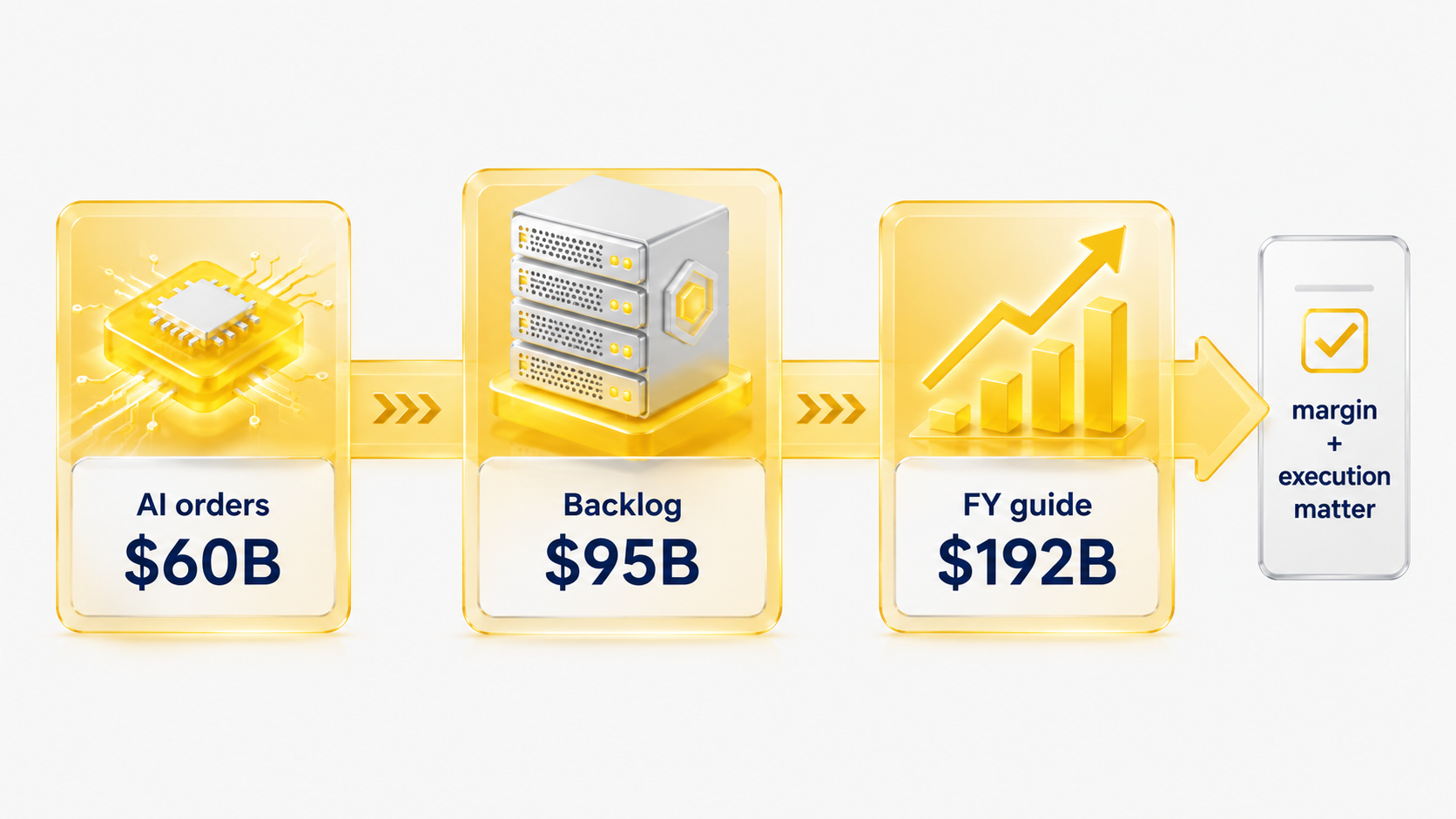
Orders are commitments placed by customers. Backlog is work that has been ordered but not yet delivered or recognized as revenue. Neither figure automatically becomes quarterly sales. Customers can change delivery schedules, suppliers can face bottlenecks and projects can be delayed by data-center construction or financing.
The quality of the backlog also matters. A backlog made mostly of high-performance AI servers may support stronger growth than a lower-margin commodity mix, but it can require more working capital and create greater exposure to a small number of buyers. Investors should therefore compare backlog growth with gross margin, operating cash flow, inventory and accounts receivable rather than looking at the headline number alone.
How AI Servers Could Change Dell’s Growth Mix
AI servers combine accelerated computing, high-bandwidth memory, networking and power management. Dell often integrates Nvidia chips into complete systems, which means its revenue can grow as customers build clusters even though Dell does not manufacture the core GPU. Storage is another important piece: AI workloads generate large data sets that must be stored, moved and analyzed.
This system-level position can broaden Dell’s opportunity, but it also adds execution risk. A shortage of one component can delay an entire rack. Higher component costs can compress margins if contracts were priced before costs increased. Customers may also negotiate aggressively once several vendors compete for the same large projects.
Another question is mix. A dollar of high-performance infrastructure revenue does not necessarily carry the same margin as a dollar of legacy hardware or services. Dell’s next filings should show whether the AI mix improves profitability or mainly expands working-capital needs. That distinction will help investors judge whether the rally is being supported by cash generation rather than only by order headlines.
Dell Stock Outlook: Bull, Base and Bear Scenarios
Bull scenario: AI-server orders convert into shipments without major delays, storage remains strong and management raises guidance again. In that case, investors may accept a higher multiple because growth is supported by visible demand rather than only by future speculation.
Base scenario: Demand remains strong, but the backlog converts over several quarters and margins normalize. Dell continues to grow faster than its legacy PC business, while the stock trades with high sensitivity to each guidance update.
Bear scenario: Cloud customers delay capital spending, component costs rise or backlog conversion slows. A high-growth valuation can contract quickly even if Dell continues to report solid absolute revenue. The stock could also weaken if AI infrastructure enthusiasm rotates into other hardware names.
What DELL Traders Should Monitor Next
- AI-server revenue and backlog conversion rate.
- Gross margin and operating cash flow as the product mix changes.
- Customer concentration, delivery schedules and supply-chain commentary.
- Peer read-through from Nvidia, Super Micro, HPE and networking suppliers.
- Whether the new $192 billion outlook is raised, maintained or reduced.
Similar Tapbit Products for AI-Infrastructure Exposure
Dell has no corresponding Tapbit contract in this review. Traders who want an adjacent theme can review NVDA-USDT perpetual futures for Nvidia price exposure or SMCI-USDT perpetual futures for Super Micro price exposure. These contracts are not DELL stock, do not provide Dell ownership and can move differently because each company has distinct financials, valuation and supply-chain exposure.
Both products are derivatives. They can involve leverage, funding costs, margin requirements and liquidation. A trader should compare the proxy’s own chart and news rather than assuming that a strong Dell report guarantees a move in NVDA or SMCI. New users can create an account only after reviewing the relevant contract specifications and risk controls.
Bottom Line
Dell’s AI-server orders, backlog and raised guidance explain why DELL stock attracted immediate attention. The opportunity is real, but the investment case depends on converting orders into profitable shipments. Watch margins, cash flow and delivery timing as closely as the $95 billion backlog. Since Tapbit has no verified DELL contract in this review, NVDA-USDT and SMCI-USDT should be treated only as adjacent AI-infrastructure proxies.
FAQ
Why is Dell stock up?
Dell stock rose after record quarterly revenue, stronger AI-server orders and a higher full-year revenue outlook.
What is Dell’s AI-server backlog?
It is the value of ordered but not yet delivered AI-server work. It is an indicator of demand, not guaranteed recognized revenue.
Is Dell’s backlog the same as revenue?
No. Dell must deliver the products and satisfy accounting-recognition requirements before backlog becomes reported revenue.
Are NVDA-USDT and SMCI-USDT the same as DELL stock?
No. They are separate perpetual futures markets based on different companies and do not provide DELL ownership or identical price exposure.


