
United Oil Trust Fund, or UOTF, cannot currently be confirmed as a legitimate oil-backed investment product. Available information suggests that several Solana tokens use the same name and ticker, while sufficient independent evidence of physical oil ownership, audited reserves or legally enforceable redemption rights has not been established.
That does not prove every UOTF token is an intentional scam. It does mean buyers should treat UOTF as an unverified, highly speculative crypto asset—not as a regulated oil fund or a digital claim on petroleum reserves.
UOTF is not presented as a supported Tapbit market. Users can instead create a Tapbit account to compare supported crypto markets and access established trading tools.
The Short Answer: Is UOTF Legit?
There is not enough reliable evidence to describe United Oil Trust Fund as a verified commodity-backed project. The name contains three financially significant terms—“oil,” “trust” and “fund”—but branding does not create legal ownership or regulatory status.
A legitimate oil-backed product should identify the legal issuer, disclose where the underlying assets are held, name the custodian and explain what rights token holders receive. Independent reserve audits and clear redemption procedures would also be expected.
Publicly available UOTF information does not consistently provide those protections. The presence of multiple tokens using the same name makes the situation even harder to verify.
| Legitimacy Check | What Investors Should Expect | UOTF Status |
|---|---|---|
| Named legal issuer | Registered entity with accountable management | Not clearly established |
| Oil ownership records | Documents identifying reserves or contracts | Not independently verified |
| Qualified custodian | Named party holding the alleged assets | Not clearly disclosed |
| Independent audit | Third-party confirmation of collateral | No sufficient public evidence |
| Redemption rights | Defined method for exchanging tokens for value | Not established |
| Unique contract | One consistently published mint address | Multiple conflicting contracts appear online |
| Regulatory status | Clear jurisdiction and applicable licences | Not demonstrated |
Why the Oil-Backing Claim Requires More Evidence
An oil-backed token needs more than a website, ticker or statement about petroleum reserves. Token holders must know what “backed” actually means.
The collateral could theoretically be physical barrels, warehouse receipts, futures contracts, shares in energy companies or revenue from oil production. These assets have different risks and legal structures. Without documentation, investors cannot determine whether UOTF represents any of them.
A reserve claim should also be matched against the circulating token supply. If additional tokens can be created without additional collateral, the backing ratio can deteriorate. If holders have no contractual redemption right, even verified reserves may not be accessible to them.
The earlier Tapbit analysis, What Is UOTF? Oil-Backing Claims, Price, and Risks, similarly found insufficient evidence to treat UOTF as a regulated commodity product.
Multiple UOTF Contracts Are a Major Warning Sign
Contract confusion is one of the clearest UOTF risks. Market pages and token trackers display several different Solana mint addresses under the United Oil Trust Fund name.
One source identifies a contract beginning with BGZ5o, while other trackers display unrelated addresses beginning with 24Ns, YyKE, zEha and additional variants. Some may represent copycat tokens, abandoned launches or entirely separate projects.
A ticker is not a unique identifier. Anyone can create another Solana token called UOTF and reuse the project name or logo.
This makes it unsafe to label any contract “official” based on a single wallet, DEX page or search result. The correct mint address should be published consistently through project-controlled channels and supported by verifiable issuer information.
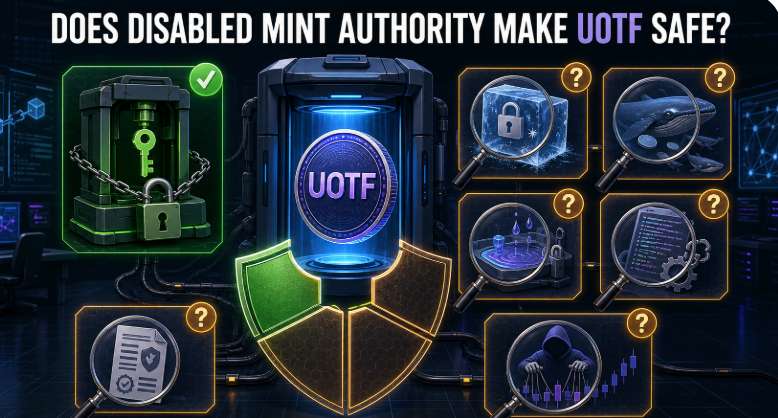
Does Disabled Mint Authority Make UOTF Safe?
Some UOTF token pages report that mint and freeze authorities have been disabled. These settings can reduce two specific risks: the creator may no longer be able to generate additional supply or freeze token accounts through those authorities.
However, revoked authority does not confirm oil backing, honest management or adequate liquidity. It also does not prevent insiders from selling tokens they already control.
A token can have fixed supply and still lose nearly all its value. Buyers must separately examine holder concentration, developer wallets, liquidity-pool control and transaction activity. On-chain configuration does not validate off-chain claims about oil reserves or legal rights.
Liquidity May Matter More Than the Displayed Price
Some UOTF markets have shown extremely low liquidity and trading volume. A quoted price can look valuable even when only a small amount of capital supports the market.
These conditions can produce misleading market-cap figures. Multiplying the last traded price by the full token supply does not mean that holders could collectively sell at that valuation.
Before buying, users should compare the intended order size with the available liquidity and estimated price impact. They should also confirm that an actual sell transaction can be completed.
Scam Indicators to Check Before Buying UOTF
No single warning sign proves fraud, but several unresolved issues together should raise the level of caution.
The most important questions are whether the issuer can be identified, whether the oil-backing claim has been independently audited and whether the project consistently publishes one contract address.
Users should also examine whether promotional posts promise guaranteed returns, imply government support or pressure buyers to act quickly. Claims that rising oil prices must cause UOTF to rise are misleading unless a verified mechanism links the token to an oil benchmark.
An unknown UOTF website should not require unlimited token approvals, seed phrases or private keys. A site requesting any recovery phrase should be treated as malicious.
Can UOTF Be Sold After Buying?
The ability to buy a token does not guarantee that it can be sold efficiently. A Solana DEX may quote a transaction while exposing the user to extreme slippage because the liquidity pool is too small.
Selling can also become difficult if liquidity providers withdraw funds, trading activity disappears or buyers discover that they purchased the wrong UOTF contract.
A small test transaction can help confirm basic trading functionality, but it does not guarantee that a larger position can exit at a similar price. Investors should review pool liquidity, recent sell transactions and estimated price impact before committing funds.
Legit Project, Scam or Unverified Token?
The most defensible classification is currently unverified high-risk token.
Calling UOTF legitimate would require evidence that is not sufficiently available. Calling it definitively a scam would require proof of deliberate deception that public token data alone cannot establish.
Investors do not need to prove fraud before deciding that an asset lacks enough evidence to justify participation. Unclear ownership, conflicting contracts, thin liquidity and unsupported oil claims are already material risks.
Conclusion
United Oil Trust Fund cannot currently be verified as a legitimate oil-backed fund. Multiple Solana contracts use the UOTF identity, and available information does not clearly establish a legal issuer, audited petroleum reserves, qualified custodian or enforceable redemption mechanism.
UOTF should therefore be evaluated as a speculative Solana token rather than direct exposure to oil. Until the issuer and collateral claims can be independently verified, contract confusion and limited liquidity make the asset especially difficult to assess or trade safely.
FAQ
Is United Oil Trust Fund a scam?
There is insufficient evidence to definitively label every UOTF token a scam. However, the oil-backing claims, issuer identity and multiple contracts remain inadequately verified.
Is UOTF really backed by oil?
No sufficient independent evidence currently confirms physical oil ownership, audited reserves or token-holder redemption rights.
What is the official UOTF contract address?
Multiple Solana contracts use the UOTF name. An official contract should not be assumed without consistent confirmation from verifiable issuer-controlled sources.
Can UOTF holders redeem tokens for oil?
No clearly established redemption mechanism has been independently verified.
Is UOTF available on Tapbit?
UOTF is not presented as a supported Tapbit market. Users should check Tapbit’s current market directory rather than assuming that the token is listed.


