
There is no safe way to identify the “real” United Oil Trust Fund coin from the UOTF ticker alone. Multiple Solana tokens use the same name and symbol but have different mint addresses, creators, liquidity pools, holder distributions, and prices. They are separate on-chain assets even when their logos and descriptions look identical.
The correct UOTF for a particular community or website is the exact contract that the project itself consistently publishes and that independent blockchain records confirm. Even then, matching the promoted contract does not prove that its oil-backing claims, management team, or investment value are legitimate.
UOTF is not confirmed as available on Tapbit. Readers who want to compare established digital-asset markets can instead explore broader crypto markets on Tapbit.
Why Are There Several United Oil Trust Fund Tokens?
Solana allows anyone to create a token and select a name, symbol, image, and description. The network does not reserve “UOTF” for one issuer, and a ticker is not a unique identifier. As a result, unrelated creators can launch several assets called United Oil Trust Fund.
Search results currently expose numerous UOTF-labelled contracts. Examples found across market pages include mints beginning with nADepir, 4Ms1Tpe, nWtPgk, keZ4mA, J6wq5c, BGZ5oJ, and uAenQgf. Each address points to a different token, regardless of similarities in branding.
This multiplication is common around narrative-driven meme coins. Once a name gains attention, copy tokens may appear within minutes. Some copies are obvious, while others reproduce the same website, social links, token description, and artwork.
The Contract Address Matters More Than the Ticker
A Solana token’s mint address is its primary blockchain identity. Wallets, decentralized exchanges, explorers, and market-data platforms use that address to locate the asset and its pools.
| Field | What It Tells You | Can It Be Copied? |
|---|---|---|
| Name and ticker | How the token is displayed | Yes |
| Logo and description | Branding chosen by the publisher | Yes |
| Mint address | The exact Solana token | No; another token receives another address |
| Pool address | The specific trading market | No, but one token can have multiple pools |
| Website or social link | A claimed project connection | Yes |
A platform can therefore display the correct name while mapping it to a different contract from the one a user intended to research. Searching by address instead of “UOTF” reduces this ambiguity.
Why UOTF Prices Differ Across Platforms
A decentralized token does not have one centrally imposed price. Each liquidity pool establishes its own exchange rate from the assets deposited in that pool. If two websites track different UOTF contracts, their displayed prices can differ by thousands of percent because they are measuring different assets.
Even platforms following the same mint may show slightly different quotes. One service may use the most liquid UOTF/SOL pool, while another uses a smaller pool, aggregates several venues, applies a delayed exchange rate, or displays the last completed trade.
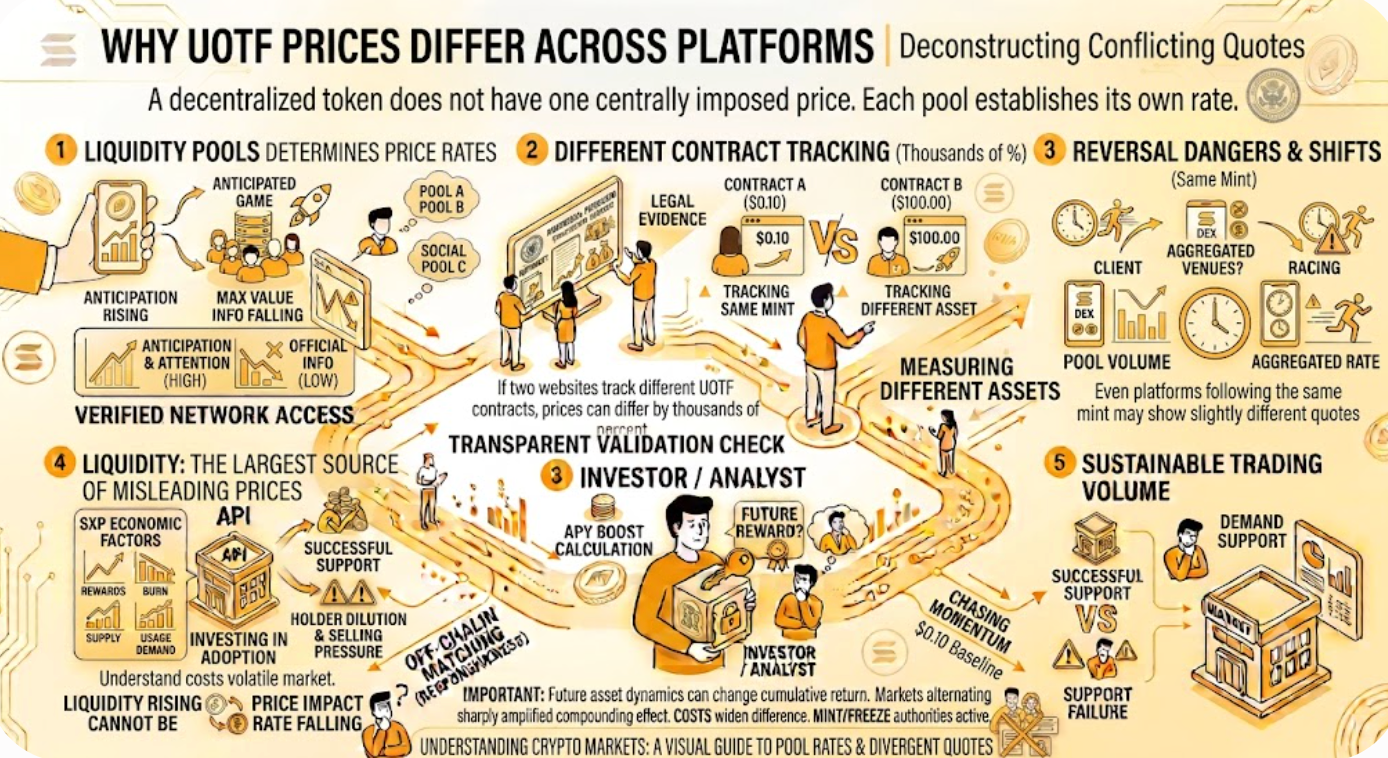
Liquidity is often the largest source of misleading prices. A pool containing only a few dollars can produce an impressive quote that cannot support a meaningful sale. One UOTF page has reported liquidity below $100, while another UOTF-labelled contract has been associated with liquidity above $1 million. Those numbers cannot be compared as if they describe one market.
Examples of Conflicting UOTF Market Data
The visible data illustrates why the token contract must be checked before interpreting any price.
| Listed Contract Prefix | Reported Price or Valuation Context | Important Limitation |
|---|---|---|
nADepir |
Price near $0.0000018 and market cap under $2,000 | Very limited reported liquidity |
J6wq5c |
Price near $0.0000015 | Reported holder concentration and minimal liquidity |
BGZ5oJ |
Previously displayed near $0.000253 | Point-in-time quote for another mint |
uAenQgf |
Previously displayed near $0.005 | Different creator, pool, and holder set |
keZ4mA |
Substantially larger reported valuation | Marked unverified by the referenced wallet page |
These figures are snapshots rather than current trading recommendations. The main conclusion is not that one quoted price is correct and the others are errors. The pages frequently describe different contracts.
Does Sharing a Website Prove Which UOTF Is Official?
No. Several token-data pages have associated different UOTF contracts with similar social accounts or the same claimed website. Metadata can be copied when a token is created, so a website field inside a token profile is not independent verification.
Stronger evidence would include a consistent contract published through a long-established official domain and verified social accounts, transparent control of those accounts, identifiable project operators, and documentation explaining issuance and utility. For an asset claiming real oil exposure, users would also need legal evidence describing ownership, custody, valuation, audits, redemption rights, and the entity responsible for the reserves.
Without those materials, “United Oil Trust Fund” should be read as branding. The words oil, trust, and fund do not themselves give the token a claim on petroleum, a regulated investment structure, or redemption rights.
How to Identify the UOTF You Intended to Research
Begin with the full mint address from the project channel you intended to use. Copy it into a Solana explorer and confirm the token name, supply, creator history, authorities, largest holders, and creation time.
Next, search that same address on several market-data services. The token, supply, and active pools should align even if the live price differs slightly. Confirm that the quoted market has meaningful liquidity and recent organic transactions rather than relying on headline volume.
Finally, make a clear distinction between identifying a contract and validating a project. The first step tells you which on-chain asset you are viewing. The second requires evidence about the people, claims, reserves, and risks behind it.
Red Flags Across UOTF-Labelled Tokens
Extreme differences in price, liquidity, and holder count are already warning signs that search results are mixing several assets. Additional concerns include newly created contracts, copied social links, concentrated ownership, pools with almost no liquidity, and volume that appears disproportionate to available market depth.
Users should also be cautious when promotional material claims that UOTF is backed by oil without identifying the reserve owner, custodian, auditor, jurisdiction, and redemption process. A smart contract cannot independently verify barrels of oil stored off-chain.
Sending funds based on a ticker, screenshot, or direct message creates a high risk of buying the wrong token. A small test transaction may reduce address mistakes, but it does not protect against illiquidity or false project claims.
Conclusion
The reason United Oil Trust Fund prices differ across platforms is that many pages are not tracking the same UOTF coin. They may reference different Solana mint addresses or separate pools with radically different liquidity.
No version should be labelled the definitive “real UOTF” based solely on its name, logo, price, or claimed website. Users must identify the intended mint address and then independently evaluate its liquidity, holders, authorities, team, documentation, and any oil-backing claims. Until that evidence is clear, UOTF remains a high-risk and easily confused token name.
FAQ
Why does UOTF have different prices?
Platforms may be tracking different UOTF contracts, different liquidity pools, or price feeds updated at different times.
Can two Solana tokens have the same UOTF ticker?
Yes. Token names and tickers are not unique on Solana. Each mint address identifies a separate asset.
How can I find the correct UOTF contract?
Start with the complete mint address published by the project you intend to research, then compare it across a Solana explorer and independent market-data services.
Is UOTF backed by real oil?
No oil backing should be assumed without verifiable legal ownership, custody, audit, valuation, and redemption documentation.
Is United Oil Trust Fund available on major exchanges?
Availability depends on the exact contract. A price information page does not necessarily mean the asset is tradable on that platform.


