
Semiconductors are still one of the most important trades in the market. AI data centers need GPUs. GPUs need memory. Memory needs equipment, packaging, power, cooling, and foundry capacity. The entire chip supply chain has become a way for investors to trade the AI buildout without choosing only one company.
That is why SOXX matters. The iShares Semiconductor ETF is one of the most watched baskets for U.S. chip exposure. It gives traders access to a group of semiconductor leaders instead of forcing them to pick one name such as Nvidia, AMD, Micron, Broadcom, Intel, or Marvell.
But there is a problem. Not every user can buy SOXX directly. Some traders do not have access to a U.S. brokerage account. Some face regional restrictions. Some cannot easily fund an account in U.S. dollars. Others prefer to keep capital inside crypto-native rails and use USDT-based products instead of traditional bank transfers.
That is where SOXX alternatives come in.
SOXX Is a Semiconductor Basket, Not a Single AI Stock

Many people think of SOXX as an Nvidia trade. That is too simple. SOXX is a semiconductor ETF. It tracks a basket of chip-related companies across design, memory, equipment, networking, processors, and other parts of the semiconductor chain. That makes it broader than a single-stock AI bet.
Recent holdings show why this matters. SOXX has meaningful exposure to companies such as Micron, AMD, Broadcom, Intel, Marvell, and Nvidia. That means the ETF is not only about GPU demand. It also reflects memory pricing, AI accelerators, networking chips, CPU competition, semiconductor equipment, and the broader capex cycle.
This is useful for traders who want semiconductor exposure without betting everything on one company. It also means SOXX can move sharply when the entire chip sector reprices.
A strong Nvidia headline can help the group. A memory supercycle can help. AMD AI chip expectations can help. Broadcom AI revenue can help. But if investors suddenly reduce risk across semiconductors, SOXX can fall even if the long-term AI story remains intact.
That is the trade-off. SOXX gives diversification, but it does not remove sector risk.
The AI Chip Trade Has Become More Volatile
SOXX has had a powerful run, helped by AI infrastructure demand and investor enthusiasm for semiconductor stocks.
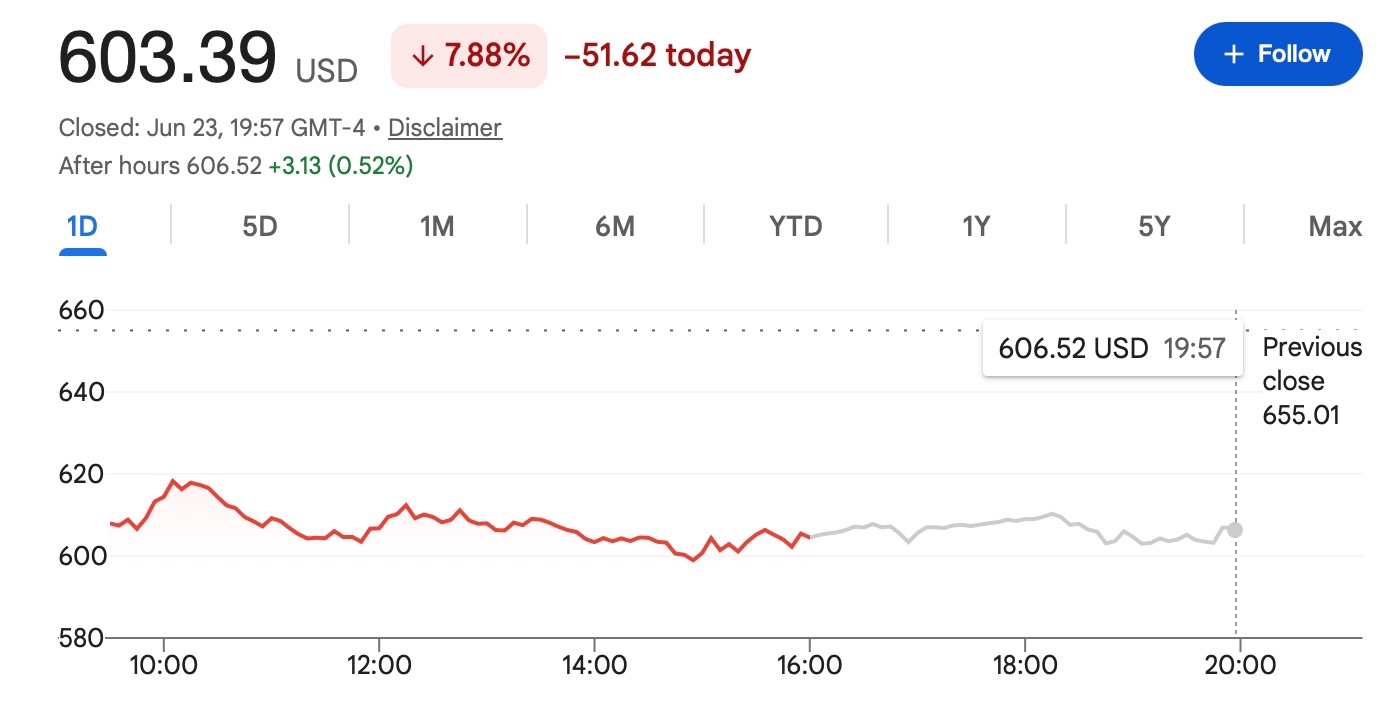
But the latest market action shows that this is no longer a quiet trade. SOXX recently traded around $603, after a sharp daily drop. Official fund data showed the ETF’s NAV near $603.38, with a one-day NAV decline of about 7.91%. Even after that pullback, year-to-date total return was still extremely strong, showing how far the semiconductor trade had already moved.
That is the important context. The chip story is not dead.
But the easy part of the rally may be over. When an ETF rises quickly, expectations build. Investors begin pricing in strong AI capex, continued chip demand, high margins, memory recovery, and sustained growth from data center spending. If any part of that story looks less certain, the whole basket can reprice fast.
That is why traders should treat SOXX as a high-conviction sector trade, not a low-risk index product. It may be diversified, but it is still tied to one very crowded theme: AI infrastructure.
Why Some Users Cannot Buy SOXX Directly
For investors with a U.S. brokerage account, buying SOXX is straightforward.
For many global users, it is not. Traditional ETF access usually requires broker onboarding, KYC checks, eligibility approval, bank funding, foreign exchange conversion, and sometimes tax documentation. Some brokers do not offer U.S. ETFs in certain regions. Some users can open accounts but cannot easily move funds. Others face restrictions based on residency or local rules.
This creates an access gap. A trader may understand the semiconductor thesis and want exposure to SOXX, but still be unable to buy the ETF through a traditional broker.
That is why alternative instruments exist. CFDs, futures, perpetual contracts, tokenized ETFs, and synthetic stock-linked products can offer another route to semiconductor price exposure.
But the product structure matters. A trader should not treat every SOXX-linked instrument as if it were the same thing.
Price Exposure Is Not ETF Ownership
This is the key distinction. Owning SOXX through a traditional broker means owning shares of the ETF. The user has fund exposure through regulated market infrastructure, custody, and the rules that apply to the ETF structure.
Trading a SOXX-linked perpetual contract, CFD, or tokenized product is different. The user may gain or lose based on SOXX-like price movement, but they are usually not holding the ETF itself. They may not receive the same fund ownership rights, distributions, custody protections, tax treatment, or legal structure as a traditional ETF holder.
That does not make these products useless. It makes them different.
For short-term traders, price exposure may be enough. If the goal is to trade a semiconductor rebound or hedge chip-sector sentiment, a derivative may provide the flexibility they need.
For long-term investors who want true ETF ownership, a broker-based route may still be more suitable.
The Main Alternatives to SOXX
There are several ways traders may access SOXX-like exposure without buying the ETF directly.
CFDs can provide long or short exposure to SOXX-linked prices. They are flexible, but traders need to understand spreads, financing costs, overnight charges, and provider risk.
Futures and perpetual contracts can offer margin-based exposure, sometimes with 24/7 access and USDT collateral. These are useful for active traders, but leverage can turn a normal sector move into a liquidation event.
Tokenized ETF products attempt to bring ETF-like exposure into crypto markets. They may be backed, synthetic, oracle-based, or structured through an issuer. Each version has different custody, redemption, and tracking risks.
Synthetic TradFi products may mirror SOXX price action without giving direct ownership of the fund. These can be convenient, but traders must understand who provides the pricing, how the product settles, and what happens during market gaps.
The headline may say “SOXX exposure.” The risk underneath may be very different.
Why USDT-Based TradFi Products Appeal to Crypto Users
Crypto-native traders often prefer USDT-settled products because they fit into the way they already manage capital.
They do not need a wire transfer. They do not need to move money into a separate broker. They can switch between crypto pairs and TradFi-linked products in one account, where available.
That convenience matters. A trader who already holds USDT may want to express a view on semiconductors without leaving the crypto ecosystem. A SOXX-linked contract can make that possible.
But convenience should not be confused with safety. USDT-based access can be faster, but it can also involve funding rates, leverage, basis risk, liquidation rules, tracking differences, and platform-specific terms. That is why product details matter before entering a trade.
Users can visit Tapbit to follow supported markets and review available trading products. Existing users can log in, while new users can register here.
Frequently Asked Questions (FAQ)
What is SOXX?
SOXX is the iShares Semiconductor ETF. It gives investors exposure to a basket of U.S.-listed semiconductor companies across areas such as chip design, memory, processors, networking, equipment, and AI infrastructure.
Why do traders care about SOXX?
Traders care about SOXX because it is one of the clearest ETF ways to follow the semiconductor cycle. It can reflect AI data center demand, memory pricing, chip capex, Nvidia sentiment, AMD expectations, Broadcom AI revenue, and broader tech risk appetite.
Is SOXX only an Nvidia ETF?
No. Nvidia is important to semiconductor sentiment, but SOXX is not only an Nvidia trade. It also includes companies such as Micron, AMD, Broadcom, Intel, Marvell, and other chip-related names. That makes it broader than a single-stock AI bet.
Why can’t some users buy SOXX directly?
Some users may not have access to a U.S. brokerage account. Others may face regional restrictions, KYC issues, banking limitations, foreign exchange costs, or broker policies that prevent them from buying U.S.-listed ETFs.


